
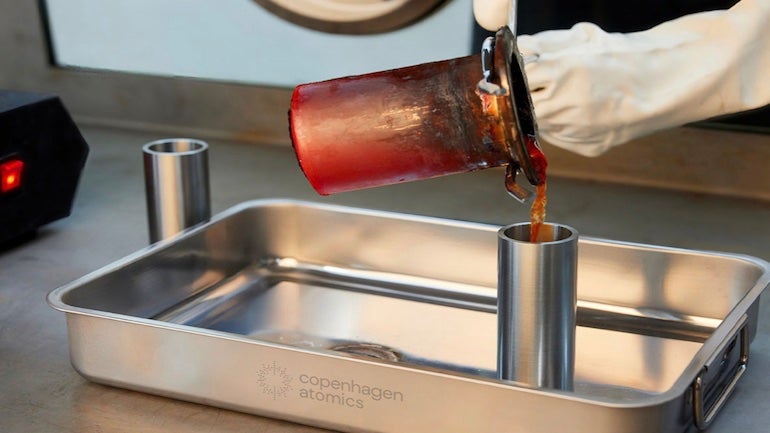
Researchers from the University of Liverpool and Copenhagen Atomics have proven that corrosion in molten salt reactors (MSRs) is practically eliminated when using purified salts. The study, published in the Journal of Nuclear Materials reveals that salt purity is the critical factor in preventing corrosion of 316L stainless steel widely used in MSRs. This discovery paves the way for more affordable, durable, and scalable next-generation nuclear energy systems.
Salt purity is absolutely central to corrosion control in molten salt reactors,” said Maulik Patel, Professor of Nuclear Materials at University of Liverpool. “These results confirm what decades of research, including work at Oak Ridge during the MSRE [Molten Salt Reactor Experiment] era, have pointed toward: if you remove the reactive impurities, molten salts can become a stable and manageable environment for reactor materials. This is a major step forward for the field.”
While MSRs are viewed as a promising technology for nuclear energy, the harsh, high-temperature environment of molten fluoride salts has historically caused rapid corrosion of structural materials, limiting their commercial viability. Previous solutions relied on using expensive, high-nickel alloys, which drove up costs and complicated manufacturing.
Thomas Steenberg, co-founder & Vice President for Critical Materials at Copenhagen Atomics hopes the study will put an end to the corrosion myth that MSR technology is unfeasible due to corrosion. “Using engineering controls is highly preferable to the use of exotic unobtanium alloys,” he noted.
The researchers conducted long-term corrosion tests on 316L stainless steel in both purified and untreated molten salts (FLiNaK and LiF-ThF₄) at temperatures up to 700°C. FLiNaK is a ternary eutectic salt mixture consisting of lithium fluoride (46.5%), sodium fluoride (11.5%), and potassium fluoride (42%). Historically it was used as a secondary coolant or intermediate heat transfer fluid. It is the leading candidate for the intermediate loop in salt-cooled high-temperature reactors (FHRs) and some MSRs.
Lithium-thorium fluoride (LiF-ThF is the “fuel” or “blanket” salt for thorium-based reactors. The Thorium-232 in the salt absorbs a neutron to eventually become Uranium-233, which then undergoes fission. In a Two-Fluid MSR, a FLiNaK-type salt might be used for cooling while the LiF-ThF₄ salt circulates in a separate blanket for breeding.
The results of the tests were striking. Untreated salts containing moisture and oxides caused severe corrosion, with metal loss, surface degradation, and structural weakening after just 1,000 hours. Purified salts, with impurities removed, resulted in negligible corrosion even after 3,000 hours. The steel retained its integrity, with only a thin, protective chromium carbide layer forming on its surface.
Purified salts, with impurities removed, resulted in negligible corrosion even after 3,000 hours. The steel retained its integrity, with only a thin, protective chromium carbide layer forming on its surface.
This opens the possibility of using 316L stainless steel, which is significantly cheaper and more accessible than high-nickel alloys, reducing construction and maintenance costs. Purified salts that minimise corrosion would extend the lifespan of reactor components and improve operational reliability. The use of standard industrial materials and proven purification processes would make it easier to scale MSR technology for widespread energy production. Reduced corrosion risks also enhance reactor safety, a critical factor for regulatory approval and public confidence.
However, further research is needed to assess the impact of radiation, fission products, and dynamic reactor conditions on long-term material performance. Optimising salt purification methods will also be essential to eliminate even trace impurities.
Nevertheless, the tests showed that purified molten salts and 316L stainless steel offer a practical, economical solution for building durable molten salt reactors. By addressing one of the biggest technical hurdles, this research brings us closer to realizing the full potential of thorium MSRs as an affordable, efficient, and scalable source of clean energy.
Copenhagen Atomics is developing a containerised molten salt reactor. Moderated with unpressurised heavy water, the reactor consumes nuclear waste while breeding new fuel from thorium. The reactor with an output of 100 MWt. Is small enough to allow for mass manufacturing and assembly line production.


