
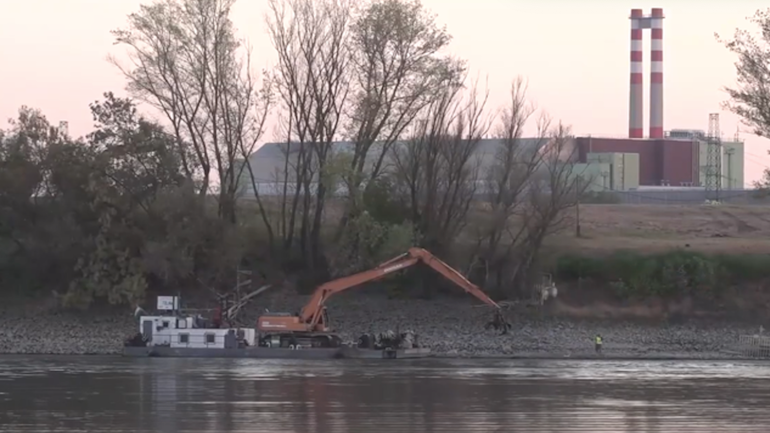
Hungary rushed to raise the water level of the Danube at the Paks NPP after the exceptionally dry summer brought the plant close to a complete shutdown. The plant uses the river water as coolant, and in early August, three of the plant’s four reactor units had to be taken offline because of the extremely low river level.
However, after the authorities artificially raised the water level near the plant, the accelerated current quickly started to erode the submerged weir being built to achieve this. This caused the Danube’s riverbed to deepen by 8–13 metres in that area, raising concerns that it may not be possible to complete the structure in its originally planned form.
The work involved sinking two 80-metre barges into the Danube as a temporary measure before launching the construction of a submerged rock weir near the plant’s cooling-water intake. The structure, designed to raise the water level by as much as half a metre, is expected to contain around 145,000 cubic metres of rock.
The weir was built simultaneously from the two banks towards the centre of the river. As the two rock embankments approached each other, the remaining opening through which the Danube had to flow became increasingly narrow. This succeeded in raising the water level, allowing the Paks NPP to return to normal output, but also increased the velocity of the river’s current placing considerable stress on the structure that began eroding the riverbed beneath it.
Videos released by the government at the beginning of construction indicated water depths of around four to five metres at the deepest points of this section. In subsequent videos, the Minister of Defence confirmed that the riverbed is eroding fast, saying that it has deepened to 13 metres, and, in some places, to as much as 16–18 metres in roughly two weeks. For comparison, the bed of the Hungarian section of the Danube has deepened by around two metres on average over the past 50 years.
Balázs Szendőfi, a nature filmmaker and ichthyologist, told Átlátszó that the riverbed around Paks consists mainly of sand and smaller gravel, with older, more stable gravel and marl layers underneath. He said the extremely fast current created by the unfinished weir began removing these lower sediment layers at an unusually rapid rate. This could produce precisely the opposite effect to the one intended because, as the riverbed deepens, the water level may also fall. Long-term riverbed erosion is already a factor contributing to increasingly low-water conditions on the Danube.
The project is being carried out jointly by Hungary’s General Directorate of Water Management (OVF – Országos Vízügyi Főigazgatóság) and the Hungarian Defence Forces. OVF told Átlátszó that the erosion was not the result of a construction failure. According to the authority, scouring had been expected during construction, particularly after the river’s cross-section had been significantly narrowed and the original construction schedule accelerated.
The authority said hydrodynamic and sediment-transport modelling had been used in advance to estimate the likely extent of erosion. Large concrete blocks had already been transported to the site weeks earlier because their possible use for stabilisation was part of the available construction methods.
The Ministry of Defence said the concrete blocks were not required because of a construction defect, but were chosen because their size and weight allowed them to be positioned quickly and precisely. The Ministry added that the intervention has stabilised the riverbed and no further scouring has been detected.
It is not clear however, whether the weir can still be completed as a single continuous structure in accordance with the original design. OVF said that some sections of the structure were always expected to be partially dismantled during later phases. Temporary overbuilding had been necessary, it said, in order to reach the water level required by the nuclear plant as quickly as possible.
The Department of Hydraulic and Water Resources Engineering at the Budapest University of Technology and Economics participated in designing and preparing the project. According to an earlier university statement, its experts worked on the hydraulic effects of the submerged barges as well as questions concerning flow conditions and riverbed morphology around the new weir.
Szendőfi warned that the intervention could also have significant ecological consequences both upstream and downstream. Sediment may accumulate above the weir, while downstream the faster current may remove gravel and other material from the riverbed. Both processes can destroy habitats used by aquatic organisms. The
Danube is home to several endemic or highly protected fish species, including zingel and streber, as well as the European mudminnow and several gudgeon species. Szendőfi argues that continuous ecological monitoring around the construction site should be a minimum requirement. This is particularly important because, as Átlátszó reported earlier, construction of the Paks weir began without the environmental impact assessment and Natura 2000 assessment normally required before an intervention of this scale.


