
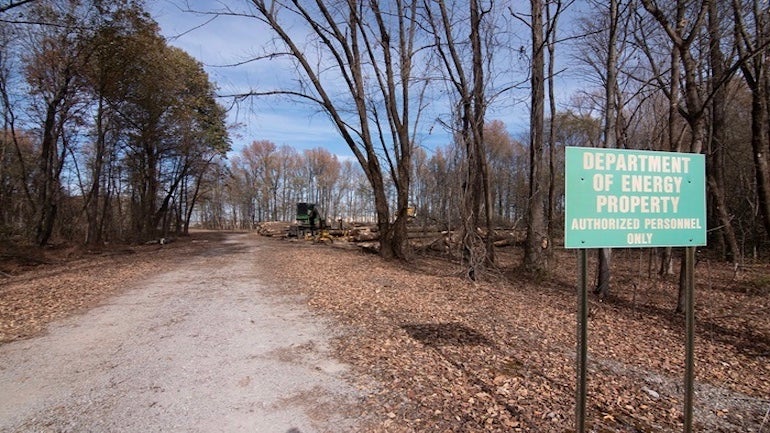
The US Department of Energy (DOE) Office of Environmental Management (EM) crews have begun clearing trees at the Paducah Site in Kentucky to prepare for new tenant General Matter to eventually build a uranium enrichment plant on leased land. This will be the company’s flagship enrichment site. General Matter’s construction is expected to begin in 2026 with uranium enrichment operations planned to start by the end of the decade.
General Matter in August 2025 leased a 100-acre parcel at the former Paducah Gaseous Diffusion Plant to build a new private-sector commercial facility. The project is valued at approximately $1.5bn and aims to produce both low-enriched uranium (LEU) and high-assay low-enriched uranium (HALEU). The lease provides General Matter with a minimum of 7,600 cylinders of existing uranium hexafluoride to supply fuel for future re-enrichment operations. Reprocessing of uranium hexafluoride saves about $800m in avoided disposal costs while General Matter benefits from a consistent supply of US-origin uranium hexafluoride feed.
“This skyline change is a visible reminder new industry is coming,” Portsmouth Paducah Project Office (PPPO) Interim Acting Deputy Manager and Paducah Site Lead April Ladd said. “Paducah is leaning into the new nuclear renaissance, working with commercial companies supporting national security and providing competitive jobs for the current and future Paducah workforce.”
Well before DOE announced the lease agreement with General Matter for a new private-sector uranium enrichment facility, EM’s critical environmental planning was underway, including a cultural evaluation to ensure no archaeological items needed to be preserved. Paducah Site officials also worked with General Matter on a National Environmental Policy Act (NEPA) review to assess potential environmental impacts of the project and ensure environmental considerations are consistent with the proposed use.
“Because this is DOE property, it’s important all requirements are met to move forward with leasing a portion of the land,” Enterprise Technical Assistance Services (ETAS) Paducah Project Manager Kelly Layne said. “The NEPA review is an administrative checklist to verify it’s appropriate to move forward.” ETAS is the PPPO technical support services contractor.
General Matter performed an ecological survey in autumn 2025 to evaluate wildlife and biological fauna. The company engaged with regulatory bodies to confirm endangered species would not be impacted by preparations for construction.
General Matter representatives are also now part of a shared site initiative. They participate in meetings and are at the table to discuss their plans. “It’s all about good communication between General Matter and the site contractors,” said Layne.
After the trees are cut down, they will be removed from the site for size reduction and reuse. Crews will soon begin extracting tree root systems, allowing for a smoother surface. General Matter will also perform geotechnical sampling to validate the soil has the right compaction specifications before building. Further studies will take place this year.
Global Laser Enrichment (GLE), a company building a laser uranium enrichment facility on land adjacent to the Paducah Site, is also clearing trees ahead of constructing its facility, adding to the changing skyline.
General Matter plans to launch uranium enrichment operations by the end of the decade upon receiving a licence from the Nuclear Regulatory Commission. GLE recently announced that the commission completed an acceptance review of its licence application for the slated Paducah facility and intends to re-enrich a portion of the depleted uranium tails inventory at the Paducah Site by 2030.
EM also announced that it is partnering with General Matter for the potential use of the Fuels and Materials Examination Facility (FMEF) at the Hanford site in Washington. “Thanks to President Trump’s leadership, we are leveraging redevelopment projects to accelerate next-generation nuclear technology, lower energy costs and power the global AI race,” said EM Assistant Secretary Tim Walsh, who got a firsthand look at FMEF in November. “FMEF can be transformed into an asset to unleash American energy dominance and drive innovation, while building prosperity and vitality for the people of Central Washington.”
DOE signed a lease with General Matter, unlocking the potential of FMEF to be used for advanced nuclear fuel cycle technologies and materials. General Matter will undertake the evaluations necessary to assess returning the facility to service, including site characterisation, potential facility upgrades and engagement with community leaders and stakeholders.
“Activating FMEF for a modern mission reflects responsible stewardship and forward momentum for the site,” said Ray Geimer, manager for Hanford Field Office. “This lease puts an asset back to work for the American people and reinforces the Department’s commitment to safe revitalisation across the Hanford footprint.”
“Rebuilding America’s nuclear fuel capabilities is critical to strengthening our nuclear industrial base, reducing our reliance on foreign providers and lowering energy costs for utilities and consumers,” added General Matter CEO Scott Nolan. “We thank our partners in Hanford and the Department of Energy for supporting us in the development of a stronger, more secure nuclear fuel supply chain built here in the United States.”
FMEF is a 190,000-square-foot facility originally intended to support the Liquid Fast Breeder Reactor Program but was never used in any nuclear capacity. The facility has not supported a DOE mission since 1993 and has since remained in a dormant surveillance and maintenance status.
“Activating FMEF for a modern mission reflects responsible stewardship and forward momentum for the site,” said Ray Geimer, manager for Hanford Field Office. “This lease puts an asset back to work for the American people and reinforces the Department’s commitment to safe revitalisation across the Hanford footprint.”
“Rebuilding America’s nuclear fuel capabilities is critical to strengthening our nuclear industrial base, reducing our reliance on foreign providers and lowering energy costs for utilities and consumers,” said General Matter CEO Scott Nolan. “We thank our partners in Hanford and the Department of Energy for supporting us in the development of a stronger, more secure nuclear fuel supply chain built here in the United States.”
In 1950, the Atomic Energy Commission, a predecessor agency to DOE, selected a 3,556-acre tract of government-owned land near Paducah, Kentucky, as the location to construct a second gaseous diffusion uranium enrichment plant (GDP) to support US national security needs. The Paducah GDP enriched uranium from 1952 to 2013 and was the last government-owned uranium enrichment facility operating in the US. It produced low-enriched uranium originally as feedstock for nuclear weapons materials and later for commercial nuclear power plants. The safe demolition of unused facilities has been ongoing at the Paducah Site in recent years as the cleanup mission progresses to prepare the site for reindustrialisation.
FMEF was conceived in the mid-1970s as a place to study and test fuels for the breeder reactor technology programme, but its mission was changed because of nuclear proliferation concerns. The building had never been used when it was modified at a cost of $100m to support the manufacture of fuel for the Fast Flux Test Facility, a Hanford research reactor, and the proposed Clinch River Breeder Reactor. By 1986 the breeder programme was dead and $280m had been spent on the building. It stands 98 feet above ground and extends 35 feet below ground. It’s equipped with 14 hot cells for work on radioactive material it has the same capacity to withstand earthquakes as a commercial nuclear reactor.
Through the decades, different uses of FMEF have been considered. Including as laboratory space for Pacific Northwest National Laboratory to store used nuclear fuel. Other proposals included repurposing it as a movie soundstage, a secure facility for the gemstone industry or an earthquake-proof, power failure-resistant repository for records. The project that looked most promising before the current General Matter lease was manufacturing plutonium-powered batteries for the nation’s deep space probes. However, after $30m investment in the plant the project shut down.
General Matter was founded in January 2024 and emerged from “stealth mode” in April 2025. The company was established to address a critical gap in the American nuclear fuel supply chain, specifically aiming to end US reliance on Russian uranium imports. Its origins are rooted in a combination of Silicon Valley venture capital and aerospace engineering expertise. The company was incubated within Founders Fund, the venture capital firm co-founded by Peter Thiel.


