
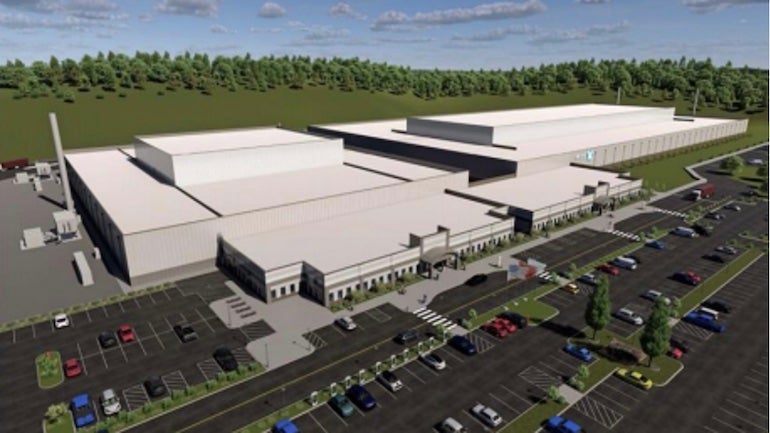
The US Nuclear Regulatory Commission (NRC) has issued a licence to TRISO-X, a wholly owned subsidiary of X-energy, authorising the commercial fabrication of tristructural isotropic (TRISO) fuel for advanced reactors. This 40-year licence marks the first-ever US approval of a category II fuel fabrication facility.
“Commercial-scale production of this fuel is key to enabling the deployment of advanced reactor designs,” said NRC Chairman Ho K Nieh. “This licence represents an important milestone that supports the Department of Energy’s (DOE’s) programme to accelerate deployment of nuclear technologies and deliver more power to the grid.”
The licence allows TRISO-X to possess and use special nuclear material at their facility under construction on the 110-acre Horizon Center Site, in Oak Ridge, Tennessee.
The NRC’s review of the licence application included a safety and security review and an environmental review. The application was approved three months ahead of the published schedule due to multiple efficiencies applied in the staff’s review processes. The final environmental impact statement (EIS) was published on 12 February. TRISO-X submitted its licence application in April 2022, and its environmental report in September 2023, then supplemented the application in December 2024.
The EIS assesses the potential environmental impacts of the proposed construction, operation, and decommissioning of the TRISO-X facility, and alternatives to the proposed action. NRC said the proposed federal action was for a licence authorising TRISO-X to possess and use special nuclear material to manufacture high-assay low-enriched uranium (HALEU) fuel at the proposed facility that would produce TRISO coated particles “and final fuel forms using uranium enriched to less than 20 weight percent uranium-235”.
NRC noted that the US government and DOE are assisting the development and demonstration of advanced nuclear reactor technology which will require HALEU fuel and that DOE cooperated on development of the EIS. “After weighing the environmental, economic, technical, and other benefits against environmental and other costs, and considering reasonable alternatives, the NRC staff’s recommendation, unless safety issues mandate otherwise, is that the NRC issue the licence to possess and use special nuclear material to TRISO-X.”
The Horizon Center Industrial Park is located within the original boundary of the Oak Ridge Reservation (ORR), but it is no longer within the area of the ORR controlled by DOE. It is now owned and managed by the Oak Ridge Industrial Development Board (IDB) for private economic development.
The site has transitioned from a top-secret government buffer zone to a modern industrial hub. During the post WWII and cold war eras the land was a “greenfield” (undeveloped) portion of the ORR. Unlike the nearby Heritage Center (the former K-25 enrichment site), the Horizon Center land was primarily used as a security and safety buffer and did not house massive industrial enrichment plants.
The DOE-managed part of the ORR (approximately 33,000 to 37,000 acres) primarily houses three major, separate operating installations – the Oak Ridge National Laboratory (ORNL), Y-12 (nuclear weapons component production, dismantlement, and the storage of special nuclear materials) and the East Tennessee Technology Park (ETTP), formerly the K-25 uranium enrichment site now undergoing environmental cleanup and being transitioned into a private-sector industrial and technology park.
TRISO-X has several facilities in Oak Ridge. The planned fuel fabrication facility (TX-1) at the Horizon Center Industrial Park (some 5 miles from ETTP) on a 110-acre site began vertical construction in late 2025 and is part of X-energy’s participation in the DOE’s Advanced Reactor Demonstration Program. TX-2 is currently in the design phase, and would significantly scale TRISO fuel production capacity to support X-energy’s planned commercial pipeline for its Xe-100 small modular reactor (SMR) as well as for other SMR developers. X-energy says full-scale production at TX-1 and TX-2 is expected to establish a stable commercial source of TRISO fuel for the first time in US.
TRISO-X also has a pilot facility located inside the ORNL campus, which has been operational since 2016 and serves as the primary testing ground for the company’s proprietary fuel fabrication process. It operates through a public-private partnership Unlike the future commercial plant that will produce tonnes of fuel, the ORNL pilot line produces kilogram quantities of HALEU.
TRISO-X uses this site to adapt and refine established TRISO production methods for commercial-scale use. Fuel produced there is used for critical testing. In November 2025, TRISO-X began irradiation testing at Idaho National Laboratory using pebbles manufactured in this pilot program to qualify the fuel for commercial reactors. The pilot facility allows engineers to validate the “spherical fuel pebble” design intended for X-Energy’s Xe-100 reactor.
As of late 2025, TRISO-X is expanding its pilot-scale footprint through the DOE’s Fuel Line Pilot Program with the aim of: building an additional laboratory facility to support pilot-scale integration; strengthening the domestic supply chain for HALEU fuel testing; and providing a “fast-track” for system validation and training before the TX-1 commercial facility at the Horizon Center becomes fully operational (targeted for late 2026/2027).
TRISO-X also has a R&D Center located within the massive Centrus Technology Manufacturing Center (TMC) in the industrial area of Oak Ridge town. Centrus provides the facility space, technical expertise, and engineering resources for TRISO-X’s development activities. Employees from both companies work together at this site on the design and licensing of fuel fabrication technology.
The R&D centre at the TMC is specifically used to train operators who will eventually work at the commercial facility being built at the Horizon Center. While the pilot facility at ORNL handles the nuclear chemistry and fabrication R&D, the Centrus Technology Manufacturing Center focuses on the mechanical engineering and operator training aspects of the project.


