
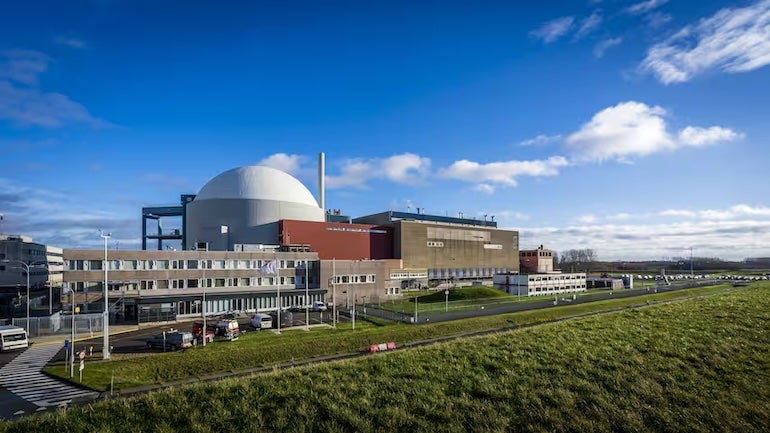
The Netherlands Minister of Climate & Green Growth, Sophie Hermans, has submitted an amendment to the Nuclear Energy Act to the House of Representatives which will extend operation of the Borssele NPP beyond 2033. Hermans informed the Senate and House of Representatives about four different topics related to nuclear energy. As well as the life extension of Borssele, she sent has letters on new nuclear construction, on small modular reactor (SMR) strategy, and on the establishment of the Nuclear Energy Organisation Netherlands (NEO NL).
At the single unit Borssele NPP operated by EPZ a 485 MWe pressurised water reactor has been in operation since 1973, and is scheduled to close in 2033. It accounts for about 3% of total electricity generation. The government has requested it remain in operation until 2054 and says it will consider acquiring a stake in the plant if its operating life is extended.
“The amendment to the law is an important step towards keeping the nuclear power plant operational longer,” the government said. “If the amendment is adopted, Borssele’s operator can apply to the independent regulator ANVS [De Autoriteit Nucleaire Veiligheid en Stralingsbescherming] to keep the nuclear power plant operating beyond 2033. This will allow the Netherlands to continue consuming CO2-free energy for a longer period. The extension aligns with the government’s policy of not relying solely on green energy sources, such as offshore wind or solar panels, but also fully committing to CO2-free and reliable nuclear energy. This will ensure our country can keep running, even when the sun doesn’t shine and the wind doesn’t blow.”
The government is also seeking the construction of two new nuclear plants. Construction of the new plants will be the responsibility of the new state-owned company (NEO NL). Hermans told the House of Representatives that the company “will contract with the builder and will also operate the new plants”. NEO NL “will take the form of a ‘policy participation’, with the Ministry of Climate & Green Growth as the sole shareholder. At least €45m ($52m) is available for its establishment,” she said.
“Our country cannot survive without nuclear energy,” Hermans said. “With the proposed establishment of NEO NL and the continued operation of Borssele, we are now taking a historic step towards a future with reliable nuclear energy. I hope that the next cabinet will continue on the path we have embarked on with the same energy and dedication.” General elections are planned for 29 October.
As to the possible deployment of SMRs, the government said it is allocating €20m “to stimulate developments in the Netherlands”. It noted that the UK is ahead in this field in Europe. “The Netherlands and the UK have therefore joined forces and signed a cooperation agreement in July 2025, allowing the Netherlands to learn from the British,” it said.
In December 2021, the new coalition government of the Netherlands decided to prioritise nuclear energy as part of its climate and energy policies. Two new 1000-1650 MWe projects were to be completed by about 2035 to provide 9-13% of electricity production. The Cabinet of Ministers announced in December 2022 that the Borssele NPP site was the most suitable location for the new reactors. Westinghouse, KHNP and EDF all submitted proposals and undertook feasibility studies. However, KHNP subsequently withdrew from the project.


