
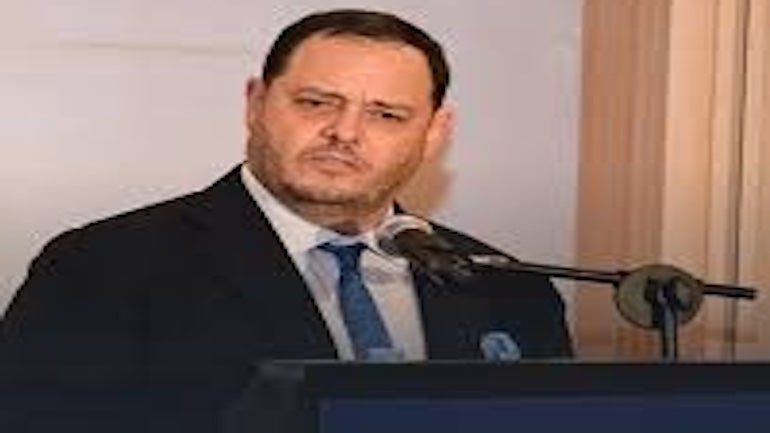
Demián Reidel has resigned as the head of state-owned nuclear utility Nucleoeléctrica Argentina SA (NA-SA), amid corruption allegations, according to the Buenos Aires Herald and the Buenos Aires Times. Juan Martín Campos, a former president of uranium products manufacturer Dioxitek, was appointed as the new NA-SA President.
All members of the Board of Directors, except Principal Director Diego Chaher, were also removed. Nucleoeléctrica Argentina announced, “the formation of the new Board of Directors that will lead our company during the next period”. Chaher, who heads the Agency for the Transformation of Public Enterprises, is seen as a key official in the privatisation process being pursued by President Javier Milei’s administration. Government sources said Reidel, a personal friend and supporter of Milei, may continue as his advisor, a role he relinquished in July 2025 to join NA-SA.
Before joining the government, Reidel forged a career in international finance: he worked at Goldman Sachs, JP Morgan Chase and co-founded an investment fund in the United States. These credentials made him one of the most influential economic advisers within the presidential circle, responsible for articulating the link between Milei’s agenda and international markets.
His management of NA-SA, however, was controversial. Beyond promoting the government’s “nuclear revolution” – which sought to integrate nuclear energy into a technological development and a wider artificial intelligence development plan – it was marked by accusations of targeted purchases, possible million-dollar overpricing and a strong confrontation with the company’s traditional technical line.
Reidel often appeared in the media, making headlines with several unorthodox and controversial public statements, including the claim that “Argentina’s only problem is that it is populated by Argentines” – a remark delivered at a business event which earned him criticism from figures both inside and outside the ruling party.
The renewal of the board of directors was formalised at a shareholders’ assembly held in the context of a change in NA-SA’s shareholding, which has now passed from the Energy portfolio to newly established Nuclear Affairs Secretariat under Federico Ramos Nápoli, an official aligned with presidential advisor Santiago Caputo, an opponent of Reidel’s ally Karina Milei, President Javier secretary general and sister. The Nuclear Affairs Secretariat absorbed some of the tasks of the National Commission of Atomic Energy (CNEA – Comisión Nacional de Energía Atómica).
While NA-SA was born from the CNEA, they have been legally separate entities since 1994. CNEA is responsible for research, development, and fuel cycle management. NA-SA is the commercial operator of Argentina’s three NPPs (Atucha I, II, and Embalse). CNEA is a shareholder in NA-SA, owning 20% of the company. The remaining 80% is held by the Ministry of Economy and ENARSA (Energía Argentina Sociedad Anónima) a state-owned company created in 2004 to re-establish the government’s presence in the energy sector across hydrocarbons and electricity.
The new NA-SA Vice-president is chemical engineer Martín Porro, who also chairs CNEA. Porro, who specialises in power reactors, was part of the team that launched Atucha II.
The new board also includes Diego Garde, a chemical engineer and manager of the Atucha I–II site with over 20 years in the company, and Javier Grinspun, designated by the CNEA as their Legal Affairs manager. Ignacio Bruera, the CNEA administrative manager, and Juan Cantarelli, manager of the Central Nuclear Embalse nuclear power plant, were appointed as alternate directors.
After the assembly, the new board held a meeting to ratify Fernando Montserrat as general manager, a post he had been holding provisionally after the ouster of Marcelo Famá, following corruption allegations. Famá and Administrative Coordination Manager Hernán Pantuso had been the focus of an internal complaint alleging that NA-SA had paid 1,000% more than originally budgeted for a software service and 140% more than market prices for a cleaning service.
While still an adviser to Milei, before formally taking over NA-SA, Reidel announced his Argentina Plan. This involved a joint venture, Meitner, between a foreign investor and state-owned INVAP aimed at the construction of Argentina’s first small modular reactor (SMR), the ACR-300, to power AI data centres.
This was a direct competitor to the CAREM SMR launched by CNEA in 2014. Shortly after taking office in December 2023, Milei in early 2024, slashed CAREM’s funding leading to massive layoffs and a complete construction halt when it was approximately 85% complete. Reidel promoted the ACR-300 as the new national priority. He intended to build four of these modules at the Atucha site using foreign equity funds rather than state investment. Internal reports suggest that due to the pay freeze at CAREM, key engineers and technical staff migrated to Meitner.
Reidel’s plan involved partnering with US investors, which effectively sidelined both the existing CAREM project and a long-planned large reactor deal with China. While Reidel maintained that his plan was about “recovering energy sovereignty”, critics in the nuclear sector viewed his management as a “dismantling” of existing national technology in favour of “marketing promises” that lacked immediate investors.
The identity of the US investors behind Demián Reidel’s alternative nuclear plan has been a subject of intense speculation and controversy, with Reidel himself refusing to name the specific entities involved. During Milei’s May 2024 tour of Silicon Valley, he courted leaders like Elon Musk, Mark Zuckerberg, Sam Altman, and Sundar Pichai. Reidel pitched the ACR-300 specifically as a stable energy source for AI data centres, leading to speculation that the investors are major US tech firms.
While the new NA-SA board has not yet issued a formal policy reversal, the appointment of Juan Martín Campos and the removal of the Reidel-aligned directors signals a move toward institutional stabilisation rather than immediate revival of the CAREM project.
The Milei administration has effectively mothballed CAREM, reclassifying it from a construction project to an “engineering revision stage”. The new board inherits a project that has suffered significant “brain drain,” with key engineering teams already dismantled or migrated to private ventures.
Because CAREM is an R&D project, it remains under CNEA. Reidel’s move to pause it was executed via his role on the Argentine Nuclear Council, a government body that coordinates both entities. Under recent laws, the government is moving to privatise 44% of NA-SA. CNEA, however, remains a non-privatised state agency. This separation is why Reidel could lead NA-SA while effectively blocking a project owned by CNEA.
If the new board seeks to restore relations with CNEA, they may face pressure to pivot back to CAREM. However, regardless of the board’s intent, the project remains a “victim” of central government austerity. Without a specific budget allocation from the executive branch, the new board’s ability to restart work will probably be limited to technical maintenance rather than active construction. The government’s upcoming March 2026 budget review will be the definitive indicator of whether the board has the financial mandate to move beyond engineering revision.


