
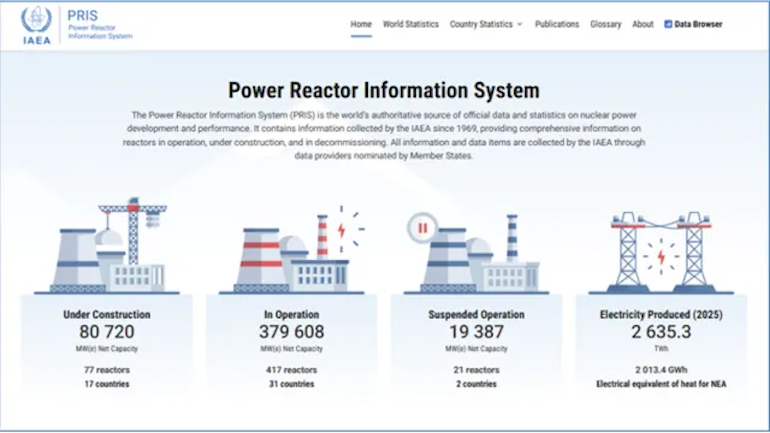
The International Atomic Energy Agency (IAEA) has updated its Power Reactor Information System (PRIS), launching a new public webpage featuring an optimised interactive PRIS Data Browser, providing faster, more intuitive access to power reactor information from around the world.
PRIS has, for more than 50 years, supported IAEA member states, policymakers, regulators, utilities, researchers and the public with reliable data on reactor status, design characteristics, operating experience and global nuclear power development trends.
A multi-year digital transformation programme has progressively modernised the entire PRIS portfolio, from data collection and validation to data analysis, visualisation and public dissemination. This has created a modern platform designed to meet the future needs of the global nuclear community. Its flagship publication, Nuclear Power Reactors in the World (RDS-2), is among the IAEA’s three most widely used publications, with more than 20 000 annual downloads.
“Since its establishment in 1969, PRIS has grown into the world’s authoritative source of nuclear power reactor information, attracting more than one million visits annually,” said Aline des Cloizeaux, Director of the IAEA Division of Nuclear Power. “This revamp is more than a technical upgrade — it demonstrates the IAEA’s commitment to making nuclear data more accessible, more useful and more engaging for our stakeholders around the world.”
The new PRIS website responds to the growing demand for timely, transparent nuclear power data by offering improved navigation, enhanced search capabilities and a modern user experience that makes nuclear power information easier to explore and understand. The new PRIS Data Browser allow users to explore decades of reactor information and operational data through dynamic visualisations and customisable reports.
The platform enables users to analyse trends, benchmark the performance of reactor technologies and access statistical information through an intuitive interface designed for both technical experts and non-specialist users. The modernisation also provides a flexible foundation for future enhancements, ensuring that PRIS can continue to evolve alongside advances in reactor technologies, expanding reporting requirements for advanced reactors such as small modular reactors and the growing demand for data-driven analysis.
The modernisation programme began in 2018 with the transformation of the PRIS Web-Enabled Data Acquisition System (WEDAS), the platform member states used to submit and validate nuclear power data. The project introduced a modern technology platform, Data Acquisition and Validation Application (DAVA), while strengthening cybersecurity, improving usability and creating a more efficient data management process.
The deployment of PRIS DAVA in 2020 modernised the collection and validation of specification, operational, construction, decommissioning and non-electric application data. It incorporated improvements proposed by member states through PRIS technical meetings, consultancy meetings and pilot testing programmes. The modernisation now extends this transformation to the public-facing PRIS website and statistical applications.
IAEA says the participation of member states representatives, including PRIS liaison officers, data providers, nuclear utilities and international organisations, was crucial to the project’s success. Their feedback helped shape the platform and ensured it meets the practical needs of the international nuclear community.
This latest update is the first of two planned releases under the PRIS modernisation programme. A second release, scheduled for early 2027, will introduce additional analytical capabilities and complete the modernisation of the PRIS statistical applications. The upgraded platform will continue to evolve alongside the global nuclear sector, providing a stronger resource to help monitor nuclear power developments, support evidence-based decision-making and advance knowledge sharing across the global nuclear industry.


