
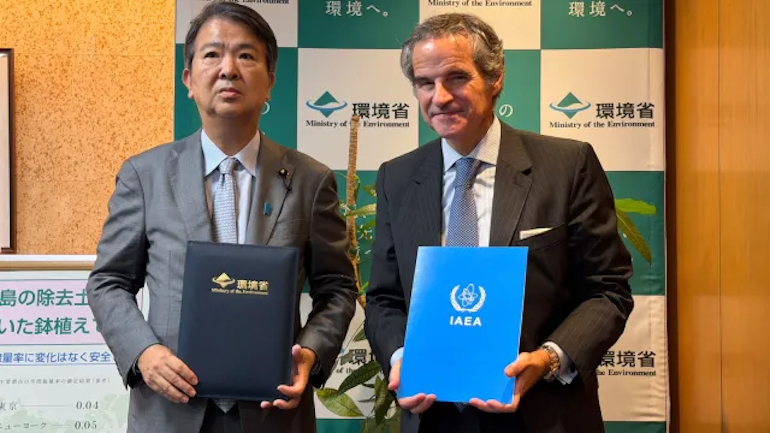
International Atomic Energy Agency (IAEA) Director General Rafael Mariano Grossi and Japan’s Environment Minister, Hirotaka Ishihara, signed a memorandum of cooperation (MOC) on the managed recycling and final disposal contaminated material. This comprises removed soil and waste generated during decontamination activities after the 2011 accident at Fukushima Daiichi NPP.
Following the accident, the IAEA and the Fukushima Prefecture agreed to cooperate on radiation monitoring and remediation. The Practical Arrangements on this cooperation aim to provide broad and extensive assistance in the Prefecture in these two areas, complementing existing Japanese activities and providing immediate assistance and support that directly benefit those living in the Prefecture.
The cooperation covers assistance in research and study on:
- Radiation monitoring, including the application of environmental mapping technology by using unmanned aerial vehicles, and using radiation monitoring data to develop maps to be made available to the public;
- Off-site decontamination, including in analyses of environmental monitoring results and the exploration of exposure pathways to reduce or avoid exposure;
- The management of radioactive waste and on management methods of low-level radioactive waste from off-site decontamination activities.
A project on the application of environmental mapping technology and the use of radiation monitoring data to develop maps for the public has been successfully concluded. Reports on the cooperative activities are prepared by the IAEA and the Prefecture respectively, describing the progress of projects dealing with the movement of radioactivity in forests and wild animals, decontamination strategies for rivers and lakes, and management methods of low-level radioactive waste produced during decontamination activities.
Four summary reports were released in May 2023 that document the developments in the implementation of the Practical Arrangements between 2013 and 2022. Two were prepared by the IAEA and two by Fukushima Prefecture.
Under the MOC, the IAEA will continue to facilitate the exchange of knowledge and experience, including on public communication and stakeholder engagement. These efforts have contributed to ensuring that Japan’s approach remains aligned with international safety standards while generating valuable experience for the global community.
Over the past decade, Japan has implemented extensive remediation activities across affected areas, including the removal and management of large volumes of soil. About 14m cubic metres of soil and waste were removed during decontamination activities. Around 75% of the soil, which has low levels of radioactivity, will be recycled for use in land development, embankments, landfills and other projects in Japan. The remaining soil is currently stored and managed at an interim storage facility in Fukushima Prefecture.
Japanese law stipulates that necessary measures must be taken to complete their final disposal outside Fukushima Prefecture by March 2045, after measures such as volume reduction are implemented.
“Cooperation with the IAEA is essential to ensure that our efforts in the managed recycling and the final disposal of removed soil and waste continue to progress in a safe and transparent manner,” said Environment Minister Hirotaka Ishihara. “Through this strengthened partnership, we aim to further enhance public understanding and confidence while advancing our long-term objectives.”
“This reflects the IAEA’s continued commitment to supporting Japan’s recovery and environmental remediation efforts following the Fukushima Daiichi Nuclear Power Station accident, in line with IAEA Safety Standards,” said IAEA Director General Rafael Mariano Grossi.


