
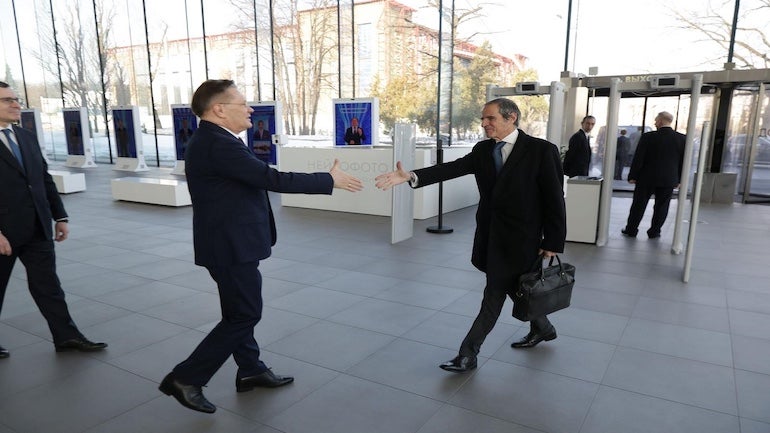
Discussions have been held in Moscow on the Zaporizhia NPP (ZNPP) between International Atomic Energy Agency (IAEA) Director General Rafael Grossi and a Russian delegation led by Rosatom Director General Alexey Likhachev.
The discussions were held at the Atom Museum at the All-Russia Exhibition Centre (VDNKh – Vistravka Dostizhenii Narodnovo Khozyaistva). This was the 12th interdepartmental consultation between the Russian delegation and the IAEA leadership.
According to Rosatom, the negotiators exchanged assessments of the current situation at ZNPP and Grossi was informed about the measures being carried out jointly with Rostechnadzor to prepare for the restart of the station’s power units, including obtaining the appropriate licences from the Russian regulatory authority. Since December Rostekhnadzor has issued 10-year operating licences for ZNPP 1&2 although Rosatom has given assurances that the units will not be restarted while the military conflict continues. Grossi also said electricity generation at the plant can only resume after hostilities end.
Likhachev acknowledged the role of the IAEA and Grossi personally in arranging local ceasefires to enable repairs to external power lines. In addition, the meeting touched upon the permanent presence of IAEA experts at the station and their regular rotations.
Russia took control of the six-unit ZNPP in March 2022 following its invasion of Ukraine and the following September a referendum was held in the occupied Zaporozhye region. According to Russian officials of the Central Election Commission, 93.11% (of 541,093 voters) favoured joining the Russian Federation on a reported turnout of 85.4%. On 5 October 2022, Russian President Vladimir Putin signed a decree formally transferring ZNPP to Russian jurisdiction under nuclear utility Rosenergoatom (part of Rosatom). A Russian Federal State Unitary Enterprise, JSC Zaporizhia NPP, was established by nuclear utility Rosenergoatom to operate the plant. Ukraine continues to claim ownership of the plant. All six units are currently in cold shutdown.
Speaking to the press after the meeting, Grossi described the talks with Likhachev as “comprehensive and timely”. He said the topics covered included the “current safety, security, and safeguards situation” at ZNPP, “including the IAEA-brokered ceasefires that enabled repairs to restore the plant’s back-up power line”. He added that the presence of IAEA experts at the plant – which is close to the frontline – “remains essential to prevent a nuclear accident”.
Likhachev told reporters that equipment needed to address the plant’s water supply issues had already been manufactured. Maintaining cooling water for the plant has been a concern since the destruction of the Kakhovka dam on the Dnieper River in June 2023.
He noted that “in terms of electricity sales and electricity use, we are prepared to consider an international and even multilateral format for this activity”, although “of course, state corporation Rosatom will operate and guarantee the safe operation of the station”. Under certain conditions, the ZNPP can generate electricity supplies to border regions, including Ukraine, he noted.


