
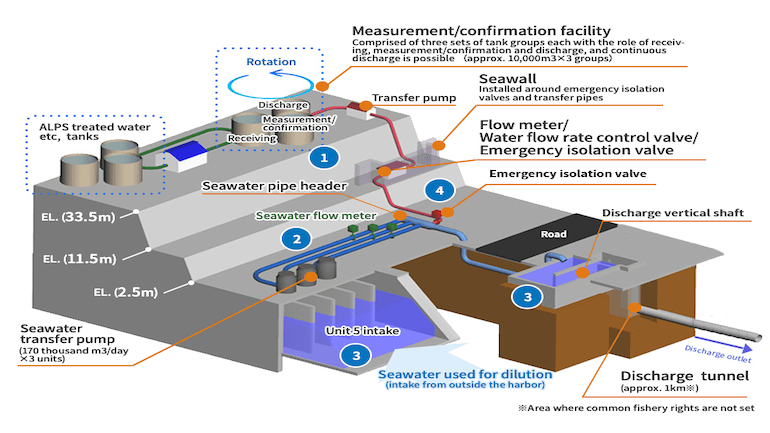
The International Atomic Energy Agency (IAEA) has published two new reports confirming that Japan’s discharge to the sea of Advanced Liquid Processing System (ALPS) treated water from the Fukushima Daiichi NPP continues to be conducted in accordance with international safety standards. The ALPS system removes all radioisotopes except tritium. The treated water is diluted with seawater prior to discharge.
Japan intends to discharge the ALPS treated water in batches over the coming decades. IAEA experts stationed at the Agency’s office at the NPP have confirmed that the tritium concentrations in the 19 batches of ALPS treated water were far below Japan’s operational limits and consistent with international safety standards.
The first report presents the findings of the latest mission of the IAEA Task Force for ALPS treated water and confirms that the water discharge was continuing in line with international safety standards and the conclusions of the IAEA’s 2023 Comprehensive Report. The report is the fifth issued by the Task Force since the start of the discharge in August 2023 and covers findings from a mission carried out from 15 to 19 December 2025.
During the mission, Task Force members visited the Fukushima NPP to directly observe the discharge‑related equipment and facilities and met with government officials, as well as representatives of plant operator Tokyo Electric Power Company Holdings (Tepco). The Task Force also visited the onsite IAEA Fukushima ALPS Laboratory, where the Agency carries out independent monitoring and corroboration of radioactive concentration measurements.
The Task Force noted that Japan’s Nuclear Regulation Authority (NRA) has maintained effective regulatory oversight of the discharge of ALPS treated water into the sea through its monitoring programmes and on‑site presence. It further confirmed that the discharge equipment and facilities are operating in accordance with relevant international safety standards.
The Task Force noted the importance of the IAEA’s ongoing corroboration activities, based on interlaboratory comparisons assessing measurement quality and prompt onsite verification of tritium levels before and during discharge in providing a comprehensive, transparent and independent verification of the accuracy and reliability of data reported by Tepco and the Government of Japan.
The second report presents the analytical results of the fourth mission conducted under Additional Measures in June 2025, during which samples of the ALPS treated water were collected prior to discharge into the sea as part of the 14th batch. The Agency confirmed that the findings independently reported by the IAEA and Tepco, as well as third party laboratories in Belgium, China, the Republic of Korea, the Russian Federation and Switzerland, were consistent.
Additional Measures were introduced to permit third-party laboratories to independently verify that the discharge of ALPS treated water into the sea continues to be consistent with international safety standards. The measures focus on expanding international participation and transparency in the IAEA’s sampling and independent analysis.
The findings also demonstrate that measurement results from the participating laboratories are consistent with the findings of the 2023 IAEA Comprehensive Report, which found that the discharges as planned would have a negligible radiological impact on people and the environment.
All samples were independently analysed by participating laboratories, all members of the IAEA’s Analytical Laboratories for the Measurement of Environmental Radioactivity (ALMERA) network, selected on the basis of their high level of expertise and analytical proficiency.


