
The US Department of Energy (DOE) has finalised a Waste Incidental to Reprocessing (WIR) determination to reclassify specific treated tank wastes from the S, SX, and U Tank Farms in the 200 West Area at the Hanford site in Washington. This decision allows DOE to legally manage and dispose of this material as low-level radioactive waste (LLW) rather than high-level waste (HLW).
The finalisation of this evaluation carries several critical implications for the broader clean-up mission at the Hanford Site. Shifting the waste management classification allows for expedited retrieval and processing. The reclassification supports the implementation of alternative immobilisation methods, such as grouting, as outlined under regional environmental agreements. Managing the treated liquid as LLW opens up possibilities for commercial disposal at specialised facilities outside Washington state. By diverting large volumes of low-activity waste from the Hanford Vitrification Plant, the site can reserve vitrification capacity for the highest-radioactivity streams. However, the waste must still undergo strict processing to remove key radionuclides to the maximum extent technically and economically practical.
The determination follows completion of DOE’s technical evaluation, an independent review by the Nuclear Regulatory Commission (NRC) and consideration of public comments. It concludes that the waste, following separation, pretreatment and solidification, is not high-level radioactive waste and meets DOE criteria for management as LLW.
The proposed disposal strategy for the grouted waste from Hanford’s S, SX, and U Tank Farms strictly avoids local disposal. Instead, under the West Area Risk Management (WARM) Project and the 2025 Holistic Settlement Agreement, the DOE is executing a “glass-plus-grout” dual strategy. This mandates shipping the stabilised low-level waste entirely outside of Washington State.
The waste will be permanently stored at one of two primary commercial disposal facilities. EnergySolutions (Clive, Utah) operates a massive commercial facility in the West Desert of Utah, roughly 75 miles west of Salt Lake City. This specialises in the near-surface disposal of Class A LLW. Waste Control Specialists (WCS) in western Texas operates a highly engineered, near-surface disposal facility built over dense red-bed clay formations. It is licensed to accept Federal Waste Streams, including Class A, B, and C LLW.
Before reaching these final burial grounds, the liquid tank waste will undergo pretreatment at Hanford. Radionuclides (such as caesium-137) are separated from the liquid matrix on-site using ion-exchange technology. The pretreated low-activity liquid is transferred off-site to a local commercial contractor – primarily Perma-Fix Northwest in Richland, Washington – where it is mixed with a cementitious matrix to form solid, stable grout blocks. Once solidified and safely encased, the final grouted waste containers are transported to either Utah or Texas using specialised trucks or railcars.
The underground storage tanks at the Hanford Site constitute the largest accumulation of highly radioactive nuclear waste in the Western Hemisphere. They were built during World War II and the Cold War to support the US nuclear weapons arsenal and now present one of the most complex environmental clean-up challenges in history.
Between 1944 and 1989, Hanford’s nine nuclear reactors synthesised 74 tonnes of plutonium, roughly two-thirds of the total US stockpile. Five large onsite processing facilities (canyons) dissolved used uranium fuel to extract plutonium. This chemical extraction process left behind 56m gallons of highly toxic, chemically complex, radioactive liquid byproducts.
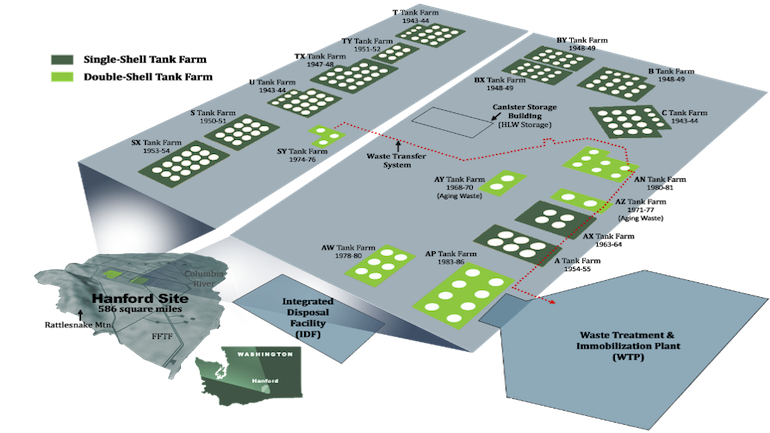
The waste is distributed across 177 underground storage tanks buried under 10 feet of soil and gravel to shield workers from radiation. The tanks are organised into 18 distinct groups called tank farms. The architecture is divided into two eras. The 149 Single-Shell Tanks (SSTs) were constructed between 1943 and 1964 out of a single carbon-steel inner liner surrounded by a thick, reinforced concrete shell. They hold between 55,000 and 1m gallons each. They are long past their intended 20-year design life and 67 are known or suspected to have leaked over 1m gallons of waste into the surrounding soil and groundwater.
The 28 Double-Shell Tanks (DSTs) were constructed between 1968 and 1986 and feature an extra “tank-within-a-tank” steel barrier with a monitored space (annulus) to detect internal leaks before waste escapes into the environment.
The tanks are organised into 18 distinct groups – tank farms – divided geographically between two primary operating zones known as 200 East Area and 200 West Area. The 88 tanks in the 200 West Area are all SSTs. This area includes the S, SX, and U farms involved in the low-level waste reclassification. The U tank farm hold 16 SSTs built 1943–1944); the S tank farm holds 12 SSTs built 1950–1951; and the SX tank farm hold four SSTs built 1953–1954.
The contents of the tanks are not uniform fluids. Over decades of chemical shifts, evaporation, and settling, the inventory has separated into three distinct layers, roughly split into equal thirds. A dense, heavy layer at the bottom of the tanks has a consistency resembling wet beach sand. It contains most of the high-level radionuclides (strontium and plutonium). Above that is a hard, crusty, concrete-like layer formed when liquid waste evaporated, locking up highly water-soluble salts. Then there is the highly alkaline, intensely radioactive liquid layer hovering above or trapped within the saltcake and sludge matrix.
To mitigate the risk of further catastrophic leaks, crews utilize specialised robotic arms and high-pressure liquid sluicing to scrape, scour, and pump out the remaining solids from the ageing single-shell structures. As of mid-2026, DOE has successfully emptied waste from 23 of the 149 SSTs, moving the retrieved material into newer double-shell tanks to await final stabilisation via glass vitrification or out-of-state grouting.


