
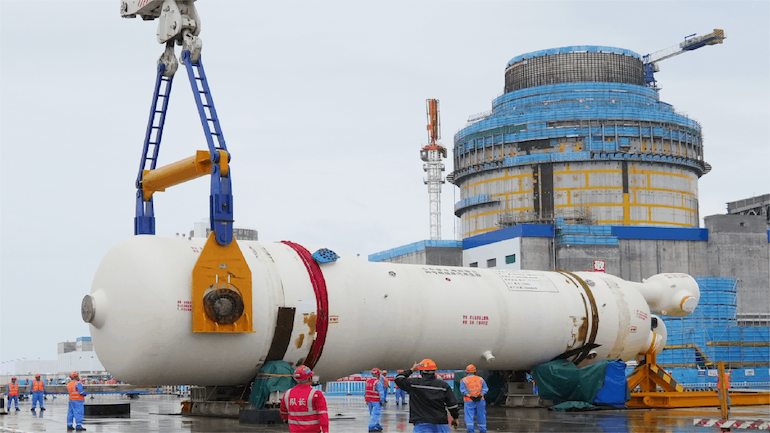
The first steam generator has been installed at unit 4 of China’s Haiyang NPP in Shandong province. State Power Investment Corporation (SPIC) subsidiary Shandong Nuclear Power Group said this lays a solid foundation for the completion of the main circuit of the nuclear island reactor and the capping of the reactor building.
Construction of Haiyang 4 began in April 2023 and first concrete was poured for the nuclear island of Haiyang 3 in July 2022. This marked the official start of construction of the first of two CAP1000 pressurised water reactors planned as Phase II at the site. The planned construction period is 56 months, with the two units scheduled to be fully operational in 2027.
Each unit contains two 630-tonne steam generators, each nearly 6 metres in diameter and 24 metres long. It is the heaviest single unit and the largest equipment in the main circuit of the nuclear island.
SPIC said hoisting the steam generator, which took three hours and 22 minutes, involved a series of operations including horizontal hoisting, circumferential rotation, flipping and erection, hoisting introduction, and precise alignment.
In order to ensure smooth implementation, the construction team for Haiyang 3&4 carefully planned and carefully organised, formulating improvement measures based on the experience of unit 3. Laser three-dimensional measurement modelling technology was used for installation simulation, special supervision and inspection were carried out, and on-site safety and quality were strictly controlled during the hoisting process.
The Haiyang NPP hosts two AP1000 reactors (units 1&2), which entered commercial operation in 2018 and 2019, with two CAP1000 reactors (units 3&4) – the Chinese version of the Westinghouse AP1000 – under construction. Unit 1 of the Haiyang plant entered commercial operation in October 2018, with unit 2 following in January 2019.
Construction of units 5&6 of the plant received official approval in April this year. “Once all the six units of the nuclear plant are fully operational, the annual power generated will be sufficient to meet the needs of 70m residents for a year.


