
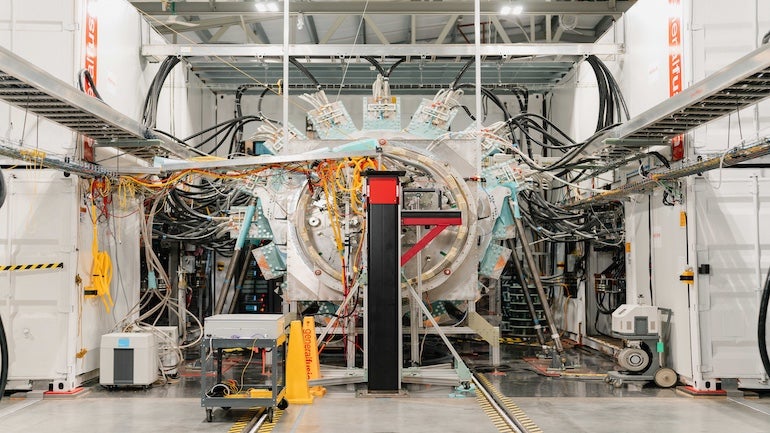
Canada’s General Fusion has achieved a landmark milestone by heating plasma to 1.1 kiloelectronvolts (keV – equivalent to 12.6m degrees Celsius using its large-scale Lawson Machine 26 (LM26) demonstration reactor. The electron heating results were recorded using gold-standard Thomson scattering diagnostics and co-published with the UK Atomic Energy Authority (UKAEA). The metrics were cross-verified via absolute extreme ultraviolet (AXUV) diagnostics, which tracked a peak of 1.2 keV (13.7m degrees C), alongside notable ion heating increases.
This achievement represents the world’s first 1 keV fusion milestone reached using low-speed mechanical compression. General Fusion uses a Magnetised Target Fusion (MTF) system. This mechanically squeezes magnetically confined plasma with a solid metal wall over a span of milliseconds, radically reducing complexity, power requirement constraints, and overall production costs.
MTF technology is based on the concept of an enclosed, liquid-metal vortex. Plasma is injected into the centre of the vortex before numerous pistons hammer on the outside of the enclosure, compressing the plasma and sparking a fusion reaction, with the resulting heat being absorbed by the liquid metal. MTF aims to achieve fusion in a practical and economical way, avoiding superconducting magnets and high-powered lasers while enabling the use of existing materials for durable machines.
The July public listing of General Fusion gave the company around $150m in cash. This is expected to fund the Lawson programme through several key technical milestones targeted for completion in 2028, with the goal of demonstrating and de-risking MTF technology in a commercially relevant way. Proceeds from the transaction will fully fund the LM26 facility, which is operating at the company’s headquarters near Vancouver.
Over the past two decades, General Fusion has built and operated dozens of testbeds, prototypes, and demonstrations, completing more than 200,000 plasma experiments culminating in LM26. The company is already engineering upgrades to the LM26 platform.
The company’s roadmap aims to cross the 10 keV (100m degrees C) mark next, with an ultimate target of demonstrating full scientific breakeven (Lawson Criterion) through its testing programme. The Lawson Criterion, formulated by British physicist John D Lawson in 1955, is the foundational mathematical rule used to determine when a nuclear fusion reactor will generate more energy than it consumes (net energy) to heat and hold the plasma. The roadmap is designed to fully de-risk the physics by 2028, preparing the company to supply commercial grid power from a first-of-a-kind commercial plant by around 2035.
Only a few fusion companies have achieved the key milestone of 1 keV, all using other approaches. Tokamak Energy achieved more than 1 keV in 2023 using a compact, spherical tokamak. This approach relies on strong magnetic confinement generated by cutting-edge high-temperature superconducting (HTS) magnets.
Also in 2023, Helion Energy achieved 1 keV using their seventh prototype (Trenta) based on a pulsed magneto-inertial approach (Field-Reversed Configuration). This involves shooting two plasma puffs at each other at hypersonic speeds, colliding them in a central chamber before compressing them with high-speed magnetic fields.
Zap Energy used Sheared-Flow Z-Pinch technology in 2024 to achieve 1-3 keV. Instead of magnets, this involves an immense electrical current running straight through a column of plasma, using the plasma’s own magnetic field to choke and compress itself (the Z-pinch effect).
While these on massive magnetic fields or ultrafast microsecond electrical pulses, General Fusion achieved 1.1 keV using low-speed physical compression, on the order of milliseconds, compared with other types of plasma compression technologies (microseconds or nanoseconds). This compression is achieved with a metal wall, rather than high-powered lasers or other methods operating in physical extremes. This is advantageous for the commercialisation of fusion power and, ultimately, its economics – it requires less power, is less complex, and less expensive.
In General Fusion’s commercial design, a liquid metal wall can protect the machine from neutrons, breed fuel, and efficiently capture heat to create steam and spin a turbine – key commercialisation advantages.
General Fusion has spent more than two decades developing its fusion technology in Canada, with support from the Government of Canada’s Strategic Response Fund and other programmes. General Fusion has also worked with UKAEA to develop the diagnostic systems behind this result. General Atomics Energy Group is advising on the diagnostic system required for the Company’s next milestone.
“Reaching more than 1 keV on LM26, alongside confirmed ion heating and corroborating AXUV data, is an important step forward for General Fusion and a meaningful validation of the approach we have spent more than two decades developing,” said General Fusion CEO Greg Twinney. “It shows that we are delivering against the technical roadmap we set out for LM26 and gives us greater confidence as we advance toward our next target of 10 keV, the Lawson criterion and practical and economical fusion power at commercial scale.”


