
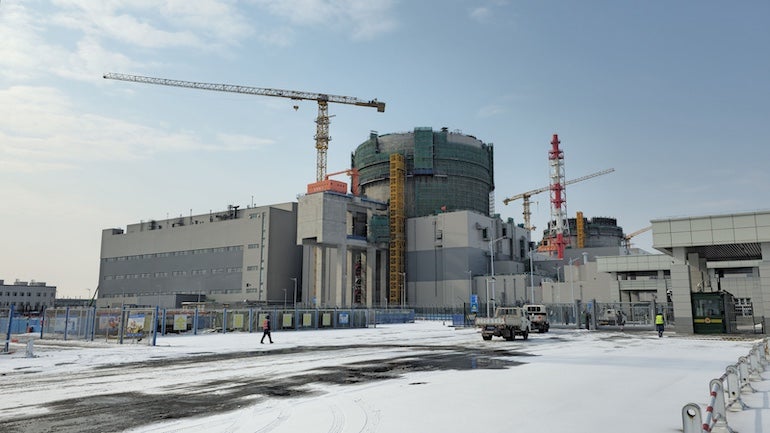
Rosatom’s Fuel Division TVEL has delivered nuclear fuel for the initial core of the VVER-1200 reactor at unit 3 of China’s Xudabao NPP in Liaoning province. The fuel load was manufactured at the Novosibirsk Chemical Concentrates Plant (NZKhK – Novosibirskii Zavod KhimConsentratov) as part of TVEL’s contract to supply fuel for Xudabao 3&4, which are being built by Rosatom.
“Xudabao NPP is a new milestone in the geography of Russian nuclear fuel supplies,” said Oleg Grigoriev, Senior Vice President for Commerce & International Business at TVEL. “Previously, we supplied fuel for the VVER-1000 and VVER-1200 reactors at the Tianwan NPP, as well as fuel assemblies for Chinese fast neutron reactors. Now another page is opening in the history of our relations with Chinese partners, which are developing very dynamically. We plan to manufacture and deliver initial fuel loads for two more new VVER-1200 reactors at the Tianwan and Xudabao NPPs by the end of this year.”
Four VVER-1200 reactors are being built in China, including units 7&8 of the Tianwan plant in Jiangsu province, as well as units 3&4 at Xudabao. In 2019, a number of contracts were signed, including a general contract for the construction Xudabao 3&4 as well as a contract for the supply of nuclear fuel. Commissioning of the units is scheduled for 2027-2028.
Meanwhile comprehensive tests of the tightness and strength of the containment at Xudabao 3 have been completed. By simulating the pressure corresponding to the design baseline event, a comprehensive check was carried out on the integrity of the containment, the level of leaks and the sealing properties of key components, which confirmed the effectiveness of quality control and safety during construction of the facility.
To ensure successful testing, the company Liaoning Newclear Power, together with organisations involved in the construction, formed a special task force. Before the start of the tests, compliance with the specified conditions, risk analysis and multiple simulation simulations were carried out. During the tests, specialised teams were on duty around the clock. They, strictly controlled the rate of pressure increase and at each stage accurately performed pressure exposure, data collection and comprehensive inspection, ensuring compliance with all safety requirements. The tests mark the final stage before commissioning.


