
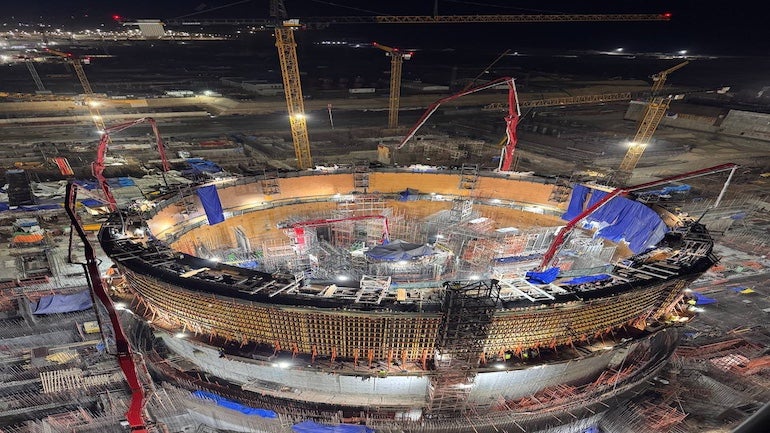
Concrete pouring has been completed for the fourth level of the internal containment vessel for the unit 1 reactor building at the El Dabaa NPP under construction in Egypt. The concrete pouring took 30 continuous hours, during which five pumps with guide arms were used to pour the concrete throughout the implementation period. About 80 specialists took part in the casting work during the day shift, in addition to another 80 specialists during the night shift with some 20 individuals continuing their work around the clock to ensure the uninterrupted operation of construction equipment and machinery.
The total volume of concrete poured was 1,608 cubic metres, and the work contributed to increasing the height of the reactor building from the level of 24,400 metres to 34,000 metres, while the height of the fourth tier was 9.6 metres.
“The success in completing the concrete casting work for the fourth level in the first nuclear unit is a new strategic step that reflects the continuous progress of the project,” said Dr Sherif Helmy, Board of the Nuclear Power Plants Authority (NPPA). “This achievement is the result of fruitful cooperation and integrated coordination between all work teams from NPPA, the owner and operator of the project, and general contractor Atomstroyexport. The Authority is keen to closely follow all stages of implementation to ensure full compliance with the highest standards of nuclear quality and safety approved internationally and locally, which enhances Egypt’s journey towards diversifying energy sources and achieving sustainable development.”
Alexei Kononenko, Vice President of Atomstroyexport and Dabaa Nuclear Plant Construction Project Manager noted: “The completion of Level 4 of the internal containment vessel represents a major new phase in the construction of the first nuclear unit and reflects the level of professionalism and dedication of the entire project team. By mid-August, we are scheduled to begin installation work on Level 5, which will later support installation work on the polar crane.”
The work took place after completing the required regulatory procedures and obtaining the necessary approvals from the Egyptian Nuclear and Radiological Regulatory Authority, which confirms strict adherence to the strictest safety and quality requirements.
The plant is being developed under a 2015 agreement between Egypt and Russia, with final contracts signed in 2017. The estimated cost stands at $25bn, largely financed through a Russian state loan on concessional terms. Once completed, the facility will comprise four VVER-1200 reactors with a combined capacity of 4,800 megawatts. The first unit is currently scheduled to begin operations in 2028, with the remaining units planned to come online by 2030.


