
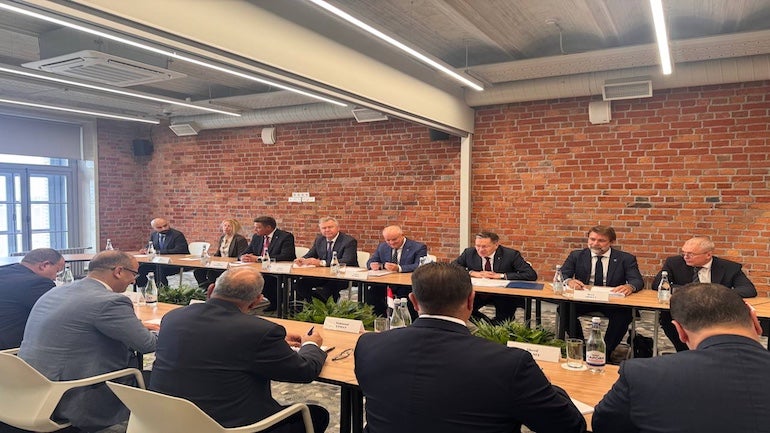
Rosatom is actively negotiating with Egypt to expand their energy and technological partnership. This expansion includes discussions for a second stage of the El Dabaa NPP alongside specialised medical, industrial, and water desalination initiatives.
The discussions took place at a meeting in Nizhny Novgorod between Rosatom Director General Alexey Likhachev and Egypt’s Minister of Electric Power & Renewable Energy Mahmoud Esmat. Earlier in August, Esmat said the plan was adopted following instructions from Egyptian President Abdel Fattah El-Sisi.
The existing plant, being built by Rosatom, is designed to include four VVER-1200 pressurised-water reactors with a combined capacity of 4.8 GWe. Each reactor is rated at 1,200 MWe, with the four units targeted for completion by the 2029/2030 fiscal year. Rosatom is constructing the plant under an agreement first signed in 2015. Russia is financing 85% of the project’s total cost while the remaining 15% is being funded by Egypt.
In accordance with contractual obligations, Russia will also supply nuclear fuel throughout the entire life of the plant, as well as provide assistance to Egyptian partners in training plant personnel during the operation and maintenance phase during the first 10 years of plant operation. Under a separate contract, Russia will also build special storage facilities and provide special containers for storing used nuclear fuel, which will eventually be returned to Russia for processing.
In Nizhny Novgorod, the parties discussed the current status of work on the construction of the station as well as the financial and economic models for adding two more VVER-1200 reactors to the plant. Construction is proceeding simultaneously at all four units, with nuclear fuel delivery for unit 1 set for the first half of 2027 and grid connection scheduled for 2028.
Beyond large-scale units, the two sides are also evaluating:
- The construction of small modular reactors (SMRs) and floating nuclear power plants;
- Utilising nuclear power infrastructure to host large-scale water desalination plants to address regional water scarcity;
- Developing specialised centres in Egypt focused on advanced cancer therapies, diagnostics, and radiopharmaceuticals;
- Establishing centres for 3D printing and advanced material manufacturing based on specialised industrial technology.
The development of the El Dabaa NPP involves complex financial agreements and aggressive timelines. The financial layout for the first four reactors follows a comprehensive state-backed lending agreement. Total project cost is estimated at approximately $28.75-30bn. Russia is financing 85% of the construction ($25bn) via a state export loan. Egypt will repay the loan over 22 years, beginning in 2029, at an annual interest rate of 3%. Egypt funds the remaining 15% out of its national budget.
The completed plant is projected to save Egypt around 8bn cubic metres of natural gas annually, which can instead be redirected to domestic consumption or profitable exports. The economic discussions for the proposed fifth and sixth units are currently focused on establishing a similar or optimised financial framework to account for current global economic conditions.
“Today we are starting a conversation about the second stage, the possible expansion of the station by two more units, and the financial and economic model for the fifth or sixth unit. If we come to a common point of view, a common understanding, we will report to the leadership of our countries,” Likhachev noted. “Today we do not see any problems with the supply of electrical equipment, control systems, or turbine hall equipment. All suppliers (European, Asian) carry out their deliveries very rhythmically.”
Sheriff Helmi, Chairman of the board of Directors of the Egyptian Nuclear Power Plant Authority (NPPA), said earlier that Egypt is considering the further development of nuclear capacity and is assessing new sites for possible construction.
In November 2025 Rosatom and the Egyptian Ministry of Electricity signed a comprehensive cooperation programme establishing the framework mechanisms for cooperation and opening new areas of joint work. The programme provides for the development of economic cooperation and expansion of cooperation between specialised organisations of the two states. Particular attention is paid to the exchange of experience and scientific and technical interaction, and the formation of a sustainable platform for long-term partnership.


