
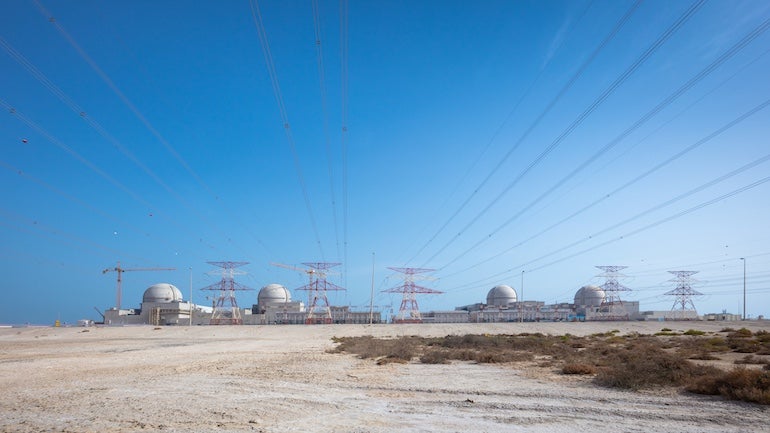
A drone strike has caused a fire in an electrical generator located outside the inner site perimeter of the Barakah NPP in the UAE. The International Atomic Energy Agency (IAEA) has been informed by the UAE that radiation levels at the plant remain normal, and no injuries were reported. Emergency diesel generators are currently providing power to unit 3 of the four units at the site. The IAEA is following the situation closely and is in constant contact with the UAE authorities, ready to provide assistance if needed, it says. IAEA Director General Rafael Mariano Grossi expressed grave concern about the incident and says military activity that threatens nuclear safety is unacceptable. He called for maximum military restraint near any NPP to avoid the danger of a nuclear accident.
UAE nuclear regulator, the Federal Authority for Nuclear Regulation (FANR), said in a statement: “There has been no release of radioactive material, radiological safety levels remain within normal ranges, and there is no risk to the public or the environment,” adding that no injuries had been recorded. FANR said the incident did not affect the safety of the plant or the readiness of its essential systems.
The statement came hours after the Abu Dhabi Media Office said authorities had responded to the fire that broke out at the electrical generator outside the plant’s inner perimeter in the Al Dhafra Region. The media office said the fire resulted from a drone strike, without identifying its source, adding that no injuries were reported and all precautionary measures had been taken.
The UAE’s ministry of defence said the drone that targeted the facility was one of three that “entered the country from the western border direction”. It added that two other drones had been “successfully” dealt with. “Investigations are ongoing to determine the source of the attacks, and updates will be disclosed upon completion of the investigations,” the ministry added.
The UAE “condemned in the strongest terms the unprovoked terrorist attack” and “will not tolerate any threat to its security and sovereignty under any circumstances. “These attacks constitute a dangerous escalation, an unacceptable act of aggression and a direct threat to the country’s security,” a Foreign Ministry statement said. There was no claim of responsibility for the drone strike, and the UAE statement didn’t blame any party for the attack.
FANR encouraged the public to rely on official sources for accurate information and to avoid sharing rumours or unverified reports. Further updates will be provided as additional verified information becomes available, it said.
FANR is maintaining close coordination with plant operator, the Emirates Nuclear Energy Company (ENEC) and the relevant national authorities to verify all aspects of the incident and to confirm the continued integrity and readiness of plant systems. As part of its independent regulatory oversight, FANR is assessing the event in accordance with established national procedures and maintaining continuous monitoring of radiological conditions and plant status.
Barakah is the first multi-unit operational NPP in the Arab world. Construction began in 2011. Korea Electric Power Company (Kepco) led the consortium built the plant comprising four APR1400 reactors. Unit 1 began commercial operation in April 2021, unit 2 in 2022, unit 3 in 2023 and unit 4 in 2024. Together, the four units are expected to contribute up to 25% of the UAE’s National Determined Contributions to Net Zero and be the largest source of dispatchable clean electricity.
Fatih Birol, Executive Director of the International Energy Agency, said in a post on X: “Attacks on energy infrastructure have multiplied recently, affecting lives & livelihoods around the world. Today’s attack on the Barakah nuclear power plant in the UAE is an alarming example. I urge all countries to avoid the targeting of civilian energy infrastructure.”
World Nuclear Association issued a statement saying: “Our colleagues at the Barakah Nuclear Power Plant and the IAEA have confirmed that everyone is safe at the plant, that the plant has not suffered direct damage, and that emergency procedures have been effectively activated and the plant is operating safely.
“We call on those responsible for military activity of any kind in the proximity of this nuclear power plant, and all civilian energy facilities, to revisit the agreements of the Geneva conventions. Attacks on energy infrastructure are reckless and unacceptable; it is vital that protections afforded to civilian infrastructure – especially nuclear power plants – are reaffirmed and respected.”
Regional tensions have escalated since the US and Israel launched strikes against Iran in February. The UAE has hosted air defences and personnel from Israel. Tehran retaliated with strikes targeting Israel as well as US facilities in the Gulf, including in the UAE, along with the closure of the Strait of Hormuz. A ceasefire took effect on 8 April through Pakistani mediation, but talks in Islamabad failed to produce a lasting agreement. US President Donald Trump later extended the truce indefinitely. The US is currently blockading Iranian ports and diplomatic efforts aimed at a more durable peace have repeatedly faltered.


