
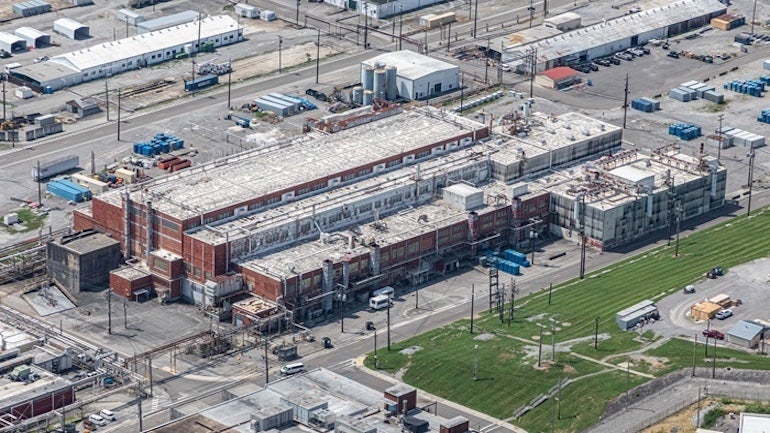
Oak Ridge crews are deactivating the Beta-4 facility, which spans the equivalent of nearly seven football fields at the Y-12 National Security Complex. This marks a significant step forward in the Oak Ridge Office of Environmental Management’s (OREM) effort to remove legacy hazards, enable modernisation and open space for important national security missions at Y-12.
The Beta-4 facility (officially Building 9204-4) at the Y-12 National Security Complex in Oak Ridge, Tennessee, was built in 1945 as one of the original Manhattan Project-era facilities designed to support the atomic bomb effort. Beta-4 was one of four “beta” buildings that housed Calutrons – electromagnetic separation devices – used for the second and final stage of separating uranium-235 from uranium-238.
Along with the Alpha-5 facility, the activities at Beta-4 were critical in producing the enriched uranium used for the “Little Boy” atomic bomb dropped on Hiroshima. The building spans roughly 360,000 to 400,000 square feet.
After the original Calutrons were decommissioned in 1946 (replaced by more efficient methods such as gaseous diffusion), the facility was repurposed for Cold War missions. In the late 1950s, Beta-4 housed the ELEX (Electrical Exchange) process for Lithium-6 isotope separation, a vital component for thermonuclear weapons. It eventually transitioned into missions involving weapons fabrication, disassembly, testing, and storage before operations finally ceased in 2003.
The National Nuclear Security Administration (NNSA) enabled this latest clean-up activity by transferring operational responsibility of Beta-4 to OREM for the characterisation, deactivation and demolition work. Following demolition, the footprint will be returned to NNSA to support critical mission needs.
Some United Clean-up Oak Ridge (UCOR) crews are performing characterisation work at Beta-4, sampling equipment and materials to support safe waste removal, packaging and disposal. Others are busy with “cold and dark” activities – isolating utilities, removing hazards and verifying systems are safely shut down.
The crews are already a step ahead after completing a major infrastructure project laying the groundwork for the current phase of clean-up at Beta-4. They built several temporary structures to position craft professionals and support teams closer to the facility, reducing travel time across the site for equipment and resources. This infrastructure will also support other major clean-up projects nearby.
“This infrastructure is the work before the work that will allow our teams to be closer to clean-up,” said Tanner Holsomback, UCOR project manager for Special Partnership Programs. “By reducing time spent away from the jobsite, we’re increasing productivity and setting the stage for successful deactivation and demolition at Beta-4.”
This next phase highlights the broader momentum happening across Y-12 as crews reduce risk and help transform the site for new uses. Currently, Y-12 is designated as the US Uranium Centre of Excellence. Its current responsibilities include:
- Nuclear Deterrence: Manufacturing, refurbishing, and dismantling components for every weapon in the current US nuclear stockpile;
- Nuclear Materials Management: Providing secure storage for highly enriched uranium and down-blending excess weapons-grade material for use in commercial nuclear power reactors;
- Naval Support: Supplying enriched uranium feedstock to fuel the US Navy’s nuclear-powered submarines and aircraft carriers; and
- Global Security: Partnering with international agencies to secure nuclear materials from other countries and training emergency responders and security forces to prevent the spread of weapons of mass destruction.
The complex is undergoing a multi-billion-dollar modernisation effort to replace its ageing Manhattan Project-era infrastructure.
A massive new facility, the Uranium Processing Facility (UPF), is nearing completion that will consolidate operations from several older buildings into a single, state-of-the-art secure location.
Construction of the Lithium Processing Facility (LPF) began in 2023 on a 245,000-square-foot facility to replace seven decades of ageing lithium processing infrastructure. As of early 2026, crews have completed major demolition of several historic structures, including the Alpha-2 building, to reduce the environmental footprint and make room for modern operations.


