
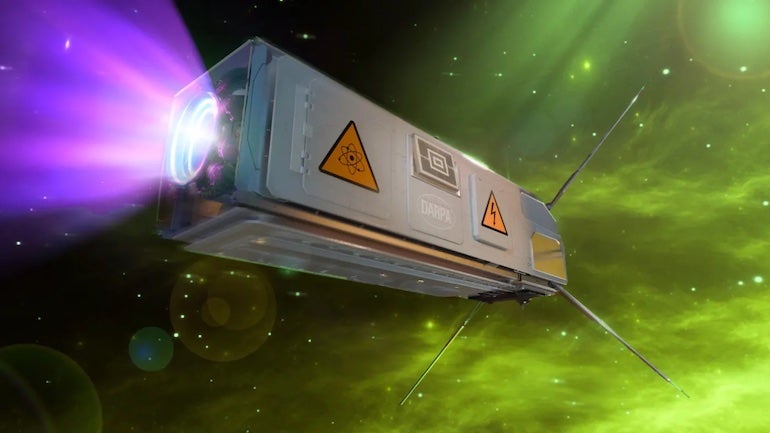
Avalanche Energy, a Seattle-based fusion energy startup founded in 2018, has been awarded a $5.2m contract from the Defense Advanced Research Projects Agency (DARPA) Rads to Watts programme to develop nuclear batteries. The 30-month programme will mature technologies that directly support Avalanche’s mission to commercialise practical, portable fusion power.
Under this contract, Avalanche will develop solid-state, micro-fabricated alphavoltaic cells that convert alpha particles from radioisotopes (such as polonium) directly into electricity. This process is functionally similar to how a solar cell converts light into energy. The programme aims to deliver more than 10 watts per kilogram. For context, current nuclear batteries used on Mars rovers provide only about 2.5 watts per kilogram.
The target is a device weighing roughly 10 pounds (a few kilograms) that could continuously power a laptop-class system for several months. The aim is to maintain performance in the harsh radiation environment of space, where conventional electronics would rapidly degrade. Avalanche will validate the device’s operational resilience using both particle accelerators and active radioisotopes. Beyond space exploration, these batteries are intended for autonomous military systems, remote forward operating bases, and subsea drones.
Avalanche is leading a multi-institutional team including Caltech, Los Alamos National Laboratory (LANL), the University of Utah, and McQuaide Microsystems. The team intends to deliver a near-term power technology that also advances Avalanche’s long-term goal: compact, manufacturable fusion systems capable of powering defence, space, and autonomous platforms.
“The DARPA contract represents a critical milestone in our path to practical fusion power,” said Robin Langtry, co-founder and CEO of Avalanche Energy. “The direct energy conversion technologies we’re developing under Rads to Watts will be essential for extracting power from fusion reactions efficiently. We’re building the capabilities today that will enable tomorrow’s fusion systems to deliver reliable, portable energy for defence, space, and commercial applications.”
While the DARPA contract focuses on radioisotope decay rather than fusion, it serves as a critical stepping stone for Avalanche’s long-term roadmap: direct energy conversion. The “degradation-resilient” microchips being developed will eventually be used to extract power directly from the charged particles produced in the company’s Orbitron fusion reactor.
The Orbitron design is adapted from the “Orbitrap” concept – a technology already widely used in commercial mass spectrometry. It uses electrostatic fields to confine ions in elliptical orbits around a central cathode, where they collide and fuse. This approach requires significantly less cooling and power than the massive superconducting magnets used in traditional tokamak reactors.
The fusion machines themselves can produce the very same high-energy neutrons needed to create the radioisotopes used in the nuclear batteries, creating a self-sustaining technology cycle. Avalanche’s modular compact fusion technology addresses critical energy needs for defence and commercial applications including:
- Remote military bases and forward operating locations;
- Space propulsion and power systems;
- Underwater unmanned vehicles (UAVs); and
- Critical infrastructure including data centres, remote communities, and other grid-challenged settings that demand resilient, carbon-free baseload power.
Avalanche Energy was established by Robin Langtry and Brian Riordan, both former aerospace engineers at Jeff Bezos’s Blue Origin. Their background in the “New Space” industry heavily influences the company’s “test-fail-fix” engineering ethos, which emphasises rapid iteration over years of theoretical planning. The founders have noted that some of their technical solutions were inspired by “archaeology” of old, forgotten Soviet research papers from the 1980s regarding Mirror fusion programmes.
To date the company has raised approximately $80m. The company announced a $29m funding round in early February 2026, as well as a $1.25m contract from the innovation arm of the Department of the Air Force, AFWERX, to rapidly develop advanced materials for extreme environments. Major backing has come from firms such as Lowercarbon Capital, Founders Fund (Peter Thiel), Toyota Ventures, and RA Capital Management. Avalanche has also secured prototype contracts with the Defense Innovation Unit (DIU) to develop nuclear-powered propulsion and power for spacecraft.
DARPA is the central research and development organisation for the US Department of Defense. It was founded in 1958 by President Dwight D Eisenhower as the Advanced Research Projects Agency (ARPA) as a direct response to the “Sputnik crisis” after the Soviet Union launched the world’s first artificial satellite, catching the US technologically off guard.
Its mandate is to ensure the US military stays ahead by pursuing radical, “unimagined” technologies that traditional military branches might find too risky or futuristic to fund. The agency is small, with only about 220 government employees overseeing roughly 250 programmes. DARPA does not own its own laboratories; instead, it awards and manages contracts for outside researchers in universities, industry, and non-profits.
DARPA’s Rads to Watts programme is one of the agency’s flagship efforts to field compact, long-lived nuclear power systems for defence and space missions where traditional batteries, refuelling, and solar power are not viable.


