
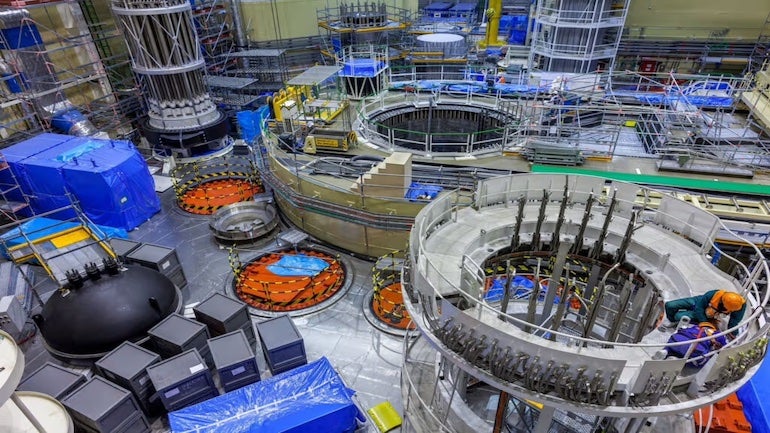
Slovak power utility Slovenské elektrárne (SE) said unit 4 of the Mochovce NPP had achieved criticality before achieving its minimum controlled power level shortly after. SE said this demonstrates the reactor’s readiness for final testing phases before commercial electricity generation begins.
“Achieving criticality and minimum controlled power is the result of the work of thousands of experts who participated in the preparation, construction, inspection, and commissioning of the fourth unit. It confirms that the power plant is ready to proceed to the next testing phase before starting electricity production,” said Mochovce Project Director Martin Mráz.
This step will be followed by physical tests and tests at different increasing power levels to verify the behaviour of all power plant systems under operating conditions and prepare the unit for connection to the electricity system. The start-up process will subsequently culminate in a 144-hour demonstration run at full output. The timeline depends on the progress and results of the individual tests. Unit 4 is expected to deliver its first electricity to the grid at the end of the summer.
Nuclear Regulatory Authority (ÚJD SR – Úrad jadrového dozoru Slovenskej republiky) authorised SE to bring unit 4 into operation in May. As no objections were filed against the decision, it became legally effective on 24 June. Fuel loading began on 29 June and was completed on 3 July.
Mochovce NPP comprises four VVER-440 units. Units 1&2 began operation in 1998 and 1999 and unit 3 began commercial operation in October 2023. Units 3&4 with a design life of some 60 years, will supply some 26% of Slovakia’s total electricity consumption.
Construction of units 3&4 began in 1986 but was suspended in 1992 and resumed only after a lengthy hiatus in 2008. SE puts the value of the entire project at approximately €6.7bn ($7.7bn), up from an estimated €2.8bn in 2008. With the addition of Mochovce 4, Slovakia will have six power reactors in operation. Slovakia also has two VVER-440 units operating at the Jaslovské Bohunice. With all six units in operation, nuclear power should cover approximately 77.5 % of domestic electricity consumption.
The history of Mochovce 3&4 is a catalogue of project delays, political upheaval, and ballooning budgets. The 39-year timeline begins in 1987 when construction officially begins. In 1991 work stalled following the collapse of the USSR and funding shortages. Construction restarted in 2008 under majority shareholder Enel, with initial plans to finish by 2012-13. Multiple delays followed due to post-Fukushima safety retrofits, cramped spacing for modern thick cabling, and ownership restructuring.
SE is owned by a 66% majority stake through an intermediary vehicle called Slovak Power Holding (SPH). In 2016, Czech energy infrastructure group Energetický a průmyslový holding (EPH) bought a 50% stake in SPH from Enel in December 2024. EPH exercised its early call option to buy the remaining 50%. Following regulatory approval from the European Commission in March 2025, the deal officially closed two months later. Currently the state holds a 34% minority stake, with shareholder rights managed via the Ministry of Economy. EPH (via SPH) holds the 66% majority stake.
SE is planning new units at Jaslovské Bohunice. In January, Slovakia agreed to build a Westinghouse AP1000 reactor at the site. In April, preparatory Front-End Engineering and Design (FEED) studies were formally launched under the US State Department’s Project Phoenix framework. Unlike the existing units owned by SE, this multi-billion-euro project will be 100% state-owned.
Financial advisors (Rothschild & Co) were contracted in January. Heavy construction is slated to begin by 2032, aiming for an operational launch by 2038–2040. Slovakia is also aiming to turn Jaslovské Bohunice into a regional testing ground for fourth-generation modular reactors. In June 2025, the state nuclear decommissioning company (JAVYS) and France-based start-up newcleo established a joint venture based at Bohunice. They plan to eventually deploy up to four 200 MWe modular reactors at the site. Separately, SE signed a memorandum with Synthos Green Energy to evaluate the feasibility of deploying GE Vernova’s BWRX-300 SMRs at the complex.
The expansion runs parallel to the ongoing teardown of historic site facilities. The old A1 reactor (shut down in 1977 after an accident) and the two older V1 reactors (dismantled as a condition of Slovakia entering the European Union) are in the final phases of environmental remediation and fuel cleanup to free up physical space for the new reactors.


