
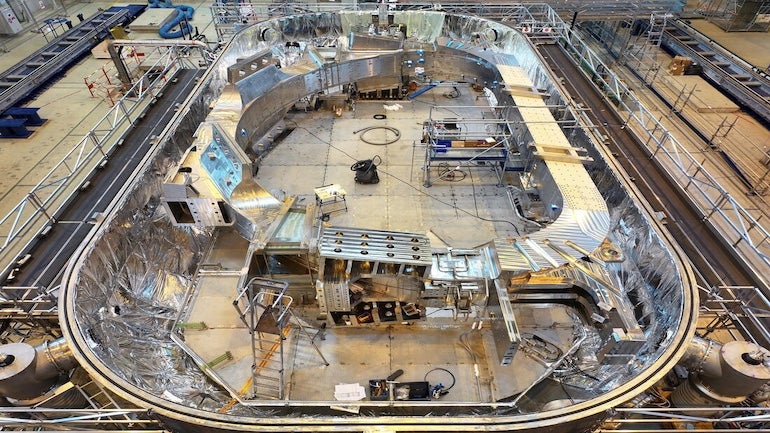
Operations have begun at the ITER Magnet Cold Test Facility in Cadarache, France. Following a 12-day cooldown process, engineers successfully lowered the first 330-tonne toroidal field coil (TF07) to its operational superconducting temperature of 4 Kelvin (-269°C). The ITER magnet cold testing programme was launched in 2023. The facility was established as part of ITER’s revised assembly and commissioning approach to mitigate technical risks before full machine integration.
While it cannot perfectly replicate the exact physical stresses of a live fusion reaction, the testing regime provides vital validation data. This includes:
- Ramping up selected magnets to full operational electrical currents – 68 kiloamperes (kA) for toroidal field units and 48 kA for poloidal field units.
- Quench Detection: Verifying that safety sensors instantly recognise a “quench” (when a magnet accidentally exits its superconducting state and suddenly generates high heat).
- Insulation Integrity: Testing high-voltage ground insulation capabilities across extreme temperature shifts.
- Joint and Structural Verification: Monitoring the performance of internal superconducting joints and how the components physically handle cryogenic stress.
To save time and budget, the ITER Organisation strategically repurposed an existing assembly hall previously used by Europe’s Domestic Agency (Fusion for Energy) to manufacture poloidal field coils. This allowed the project to utilise the building’s pre-existing heavy-lift cranes and its direct proximity to ITER’s central helium cryoplant.
The custom-built 800 m3 cryostat chamber (measuring 11 by 20 metres) safely isolates the components under high-vacuum conditions throughout the runs. Each selected magnet coil will undergo a rigorous four-to-six-month testing window, with the entire facility projected to operate over the next several years to de-risk the assembly pipeline.
Following TF07, additional toroidal field coils from different manufacturers will follow, as well as ITER’s smallest ring-shaped poloidal field coil (PF1)
“ITER as a first-of-a-kind project requires ingenuity as well as discipline,” said ITER Director General Pietro Barabaschi. “By repurposing existing infrastructure, using the capabilities of our cryoplant, and mobilizing a multidisciplinary team, we have created a practical way to reduce risk before integrated commissioning. This is important for ITER as well as an example of how ITER can support the wider fusion ecosystem by creating knowledge, infrastructure, and operational experience that others can use.”
ITER is a first-of-a-kind global collaboration. As the host, Europe contributes almost half of the costs of its construction (45.6%), while the other six members of this joint international venture (China, India, Japan, South Korea, Russia and the US), contribute equally for the remaining expenses (9.1% each). However, in practice, the members deliver little monetary contribution to the project, instead providing ‘in-kind’ contributions of components, systems or buildings.
The goal of ITER is to operate at 500 MW (for at least 400 seconds continuously) with 50 MW of plasma heating power input. Some 33 nations are collaborating in the construction of ITER, which began in 2010, many of them through their Domestic Agencies (DAs).
Construction began in 2010 and the original 2018 first plasma target date was put back to 2025 by the ITER council in 2016. In June 2024, a revamped project plan was announced which aims for “a scientifically and technically robust initial phase of operations, including deuterium-deuterium fusion operation in 2035 followed by full magnetic energy and plasma current operation”. The 37th meeting of the ITER Council in December 2025 reported significant progress. Barabaschi reported that ITER is somewhat ahead of schedule while spending is less than anticipated.


