
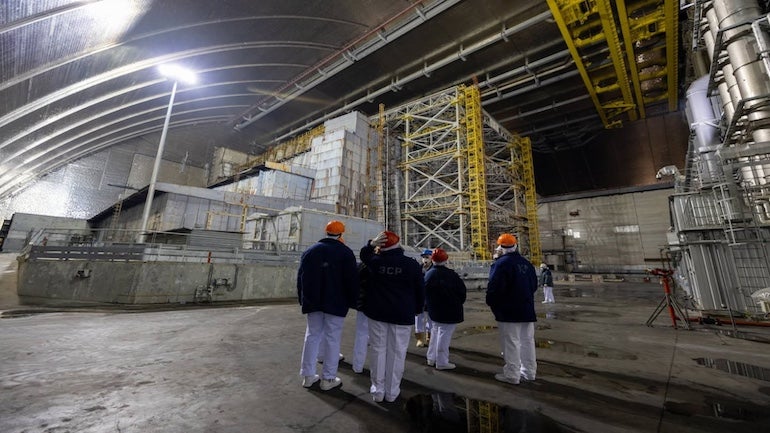
The management of the Chornobyl NPP ((ChNPP), the European Bank for Reconstruction and Development (EBRD), and French companies Bouygues and Vinci have held a working meeting to discuss the full restoration of the New Safe Confinement (NSC). The meeting took place on the eve of the Assembly of the International Chornobyl Cooperation Account (ICCA), scheduled for 31 March 2026 in London, where an interim report on restoration options will be presented.
The primary goal is to restore the NSC’s protective functions, which were compromised by a drone strike in February 2025. Key tasks identified include:
- Replacing all damaged membranes and repairing the outer cladding to ensure the “Arch” can again act as a barrier against radioactive substances.
- Repairing the main cranes maintenance system and specific steel supporting systems necessary for long-term operations.
- Re-establishing active anti-corrosion protection to ensure the structure meets its original 100-year design lifespan.
- Restoring the ability to control internal pressure and vacuum, which is currently hindered by the damage.
Until full functionality is restored ChNPP cannot resume its primary mission to dismantling unstable structures of the original “Shelter Object” (the 1986 sarcophagus) and transforming the site into an environmentally safe system.
Unit 4 of the Chernobyl nuclear power plant was destroyed in an accident in April 1986. The sarcophagus was hastily built over the damaged reactor to enable the other power units of the station to continue operating. The sarcophagus still contains a molten reactor core and an estimated 200 tonnes of highly radioactive materials.
The shelter was not designed to last very long, so the NSC was built to cover a much larger area, including the original shelter. Construction of the NSC began in 2007, but due to insufficient funding the completion dates of the facility were periodically postponed. Construction resumed in 2012, and it was put into operation in 2019. In 2021 ChNPP was formally licensed to operate it.
The €1.5bn ($1.69bn) NSC construction project, managed by the EBRD, was financed by 45 donor countries and institutions. The €935m contract for the design and construction of the NSC was signed in 2007 between the ChNPP and Novarka (a consortium led by the French construction companies Bouygues Travaux Publics and Vinci Construction Grands Projets).
ChNPP Director General Serhii Tarakanov said, over the past few months, Bouygues and Vinci have been working on proposals for the NSC restoration, including an assessment of the time frame, cost and radiation exposure to personnel.
He noted that in October urgent repairs had been made to close the whole in the NSC roof caused by the drone strike. “This made it possible to get through the autumn-winter period relatively smoothly and to prevent excessive ingress of precipitation into the structure. However, this solution was only temporary,” he said. “Now it is necessary to undertake comprehensive repairs and full restoration of the NSC functionality. In our opinion, no one will be able to handle this task better than the companies that designed and built the Confinement. These are the French companies Bouygues and Vinci, which worked as part of the Novarka consortium.”
He added that the working meeting discussed the possibility of a renewed merger between Bouygues and Vinci as part of the Novarka-2 International Consortium. Full restoration of NSC functionality should be completed by 2030 in order to prevent accelerated corrosion of structures due to their interaction with the external atmosphere.
He explained that it is necessary to carry out a whole range of measures, including the replacement of all damaged membranes; repair of the main cranes maintenance system and other damaged equipment, as well as steel supporting structures; restoration of full tightness of the outer cladding. All this is an extremely difficult technical task, given the high radiation fields in the work area.
As of March 2026, the ICCA has secured over €70m ($80.7m) from 15 international donors. However, the EBRD estimates that total repair costs for the NSC will exceed €100m. In February, the Ukrainian government allocated €31m from its national budget specifically for NSC repairs. In June 2025, a combined €42.5m was pledged during an ICCA Assembly meeting in London.
Funds are currently being directed to the Novarka consortium to finalise restoration proposals ahead of the ICCA Assembly meeting. Beyond the NSC, the ICCA continues to fund fire safety equipment, transportation infrastructure, and the ongoing dismantling of unstable structures within the original 1986 “Shelter Object”.


