
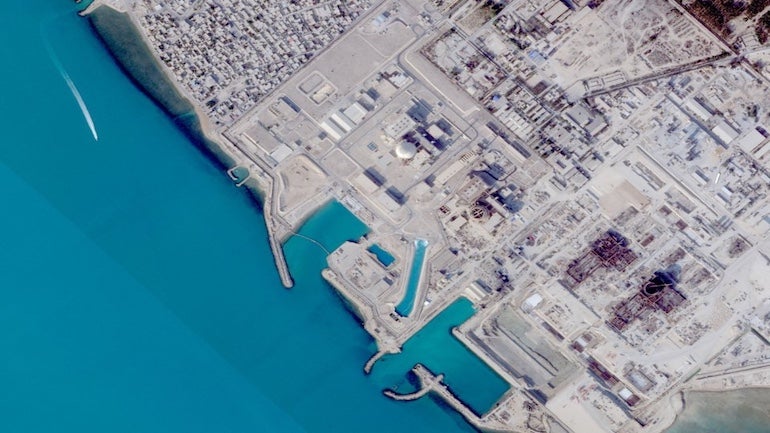
The International Atomic Energy Agency (IAEA) reported on X “Iran said a shell hit the nuclear power plant Bushehr …. There were no reports of damage to the station or casualties among staff. The statement added that IAEA Director General Rafael Grossi “reiterates his call for maximum restraint during conflict to prevent the risk of a nuclear accident”. The attack was confirmed by the Atomic Energy Agency of Iran.
Russia is assisting with the construction of units 2&3 at the Bushehr NPP, where the first unit with a 915 MWe VVER reactor has been in operation since 2011. Construction of the Bushehr NPP began in 1975 with a West German company but stopped in 1979 after the start of the Islamic revolution. In 1992, Russia and Iran signed an agreement to continue construction of the station using Russian VVER-1000 technology. Unit 1 was officially transferred to Iran in September 2013. First concrete for unit 2 was poured in 2019 and the core catcher was installed in 2024.
Rosatom Director General Alexey Likhachev said: “On 17 March, an attack was carried out on the territory adjacent to the metrological service building, located at the industrial site of the Bushehr NPP in close proximity to the existing power unit. There were no injuries among Rosatom staff. The radiation situation on the site is normal.”
He added: “The safety of human lives is our absolute priority. Previously, we had already partially reduced the number of personnel at the construction site of Bushehr units 2&3. About 250 employees and members of their families were safely removed from Iran. Preventively, even before the start of the armed conflict, the children of the employees were taken out. Now about 480 of our comrades remain there. Preparations are underway for the third evacuation of personnel.
He said firing at existing nuclear energy facilities is a blatant disregard for key rules and principles of international security. “We categorically condemn what happened and call on the parties to the conflict to make every possible effort to de-escalate the situation in the area of the Bushehr NPP.”
Russian Foreign Ministry spokeswoman Maria Zakharova said: “We strongly condemn the irresponsible, absolutely unacceptable missile strike on the inner perimeter of the Bushehr nuclear power plant, just a few meters from the operating power unit… Tel Aviv and Washington must abandon reckless attacks on nuclear infrastructure facilities, which creates real risks of radiological and environmental disaster throughout the region.”
She added: “We expect the unequivocal condemnation of this blatant incident by the IAEA, under whose safeguards the Bushehr NPP is located. We are counting on an appropriate reaction from all responsible and sensible members of the international community, and above all from the Gulf states.”
Alexey Anpilogov, President of Russian think tank Foundation for Support of Scientific Research & Development of Civil Initiatives (Osnovanie) told VZGLYAD newspaper that any serious accident at Bushehr – and in the event of the use of heavy three- or five-tonne bombs that could destroy not only the containment but also the reactor’s solid casing – would lead to the contamination of vast territories and the Persian Gulf waters.
However, less severe attacks may not have such dire consequences. “The VVER-1000 reactor at Bushehr is a second-generation plant equipped with an external sealed container. This is a powerful reinforced concrete structure designed to withstand severe external impacts, including the impact of a light aircraft. The experience of the Zaporizhia NPP, which has unfortunately been repeatedly attacked, shows that this particular design allows us to view accidental close hits with a certain degree of confidence that they will not lead to an immediate catastrophe,” he explained.
However, in addition to a well-protected reactor, any nuclear power plant has a number of vital but much more vulnerable systems. “And the most important of these is the cooling system. … Stopping the cooling process is a direct path to a Fukushima-like scenario: overheating of the core, an uncontrolled steam-zirconium reaction, and a hydrogen explosion,” he added.
He said Iran’s plant operators have two choices. “The first option, which is the least disruptive, is to put the reactor into a so-called “warm” or “hot” shutdown. The reactor continues to operate, but at a minimal level of power, sufficient only to power its own cooling systems. … For Iran, this would have tangible consequences, such as the loss of generation from the power system,” he said.
The second, more radical scenario is a “cold” shutdown in which cooling would depend on external power sources: either backup diesel generators or the external power grid. “Here, we return to the lesson of Fukushima: first, the earthquake knocked out the power grid, and then the tsunami destroyed the backup diesel generators. The plant lost all its power sources. For Bushehr, which is located in a conflict zone, this scenario cannot be ruled out. Targeted strikes on transformer substations or sites with diesel generators will sooner or later cause these systems to stop functioning,” he said. “Therefore, if the attacks on the plant continue, Iran will likely have no choice but to shut down Bushehr and put it into long-term cooling mode to achieve minimal heat generation and make the reactor conditionally safe.”
He also alluded to other vulnerable facilities at the NPP site. “For example, the used nuclear fuel storage pools. If these pools lose their cooling, the rods inside will begin to heat up, which could also lead to a radiation release,” he explained.
Similar points were made by Vladimir Kuznetsov, a doctor of technical sciences, professor, and member of Rosatom’s Public Council. He noted that the NPP is not protected by air defence systems. If it continues to be shelled, there is a possibility of a complete shutdown of electricity supply, which would result in the loss of cooling of the used nuclear fuel. This could lead to a nuclear catastrophe. He said a lot depends on how much damage Iran’s power grid has sustained and whether diesel generators can be used to power pumps in the event of power outages at the plant.


