
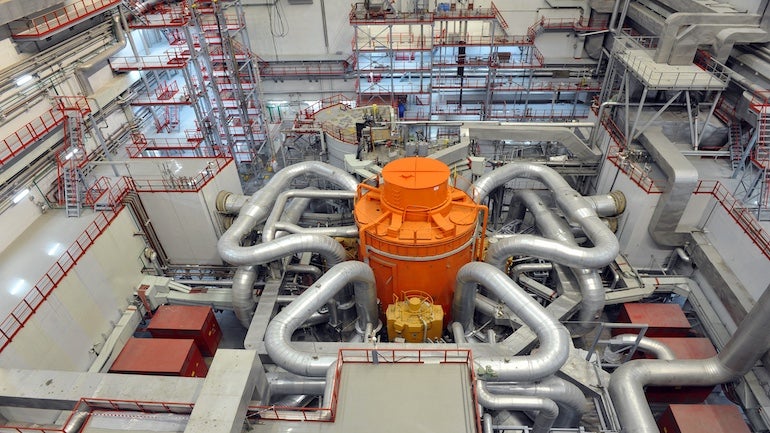
At unit 4 of Russia’s Beloyarsk NPP, engineers have loaded an experimental assembly of twice-recycled mixed oxide (MOX) fuel into the BN-800 sodium-cooled fast neutron reactor. This marked the first time a commercial high-capacity reactor has demonstrated a fully closed, self-sustaining nuclear fuel cycle.
Previously, the BN-800 ran on MOX fuel made with plutonium recovered from used fuel originating from conventional thermal reactors. This new assembly uses plutonium extracted from an irradiated MOX fuel assembly that had already completed a full operational cycle inside the BN-800 itself.
Demonstrating that fast reactors can breed, extract, and reuse their own plutonium proves that nuclear fuel can theoretically be recycled repeatedly, removing constraints tied to finite natural uranium reserves.
Rosatom manufactured the test assembly using an optimised plutonium-recovery method that reduced the number of processing steps while preserving fuel quality, improving the economics of fuel recycling.
Fast neutron reactors consume plutonium and can also “afterburn” long-lived radioactive minor actinides (a process successfully tested in the BN-800 earlier in 2026), significantly lowering the volume and radiotoxicity of high-level nuclear waste.
Operational data from this pilot assembly will directly support Russia’s upcoming commercial fast reactors, including the BN-1200M planned for Beloyarsk unit 5 and the BREST-OD-300, the world’s first lead-cooled fast neutron reactor being built as part of the pilot demonstration power complex to demonstrate a closed nuclear fuel cycle at the Siberian Chemical Combine in Seversk. As well as BREST, the complex includes on-site nuclear fuel cycle facilities including a module for fuel fabrication and refabrication and a module for reprocessing and recycling irradiated fuel. The fuel fabrication unit began operation in December 2024, with BREST scheduled to begin operation in 2029.
“Today, we have moved from theory to practice in closing the nuclear fuel cycle at fast reactors,” said Rosatom Director General Alexey Likhachev. “Having overcome another technological milestone, we are proving the viability of the very model of “renewable” nuclear energy. It will provide for the growing demand for electricity without proportionally increasing the burden on natural resources and increasing the volume of radioactive waste.”
He added: “A closed nuclear fuel cycle is not only an efficient use of uranium and plutonium, but also a systematic solution to environmental problems. The successful operation of the unique BN‑800 assembly is a direct contribution to the technological readiness of future Generation IV reactors, including the BN–1200M serial power unit under construction, which will be operational in the next decade. This is an important step towards making nuclear power generation a strategic source of energy for humanity.”
All work on loading experimental fuel assemblies is carried out in coordination with nuclear regulator Rostechnadzor and in full compliance with licensing documents.
Serial production of MOX fuel for the BN-800 was organised at the site of the Competence Centre for the Creation of Technologies for Closing the Nuclear Fuel Cycle in Zheleznogorsk (part of Rosatom’s Environmental Solutions Division). The company is also creating new facilities for the manufacture MOX for the BN-1200M, the world’s first high-power fast neutron reactor.


