

Looking back at the first issue of NEi it’s instructive to consider how much things have changed – and yet, in some ways, how some things remain unaltered.
The changes are more obvious. Black and white photographs (or those suggesting some artificial colouration). A contents page which lists the titles of articles in French, German and Spanish – as well as English! Small text in large blocks. Initial and surname used to identify most of the authors (although if you’re a “Sir” you get your full name!). Even the currency of the price harks back to many decades ago. But look beyond the magazine itself, and we can also see huge changes in our industry between 1956 and today.
Governance
Perhaps one of the most fundamental is that the UK nuclear industry of the 1950s was owned and operated directly by government agencies. The UK Atomic Energy Authority and the Central Electricity Authority (which became the Central Electricity Generating Board in 1958) were there to implement government directives over power generating infrastructure in England and Wales. Scotland had its own parallel bodies to the CEA/CEGB. When government ministers decided that more nuclear plants were a good idea, these bodies received the instructions and the funding to make such plants a reality. Just like that. There was no disconnect, as we have today, between policy and action.
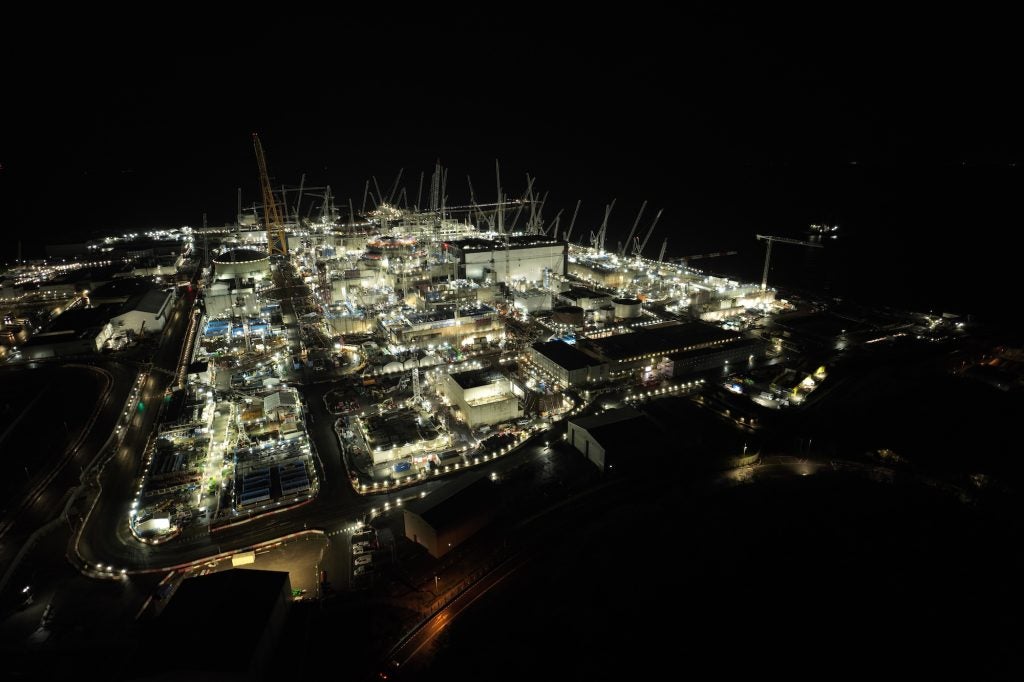
In the nuclear world of 2026, Government policymaking isn’t enough to drive construction. The expectation is that nuclear plants will be delivered by the commercial utilities which filled the gap left by the CEGB when electricity was privatised. And that means that those plants need to be funded by those utilities, either with their own money – or by bringing in investment partners. With nuclear plants costing tens of billions of pounds, and taking a decade or more to build, the impact of this change cannot be overstated. Traditionally only bodies with the financial strength and stability of a government behind them have been able to take such massive, long-term investments. And indeed that’s proved to be the case. Our current new build projects are still essentially being funded by governments. Just not always our own. Hinkley Point C is being developed by EDF (owned by the French government) in partnership with Chinese government agency CGN. Sizewell C is now being majority funded by our own government with EDF as a shareholder. And the SMR programme will also have substantial UK Government funding through Great British Energy – Nuclear. We still appear to be a long way from a scenario where commercial entities might be the sole investors in a UK nuclear power project.
Leadership
The leaders of our post-war nuclear industry were the scientists and engineers who had pioneered and implemented some of the big developments in nuclear technology up to that point. Whilst it’s always good to see top professionals rising up the career ladder, the mindset of those leading innovators wasn’t always suited to running businesses to the same extent that it was perfect for solving technical challenges.
With almost unlimited government funding available, and a drive for Britain to further cement its place as a global leader in all things scientific after the war, the temptation facing these men – and it was always men – was to build all of the learning and insight gleaned from one project into the next one. So each power station was different from the ones which had gone before. Each was intended to be “the one” which would become the gold standard. And the rest of the world would be lining up to buy the technology from us. Until the industry boffins learned more from that one, and decided they could do better.
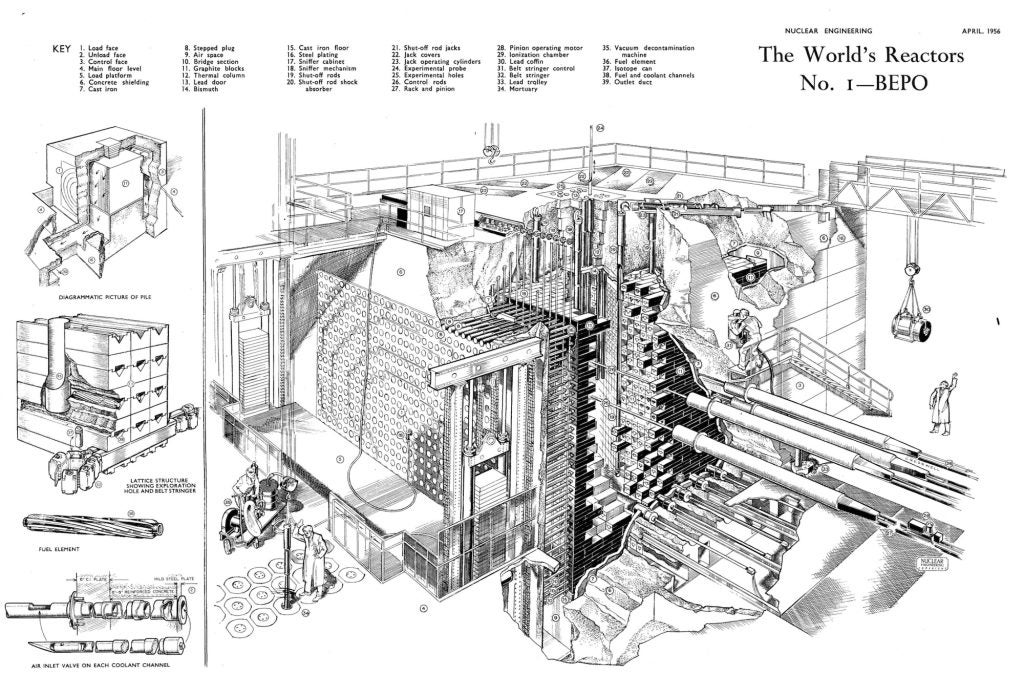
The result was a series of reactor designs, almost all unique in the world. Ironically only the first two Magnox designs were very similar, Calder Hall and Chapelcross, although they were built in parallel with one another, so there was no opportunity to benefit from the lessons of construction. Operationally though, a collection of different designs poses challenges for the owners of those plants. Maintenance is difficult, as each design will have its own issues, and securing replacements for critical components is costly and time-consuming. Other nations took a different approach. Exemplified in the extreme by the French who built 32 of the same design in the biggest rollout of standardised plants the global nuclear industry has ever known. They could have built more technically advanced plants at any point in that series. But instead chose to take the benefits of a large scale fleet, which has since served their nation well. This strategy came together with the chance to roll even small improvements out across the fleet with just one safety case made to the regulators, and with improved servicing and repair strategies in place.
As the years have gone on, the industry everywhere has woken up to the advantages of standardisation – and we see the epitome of that philosophy now in the move to SMRs.
Technology
It’s hard to imagine today the very basic technologies which were used to design the early reactors. Drawings made by hand on drawing boards. Sharing a design with someone outside that office meant getting copies made and posted to them. Having a discussion with someone outside your own office meant a landline phone call – assuming you could ensure both parties were at their phones at the same time – and exchange of written memos or letters taking multiple days, or else a journey to meet face to face. Research meant spending ages poring over documents in archives or libraries. And someone could only look at the documents which were physically in front of them.
Nowadays, of course, electronic technology means people all over the world can review and comment within minutes of an idea being floated or a draft design being shared. Information and expertise are always instantly available – wherever one is in the world.
Pace and scale of delivery
Perhaps counter-intuitively, given how much our electronic technology has improved the speed of communication and sharing of information, the pace of progress back in those days was very impressive by today’s standards. The world’s first commercial nuclear power plant, Calder Hall, began its design process in earnest in 1952 on the orders of the then Prime Minister Winston Churchill. Construction began in 1953, and the reactor was delivering electricity to the grid by the end of 1956. Design, construction and commissioning took less than four years. Read that sentence again – it’s not a misprint – and contrast with the pace of nuclear plant delivery today, when we have all the benefits of modern technology, instant communication, decades of prior experience and an established nuclear supply chain.
Perhaps in some ways the lack of technical means for a huge swathe of stakeholders (including the local communities) to discuss and debate decisions was an accelerating factor. Designers, regulators and constructors were trusted to know their stuff, make the right decisions and get the plant built in the context of a national mission to rebuild energy infrastructure and power the regeneration of the economy.
It isn’t only the pace of delivery which seems to have gone in the wrong direction since the beginning of the nuclear age. Capacity to deliver at scale has done the same. In the decade from the late 1950s to the late 1960s, the UK built no fewer than 21 nuclear reactors. As already noted, this was not a “cookie cutter” production line – every variant of power station was different from its predecessors.
Reputation
Back in the 1950s public perception of the nuclear sector was almost universally positive. Atomic weapons had helped to end the Second World War and the idea of harnessing the power of the atom for peaceful purposes was seen as a logical consequence. As time progressed, Harold Wilson talked of the UK benefitting from the “white heat of technology” in a famous address in 1963, which is credited as a major factor in his election as Prime Minister the following year. There is neither the time, nor probably the need, to explain here how that positive perception of nuclear energy has changed over the years. Events such as Three Mile Island, Chornobyl and Fukushima pushed nuclear to the front pages of the newspapers, as have – more recently – the conflicts which impact on nuclear facilities in places such as Ukraine and Iran. Concerns have been raised over potential links between nuclear plants and the health of local residents, around the transport of nuclear materials, around the links between civil and defence nuclear, around the treatment and management of waste, around the plans for the eventual disposal of that waste, and around the cost and time it takes to get new reactors built.
But on the other side of the argument, the role nuclear plays in reducing the emissions which contribute to climate change wasn’t even a consideration in the 1950s, yet that is a major factor in the way nuclear is perceived and accepted today. Similarly, the importance of energy security and the impact which volatile energy prices have on our overall economy are both much more important in the public mindset today, and both of those issues are now cited more by politicians as reasons to support nuclear than was the case previously.
Reactor size
The size of reactors has been on almost as much of a roller-coaster ride as public opinion. As we developed the early Magnox reactors, it was a case of “bigger is better” and plants became successively larger. Then the move to enriched uranium dioxide fuel for the AGRs meant that cores became smaller and more efficient – generating more power from less material. And that trend continued with the development of LWR technology.
But the advent of more commercial thinking around deployment of nuclear meant that the overall economics of a plant became more important. Economy of scale once again led to the design of bigger and bigger reactors. The original Westinghouse AP600 design was reviewed and stretched to become the AP1000. Its French counterpart – the EPR – is the biggest single generator of nuclear power of any plant ever seen. These reactors were the true giants of the industry in every sense. Yet they had almost become unaffordable. Only really open to investment from the major global economies with state-run energy industries – or highly contorted market mechanisms which could reduce the financial risks for commercial entities. So in recent years, the pendulum has been swinging back the other way again. SMRs and AMRs are the current technologies seen as holding the key to a widespread rollout of nuclear in both the traditional nuclear nations and – increasingly – a host of potential newcomer countries, which have not had the infrastructure or the finance mechanisms to realistically consider development of traditional GW scale plants. That AP1000 technology is now available in an SMR version – the AP300. Interestingly, the reactor cores of the Magnox plants at Wylfa – now the focal point for a new fleet of smaller reactors – were among the biggest anywhere in the world. The largest variant of a relatively inefficient, natural uranium-fuelled design.
Workforce
One of the most striking – and certainly one of the most welcome – changes in the sector’s 70-year history is the transformation of the workforce. That first issue of NEi is a stark illustration of an industry exclusively dominated by men in every way. But today’s nuclear sector is – thankfully – much more diverse. When I joined the industry in 1983, the only female colleagues I came across were in the typing pool, delivering the post or pushing the tea trolley. Nowadays, we see women in roles all across every nuclear organisation and – whilst there is still much more progress to be made – our workforce today is much more representative of the nation we live in.
That gender balance is matched by progress in all other characteristics too – especially in the younger entrants to our sector. Gender, race, sexuality and disability are no longer barriers to working or progressing in our industry, and long may that continue.
Changing and staying the same
Alongside all of this change however, some things have remained ever-present over the past 70 years. Our nuclear professionalism and our attention to detail.
Our relentless focus on safety and security – coupled with the recognition that these are fundamental to our “social licence to operate”.
Our drive for innovation and our creative talents for problem-solving. And perhaps most important of all, the pride we all have for the industry we work in and for the impact which that work has on the vital missions of the nation.
If we can continue to keep these aspects of our industry as strong as ever, and embrace change where it can help us, I’m sure the nuclear industry can go from strength to strength over the next 70 years and beyond.


