
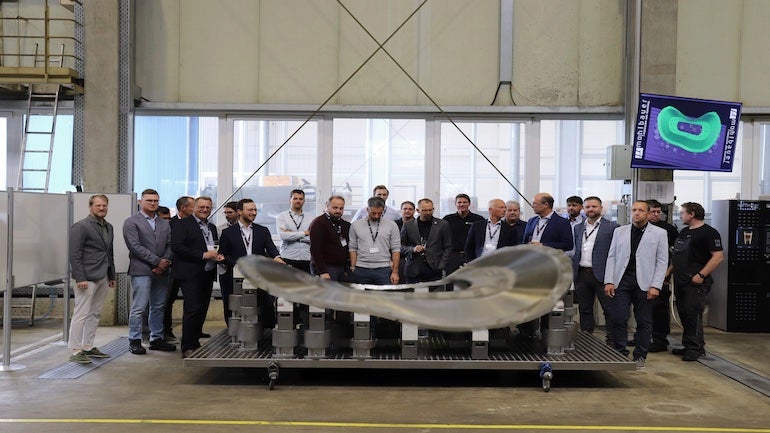
Three German industrial companies – Rolf Kind GmbH, Pro Beam GmbH, and Mühlbauer Maschinenbau – have manufactured the first structural radial plate for Proxima Fusion’s Stellarator Model Coil (SMC). This component is a critical step toward building commercial stellarator fusion power plants.
Munich-based Proxima Fusion is a spin off from the Max Planck Institute for Plasma Physics IPP. In March, Proxima signed a MOU with the Free State of Bavaria, RWE, and IPP outlining a roadmap to commercial fusion in Europe. In July, the company raised €411m ($449m) in a financing round, bringing the company’s valuation to €2.4bn.
Lindlar-based Rolf Kind GmbH forged and supplied the specialised base alloy engineered to withstand extreme electromagnetic forces and cryogenic conditions. Gilching-based Pro Beam GmbH joined the sections using the world’s largest civil electron-beam welding chamber, keeping structural distortion minimal. Runding-based Mühlbauer Maschinenbau executed the high-precision final machining required to meet tight industrial tolerances.
Unlike tokamaks that use flat, ring-shaped magnets, a quasi-isodynamic (QI) stellarator twists its magnetic field into a three-dimensional shape. Radial plates act as the structural backbone that holds high-temperature superconducting (HTS) cables in these non-planar grooves.
Proving that these twisted plates can be mass-produced to industrial standards directly informs the magnet manufacturing for Alpha, Proxima Fusion’s net-energy-gain demonstrator planned near Munich for the early 2030s, and Stellaris, its commercial power plant concept slated for the decommissioned Gundremmingen nuclear site.
“Power plants typically have large components. The challenge in fusion is that additional high mechanical loads must be absorbed, and with almost unimaginable accuracy,” said Pro Beam Managing Director Dr Thorsten Löwer, “Electron beam technology is perfectly suited for precisely this purpose, because it allows welding with minimal distortion and minimal influence on the base material. This helps to achieve high material qualities and tight tolerances, and thus very precise components for this new technology.”
Proxima Fusion Co-Founder & CEO Dr Francesco Sciortino noted: “For stellarator magnets, three-dimensional geometry is the central challenge, both in design and in manufacturing. Our engineers and industry partners must do this and solve challenges together. The radial plates are a tangible result of this collaboration: we now have a template for the structural components that will hold the high-temperature superconductor cables of our Stellarator Model Coil. Every delivery builds manufacturing experience that we take with us into the magnets for Alpha.”


