
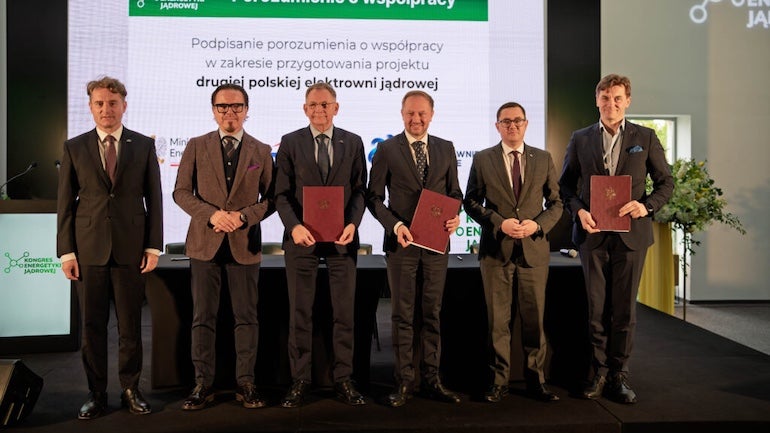
A cooperation agreement has been signed by Poland’s Ministry of Energy, nuclear project company Polskie Elektrownie Jądrowe (PEJ), and state-owned power company Polska Grupa Energetyczna (PGE) establishing the framework and individual responsibilities for preparing Poland’s second large-scale NPP.
This agreement builds on the updated Polish Nuclear Power Programme (PPEJ – Program Polskiej Energetyki Jądrowej) adopted in late September 2026, which outlines Poland’s path toward building 6-9 GWe of nuclear capacity.
Under the newly defined principles of cooperation, the tasks are split to leverage the unique capabilities of both state-backed companies. PEJ will serve as the main investor and project coordinator for the second plant, mirroring its role in the country’s first nuclear facility on the Baltic coast.
PGE will provide critical regional support by conducting site analyses, environmental assessments, and preliminary feasibility studies. PGE will also lead discussions and joint analyses alongside potential international technology suppliers. Studies will focus primarily on Bełchatów and Konin. Both sites currently host massive coal-fired power infrastructure managed by PGE, making them ideal targets for clean energy grid integration.
Minister of State Assets Wojciech Balczun said the synergy between PEJ and PGE “will allow for the efficient preparation of this strategic project and the use of the potential of both companies”. He added: “We are also committed to ensuring that the cooperation built around the nuclear programme is long-term, regardless of the political calendar, bringing benefits not only to the energy sector, but also to Polish companies, employees and cheap and stable energy sources for the entire economy.”
Deputy Minister of Energy and Government Plenipotentiary for Strategic Energy Infrastructure Wojciech Wrochna noted that the agreement allows the competences of both PEJ and PGE to be used in developing the second NPP. “Ahead of us are site analyses, feasibility studies and technology selection. We want to carry out this process in a competitive manner, so as to develop favourable conditions for the implementation of investments, taking into account not only technology, but also financing and long-term strategic cooperation.”
Construction for the second NPP is targeted to begin around 2032, with the goal of bringing the first reactor unit online by 2040. The primary objective of the pact is to streamline governmental administration, maximise state utility resources, and accelerate the multi-billion dollar shift away from coal reliance.
Poland is in discussions with strategic technology vendors from the US, France, and Canada. The state expects to finalise its choice of reactor technology and strategic partner in 2027, followed by an exact site selection in 2028.
The Ministry of Energy is conducting a “competitive dialogue” to select a comprehensive package that covers technology, financing, and long-term strategic partnership. The government is explicitly focusing on proven Generation III+ large-scale light-water reactors.
The primary vendors and technologies currently competing include:
- US Westinghouse Electric Company/Bechtel offering the AP1000 pressurised water reactor (PWR), which is already selected for Poland’s first NPP at Lubiatowo-Kopalino.
- Électricité de France (EDF) offering the EPR or EPR2 PWR pitching its high-capacity EPR fleet to European nations seeking energy sovereignty.
- Canada’s AtkinsRéalis (formerly SNC-Lavalin) offering the Candu Monark/Nuclear Systems Pressurised heavy water reactor (PHWR) which uses natural uranium, providing a distinct supply-chain alternative.
The signing of this new tripartite state agreement marks a major structural shift away from the previous separate commercial track involving South Korea’s APR1400 technology.
In 2022, PGE and private Polish energy group ZE PAK formed a 50/50 joint venture company called PGE PAK Energia Jądrowa. Working alongside Korea Hydro & Nuclear Power (KHNP), they initiated plans to build a separate, corporate-led nuclear plant using South Korean APR1400 reactors in Pątnów (near Konin). It received a preliminary “decision-in-principle” from the previous Polish government in late 2023.
In December 2023, the conservative Law and Justice (PiS) government was replaced by a broad pro-European coalition led by Prime Minister Donald Tusk. The new administration decided that allowing a semi-private, commercial entity to dictate the location and technology of critical national nuclear infrastructure was a risk to national energy security. They insisted that all large-scale nuclear rollouts must be centrally planned by the state.
In January 2025, the new government directed PGE to enter talks to buy out ZE PAK and the following October PGE signed a formal agreement to take 100% full ownership of PGE PAK Energia Jądrowa. This effectively killed the commercial venture and turned it into a fully state-owned asset. In the wake of a major international intellectual property dispute with US-based Westinghouse, KHNP withdrew from the Konin project in August 2025.
The policy shift became official government policy when the Council of Ministers formally adopted the updated Polish Nuclear Power Programme (PPEJ Program Polskiej Energetyki Jądrowej) in September.
Although the Polish Energy Ministry had invited the Koreans to bid through the official state tender for the state-led second NPP, the dispute with #Westinghouse made that impossible.
Westinghouse claimed that KHNP’s APR1400 reactor design relied heavily on proprietary US design heritage, meaning South Korea needed US regulatory permission to export it. In January 2025, the two companies signed a settlement agreement under which, to secure its contract to build APR1400s in the Czech Republic, KHNP accepted heavy geopolitical restrictions.
The settlement effectively barred KHNP from independently bidding on new nuclear plants across North America, the UK, Japan, Ukraine, and most of the European Union (except the Czech Republic). Consequently, in August 2025, KHNP that the company was withdrawing from the Polish project.
The decision was explicitly driven by a combination of Warsaw’s insistence on a state-led model and the restrictive clauses of the Westinghouse settlement. This cleared the path for PGE to buy out its private partners, fold the Konin site into the government’s overall plan and initiate the tripartite agreement.
A key priority is the development of the Polish supply chain. It is estimated that the share of Polish companies in the construction of the first reactor may reach approximately 40%. With subsequent plants, as the experience and competences of domestic enterprises increase, it may increase to as much as around 70%.
“Nuclear energy is of strategic importance for national security. Poland’s own stable energy sources strengthen its resilience to crises and reduce its dependence on external suppliers. That is why we are working not only on the first, but also on the second nuclear power plant,” said Minister of Energy Miłosz Motyka. “We want our businesses, workers and domestic industry to benefit from the implementation of this program. Therefore, already at the investment preparation stage, we focus on cooperation and development of competences of Polish companies.”


