
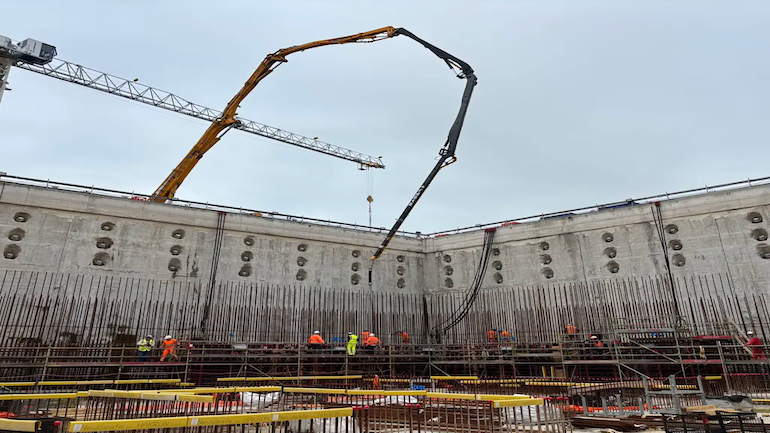
Phase 2 of the Pallas research reactor project in Petten, Netherlands, which was launched in September, is making steady progress. Pallas, designed to replace the ageing High Flux Reactor, remains on track to achieve full commercial operation by 2032.
Following completion of the underground -3 floor slab, teams are currently building out the -3 level outer walls and the Aircraft Protection Shell (APS). This initial phase covers the underground levels (-3, -2, and -1).
The walls are constructed in phases by installing formwork and reinforcement before pouring concrete. At the -3 level, the APS protection walls are poured in 12 sections. Two of these were poured in September, using a total of 275 cubic metres of concrete. Each concrete pour is a continuous operation lasting several hours.
To minimise risks on cracks in the concrete, a system of cooling pipes is installed inside the reinforcement. The cooling system is a network of pipelines and constitutes a big “refrigerator” that will be switched on when the concrete is poured. The system helps to prevent a temperature increase due to the chemical reaction of the cement with water, and consequent expansion of the concrete. Once the concrete cools down, the shrinkage caused by this temperature decrease is also reduced. The cooling system is then switched off. The pipes, which will remain in the concrete, will be filled with mortar, and will have no further function.
In October, work will start on the reactor building’s inner walls and on the first reinforcement for the reactor foundation, which will accommodate both the reactor pool and the service pool. Several key reactor components are also being manufactured in parallel, including the Heavy Water Storage Tank.
The construction pit for the secondary cooling system building currently contains approximately 15,000 cubit metres of water. Before this water can be safely discharged, its quality must meet the required standards. The teams are working towards obtaining the necessary permit confirming that these requirements have been met. Once the water has been discharged, access to the pit can be installed and the next phase of construction can begin.
In parallel, licensing and contractual preparations are underway for the horizontal drilling required for the inlet pipes of the secondary cooling system. The pipes have already been delivered and are temporarily stored at the construction site on the Zuiderhazerdwarsdijk – a coastal street and dyke area located just south of the village of Petten. It is located next to the Energy Research Centre Netherlands (ECN) campus where the Pallas Reactor Project is located. Because it is adjacent to the main building facilities, a portion of the land there is being used as an external staging and temporary storage area for the heavy infrastructure materials – specifically the massive cooling water inlet pipes awaiting horizontal directional drilling.
During Phase 3of the project (2027-2030), construction will transition from ground level to the roof. This stage will focus on the structural integration of complex specialised components such as hot cells and secondary cooling infrastructure.
Phase 4, commissioning and startup is set for 2030-2032. Civil construction is scheduled for completion around 2030. It will be followed by a two-year step-by-step testing programme, fuel loading, power ramp-up, and full regulatory validation.


