
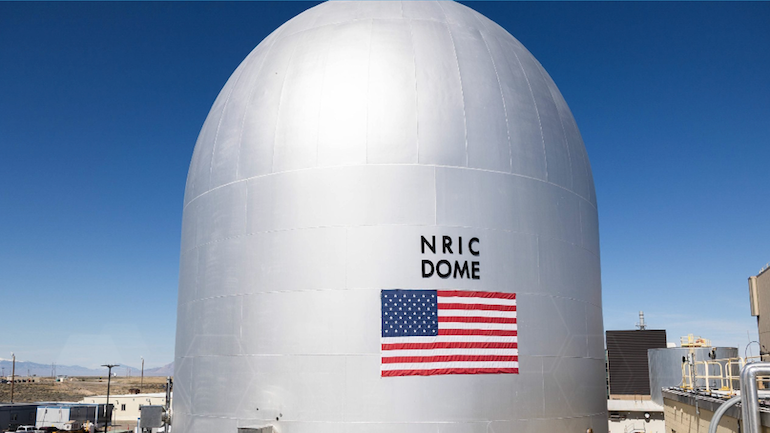
Deployable Energy, a Houston-based clean-energy startup, has been competitively selected by the US Department of Energy’s (DOE’s) National Reactor Innovation Center (NRIC) to conduct full-power trials of its Nuclear Unity Battery (NUB) microreactor. The testing campaign is scheduled for 2027 inside the Demonstration of Microreactor Experiments (DOME) testbed at the Idaho National Laboratory (INL).
DOME is an actual dome, 100 feet tall and 80 feet in diameter, built from the repurposed Experimental Breeder Reactor-II containment structure. The facility, which opened in April, is the world’s first microreactor testbed capable of safely housing fuelled reactor experiments producing up to 20 MWt.
Houston-based Deployable Energy will be the second company chosen to use the facility, following Radiant’s Kaleidos microreactor. Originally Westinghouse’s eVinci was expected to follow Radiant. DOME access is strictly managed based on rolling applications, technology readiness, regulatory approval speeds, and fuel availability. If a company falls behind on its preliminary milestones, another team can take their place in the queue. INL’s announcement confirms that Deployable Energy has now taken that second slot.
Deployable’s NUB a light-water moderated, helium-cooled transportable microreactor designed to generate 1 MWe. The DOME trial scales up the company’s existing footprint at INL. In July, its demonstration reactor achieved initial criticality under NRIC’s Nuclear Energy Launch Pad initiative. The trial will provide an opportunity to evaluate system performance, integration, controls, safety and operational procedures at increased scale.
The testing campaign is self-funded. The company must meet specific milestones throughout the process to maintain its allotted time in DOME and ensure efficient use of the test bed.
“We have a strong pipeline of companies interested in the DOME — and that’s exactly the kind of momentum we want to see,” said Brad Tomer, NRIC director. “It shows that developers recognise the value of the resources and data this testing capability provides as they push toward commercialisation.”
In October 2023 DOE and NRIC announced a combined $3.9m award divided among three specific advanced nuclear developers: Radiant, Westinghouse, and Ultra Safe Nuclear Corporation (USNC) to complete the Front-End Engineering and Experiment Design (FEEED) phase to test their microreactors inside the DOME structure. While Radiant and Westinghouse successfully advanced from this phase to secure a second round of DOE experiment design funding in 2024, USNC, struggling financially, was not and subsequently filed for bankruptcy.
In July 2025, DOE announced that Westinghouse and Radiant had been conditionally selected for the first two fuelled experiments inside DOME. Radiant was given the 2026 window, and Westinghouse a slot beginning in 2027. However, just two months later, Westinghouse notified NRIC that it would not be taking the 2027 DOME slot.
Instead, the company chose to complete zero-power, high-temperature criticality testing at the National Criticality Experiments Research Center (NCERC) in Nevada, operated by Los Alamos National Laboratory (LANL). As of October 2026, Westinghouse has not constructed a completed, fully operational eVinci microreactor and is testing separate components.
NCERC allowed Westinghouse to build a temporary, uncooled configuration of the eVinci core using real TRISO fuel and graphite and to achieve zero power criticality. In Pittsburgh, Westinghouse has also built full-scale, non-nuclear test loops for the alkali metal heat pipes used to pull heat away from the reactor core. In short, Westinghouse has built the “engine blocks” and the “cooling systems” separately to prove they work, but has not yet assembled the final, completed vehicle.
Westinghouse has also pulled out of its collaboration with the Saskatchewan Research Council (SRC) which was intended to bring Canada’s very first operational microreactor to the province. In 2022, SRC agreed to explore the eVinci microreactor and in November 2023 the Government of Saskatchewan committed CAD80m ($56m) to SRC to fully purchase, licence, and establish a first-of-a-kind eVinci demonstration reactor, with the aim of having have a 5 MWe unit fully operational by 2029.
In early 2025, Westinghouse signed manufacturing agreements with local Saskatchewan engineering and welding companies to build critical reactor components and partnered with the University of Saskatchewan (USask) to perform environmental and economic analyses on deploying the microreactor.
However, in October 2025, Westinghouse cancelled the commercial eVinci work and abruptly dissolved the contract with SRC. The company determined that the near-term commercial grid market was scaling too slowly. Instead, 100% of their microreactor resources were pivoted toward space, defence, and government contracts (such as powering military bases and space exploration initiatives), where federal funding is immediate and massive.
Westinghouse’s immediate return to DOME is on hold. NRIC confirmed that a new competitive application round will be announced in 2027 to determine which companies follow Deployable Energy into the testbed. Westinghouse will have to formally re-enter the queue through a highly structured, merit-based process and must satisfy explicit criteria and regulatory milestones.


