
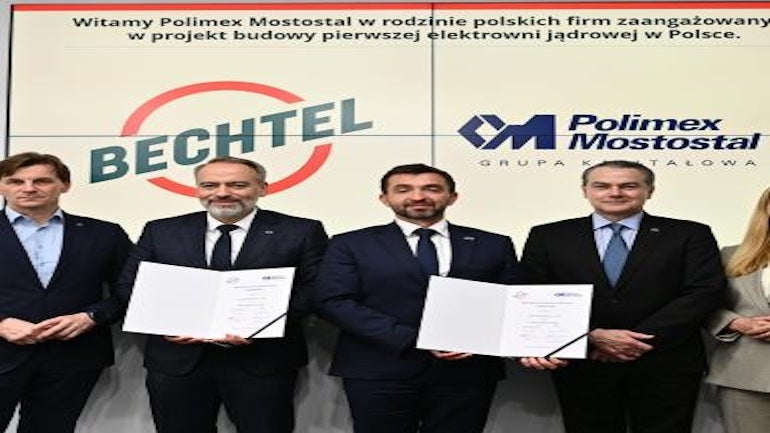
Polimex Mostostal, Poland’s largest engineering and industrial construction corporation, has concluded a contract with Bechtel, the general contractor for Poland’s first NPP, for the supply, assembly and commissioning of two large-scale modular assembly buildings (MABs) at the NPP site in Pomerania.
This comes shortly after agreement was reached on the main commercial and legal terms between project company Polskie Elektrownie Jądrowe (PEJ) and the Westinghouse-Bechtel consortium establishing the core framework for the upcoming Engineering, Procurement & Construction (EPC) contract for Poland’s first NPP.
The plant will feature three Westinghouse AP1000 reactors with a combined capacity of 3,750 MWe at the Lubiatowo-Kopalino site in the Choczewo commune in the northern Pomerania province. The first nuclear concrete pour is targeted for 2028, and the first electricity is expected to flow to the Polish grid by 2036. PEJ handed the project site over to Bechtel in August.
The PLN 292.17m ($75.7m) net design-and-build contract signed between Polimex Mostostal and Bechtel Polska marks a major operational milestone for Poland’s first NPP. A consortium consisting of Polimex Mostostal and its subsidiaries (Polimex Budownictwo and Polimex Energetyka) will construct two massive MABs each as tall as a 12-story office building, with a total footprint larger than a standard football pitch.
They are the largest logistical components built ahead of main construction. Because Westinghouse’s AP1000 technology relies on modular prefabrication, these halls act as the on-site “factory floor”. Huge structural components are shipped to the site in sub-sections and put together inside these climate-controlled structures before being lifted into the reactor island.
The buildings are massive, temporary industrial structures engineered to withstand heavy internal lifting loads built on heavy reinforced concrete piles and concrete columns to handle immense downward pressure. The shell is a structural steel load-bearing frame completely sealed with specialised insulating sandwich panels and an advanced weather-tight roofing system.
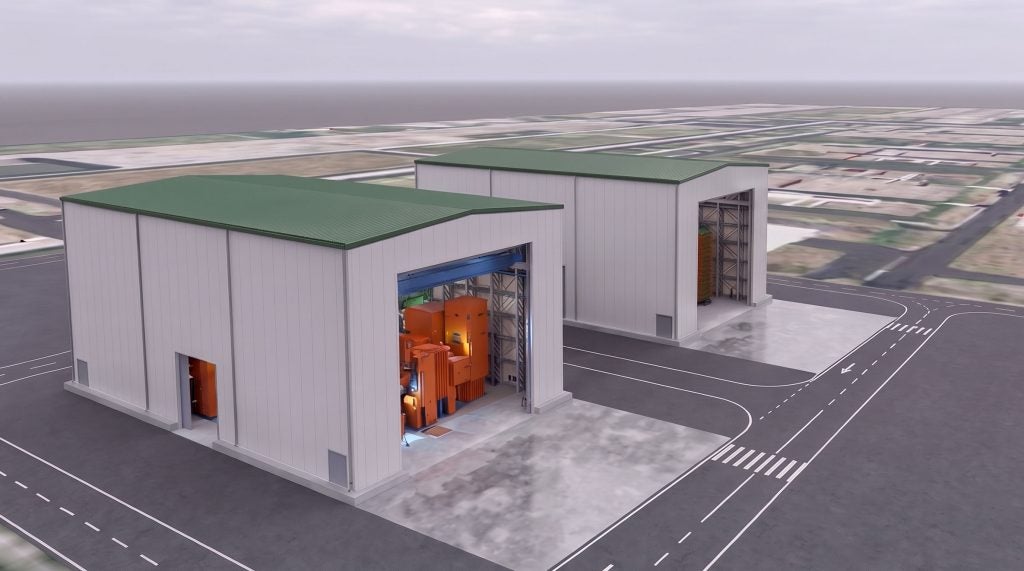
To move modules that are too heavy for standard logistics, each hall will be outfitted with an independent, high-capacity internal crane network. This includes two 125-tonne overhead cranes operating in tandem for heavy lifting and one 60-tonne overhead crane engineered specifically for high-precision component manoeuvring, alignment, and final joining. The facilities are fully climate-controlled, illuminated, and powered to allow around-the-clock assembly, testing, and regulatory inspections regardless of Pomerania’s winter weather conditions.
The MABs are positioned directly adjacent to where the three nuclear units will be erected. Inside, crews will piece together:
- The CA01 structural module – a massive steel-concrete hybrid structure weighing over 1,000 tonnes that houses the reactor vessel, steam generators, and pressuriser.
- Containment infrastructure – multi-tonne containment rings, containment vessel roofs, and modular steel panels that form the ultimate protective outer shield building.
- Mechanical skids – piping manifolds, electrical raceways, and heavy structural decks.
According to Bechtel Polska, these assembly halls will be the very first major permanent structures completed on the Lubiatowo-Kopalino site, paving the way for the official nuclear concrete pour slated for late 2028.
The consortium has 1,158 days to complete the design, permit acquisition, material supply, structural assembly, and final handover. Main construction is targeted for 2028–2029. Once all three AP1000 reactors are structural complete and their containment domes are sealed, these assembly halls no longer serve an active purpose. Once construction wraps up, the structures are disassembled to clear the landscape, fulfil environmental recovery permissions, and secure the strict site boundaries required for an operational nuclear site.
“The nuclear power plant is a pillar of our energy security, but also one of the most important industrial projects for the future of the Polish economy,” said Minister of Energy Miłosz Motyka. “That is why we consistently work for the widest possible participation of Polish enterprises – not only in the implementation of the current investment, but also in building their sustainable competitiveness. This contract shows that the domestic supply chain is already strengthening: Polish companies are gaining orders, experience and competences in one of the most demanding technological projects.”


