
US start-up Antares Nuclear has announced a partnership with UK-based Motion Applied (formerly McLaren Applied) to incorporate Formula 1 race-tested power electronics directly into its nuclear microreactor power-conversion systems. By using Motion Applied’s existing, production-grade technology rather than designing custom components, Antares aims to significantly accelerate the development and deployment of its microreactors.
In June, Antares achieved initial criticality of its Mark-0 microreactor under the US Department of Energy (DOE) Reactor Pilot Program. Mark-0 was the first of four advanced reactors to go critical by the 4 July deadline set by President Trump in his May 2025 Executive Order (EO) 14301, Reforming Nuclear Reactor Testing at the Department of Energy.
The company is targeting 2027 to operate its Mark-1 reactor to generate electricity for a six-month test window. Backed by a $1.1bn US government contract backlog and part of the US Army’s Janus Program, Antares plans to deliver production-grade installations to US military bases, specifically targeting Fort Bragg and Joint Base San Antonio by September 2028.
In Torrance, California, Antares operates a 145,000-square-foot facility optimised to mass-produce up to 10 factory-sealed microreactor units a year. It also has offices in Idaho Falls and Aiken, South Carolina. The company bypasses conventional commercial timelines by framing its reactors as vital defence assets.
The Motion Applied hardware has been developed under the extreme duty cycles of high-performance motorsport, manufactured at volumes the nuclear industry has never approached, and qualified against reliability standards forged on production runs measured in the millions.
Motion Applied has evolved over nearly four decades from a specialized Formula 1 racing branch into a standalone industrial powerhouse. The company was founded in 1989 as TAG Electronic Systems by former McLaren boss Ron Dennis, to provide real-time racing telemetry. Operating as McLaren Electronic Systems (and later McLaren Applied), the company has supplied control units to F1 since 1993.
The Fédération Internationale de l’Automobile (International Automobile Federation) selected them as the sole supplier of the Standard Electronic Control Unit (SECU) for all F1 teams for the 2026–2030 seasons in November 2022. The company was acquired by Greybull Capital from the McLaren Group in 2021, andrebranded to Motion Applied in mid-2025 to reflect its status as an independent, Tier-One technology partner. The partnership with Antares transitions power electronics designed for extreme F1 duty cycles into critical infrastructure, trading “nuclear-specific solutions” for highly reliable, ultra-durable motorsport hardware.
“The nuclear industry has never lacked for brilliance. Its instinct has traditionally been to design the hard thing itself,” said Dr Rian Bahran, Chief Nuclear Officer at Antares. “But vertical integration is a tool, not a binding principle. Automotive has put decades and enormous capital into power electronics R&D, at a scale nuclear has never had the market to support. This partnership recognises the brilliance of the automotive industry. We are harnessing a proven solution faster and at a fraction of the cost. Our reactor makes about as much electricity as one high-performance car, and that means a century of engineering is available to us.”
Luiz Oliveira is the Product Development Engineer who leads the technical development of the power-conversion programme and supports the supply chain at Antares. He is the strategist responsible for bridging the gap between high-performance motorsport technology and next-generation nuclear energy. Before pivoting to nuclear energy, Oliveira spent a decade working at the peak of high-performance automotive and motorsport engineering
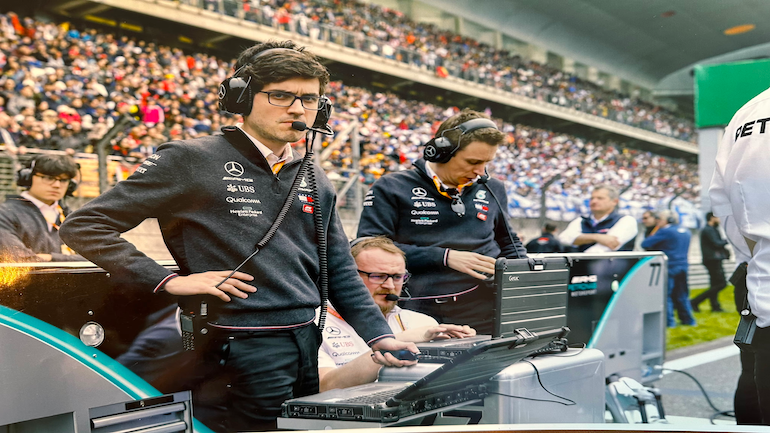
In 2019, he ran the ultra-complex hybrid power unit on Valtteri Bottas’s car for Mercedes-AMG High-Performance Powertrains during a championship-winning season. He served as a trackside race engineer with Honda Performance Development and led the vehicle validation and development of a massive 950kW hybrid powertrain for Czinger Vehicles in Torrance.
The operational model for the Antares power conversion came directly from Oliveira’s job interview. When asked by a technical panel to pitch a reactor architecture, he argued that Antares should completely abandon the nuclear industry’s traditional “bespoke, custom-built” approach. Instead, he proposed using existing Formula 1 componentry.
“This partnership shows how technology developed for the highest levels of motorsport can be transferred into critical infrastructure,” said Samir Maha, CEO at Motion Applied. “Our power electronics are built to perform in environments where efficiency, durability and reliability are non-negotiable. Working with Antares allows us to apply that capability to a new generation of compact power systems, where proven technology can help accelerate deployment and reduce technical risk.”
In Torrance, Antares machines, assembles, and tests reactor. Plenty of parts remain bespoke such as nuclear-grade graphite, certain forgings, specialty instrumentation. Those only get cheaper as the order book grows. However, everything else is judged by whether building it make the reactor better. The approach positions Motion Applied as more than a component supplier. It places the company’s proven electrification and control capability at the centre of Antares power-conversion strategy.
“We’re a lean company with a hard problem, and the only way to solve it is to be ruthless about what we work on,” said Jordan Bramble, CEO of Antares. “We said we’d have electricity in 2027, and reactors installed in 2028. Cut the bespoke parts, buy the proven ones, and you’re manufacturing a reactor instead of commissioning one. That’s what it takes to build a fleet rather than a first.”


