
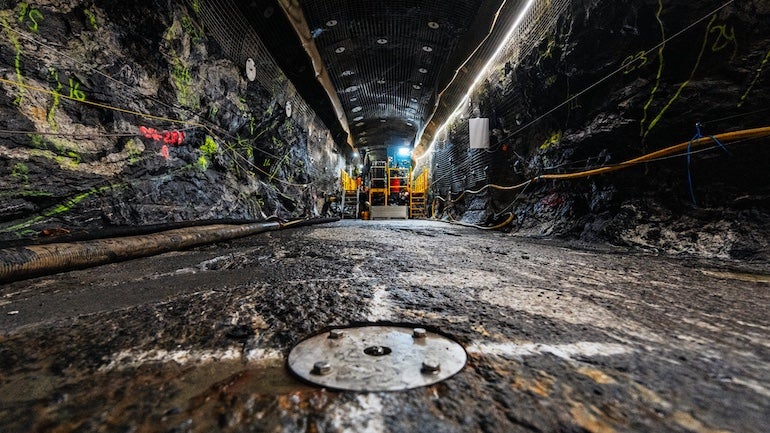
Finland’s nuclear waste management company, Posiva has begun drilling the very first deposition hole for the permanent disposal of used nuclear fuel within the bedrock at the Onkalo repository near Olkiluoto at a depth of more than 400 metres. This marks the transition of the world’s first deep geological repository from a framework of construction and commissioning into active disposal operations.
The Deposition Hole Boring Machine (DHBM) is cutting into stable, solid Finnish granite that is approximately 1.9bn years old. To meet safety regulations, the huge boring machine must drill the holes with extreme accuracy, staying within 25mm of its centre line along its entire length. The initial disposal tunnel spans about 330 metres long and is designed to eventually hold around 30 deposition holes.
The first three completed holes will undergo enhanced geometric and quality inspections. Posiva will verify these individually before accepting them for a final used nuclear fuel canister and starting series production. The campaign was launched with five DHBM operators and two rotating supervisors. While normal production crews will only require three people, the extra staff allows for the training of two new operators during initial operations.
“The final adjustments to the equipment were made during the morning and early afternoon, and before long the drill was already getting to work on the rock,” said Kimmo Lehtola, Posiva’s Construction Manager for Operations. “We have already practiced with a couple of holes and preparations for the drilling of the actual deposition holes have been ongoing for quite some time; this day has been much anticipated by our team. It is great to have the opportunity to drill for the first time a hole which will actually become part of the final disposal process.”
This operational step follows an assessment earlier in August by Finland’s Radiation and Nuclear Safety Authority (STUK – Säteilyturvakeskus), which confirmed that Onkalo met all necessary safety requirements. The Finnish government is expected to issue the formal operating licence in the autumn, keeping Posiva on track for full operational readiness by the end of 2026. Once fully sealed, the repository is designed to isolate the highly radioactive waste in copper canisters encased in bentonite clay for 100,000 years without requiring human maintenance.
The deposition hole is where a final disposal cannister containing used nuclear fuel will finally be placed. The hole under construction is being drilled vertically into the floor of a previously excavated final disposal tunnel. The finished hole has a depth of 8.4 metres and a diameter of 1.75 metres. The first deposition holes will undergo more stringent checks than normally.
Posiva said the monitoring of the straightness of the hole does not rely only on post-drilling measurements. The drilling machine also monitors its position the whole time during the drilling operation. If any deviations are detected, the position of the machine can be adjusted with control cylinders during the work. If the permitted deviation is exceeded despite the monitoring, the hole will be rejected from final disposal use.
The DHBM boring machine, manufactured by Herrenknecht, arrived in Olkiluoto four years ago from Germany. It is nine metres long, a little over three metres wide and almost four metres talland weighs 78 tonnes. The machine also needs to be accompanied by a 22-tonne energy unit responsible for electricity and power supply, as well as an 18.5-tonne separator which separates loosened rock fragments from the water used in drilling. The drilling of a large hole produces large amounts of cuttings that have to be removed.
According to Lehtola, the drilling of an eight-metre hole takes about ten hours of effective drilling time. “The harder the rock, the slower the drilling process, but ten hours is a pretty good rule of thumb in our conditions, he noted. However, most of that time is spent doing something other than drilling – preparing and positioning the machine, removing it, and transfers. Time is also needed for the cleaning and drying of the finished hole. Once the drilling operation becomes part of the normal production process, the goal is to produce about two finished deposition holes a week.


