
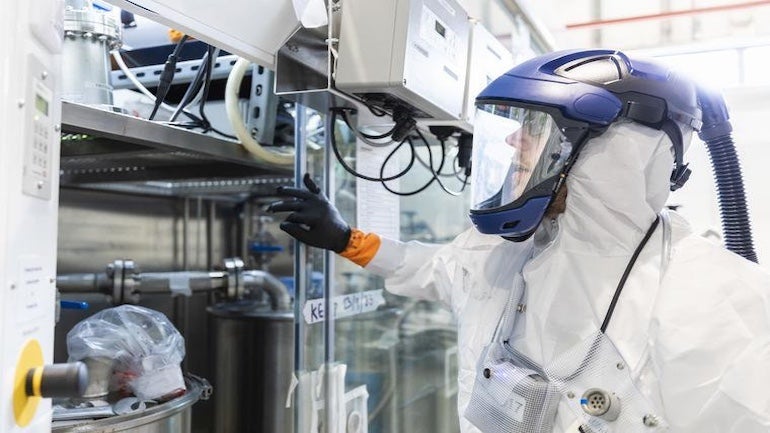
The UK Atomic Energy Authority’s (UKAEA’s) Materials Detritiation Facility (MDF) at Culham in Oxford has been upgraded and restarted enabling key research into materials which have been removed from the closed Joint European Torus (JET) facility.
Restarting the MDF is critical for analysing components exposed to deuterium-tritium plasma during JET’s historic final runs. Understanding how tritium interacts with and retention occurs within these materials is vital for designing durable components for future reactors like ITER and DEMO.
During the last three years of plasma operations, JET’s deuterium-tritium (DT) experiments resulted in residual tritium being retained within the tokamak’s walls and internal components. This reflected the isotope’s tendency to permeate into materials during high-powered fusion operations. Understanding how much tritium is retained within the materials, and how much can be removed through thermal treatment, will be essential in developing a waste management strategy for JET Decommissioning and Repurposing (JDR).
In the early 2020s UKAEA waste experts undertook initial research on tritium removal from these materials at Culham’s tritium analysis laboratories. By recovering tritium, UKAEA’s waste teams can greatly reduce disposal costs for materials such as tungsten, beryllium, Inconel, steel, copper and carbon-fibre composite. When they are initially removed from JET, these materials are classified as Intermediate Level Waste. By removing tritium, they can be reclassified as Low Level Waste, which is up to 10 times less expensive to dispose of, or even to be recycled into future fusion or fission machines.
Experimental trials on tiles and components removed from JET in late 2024 showed that they can be treated without prior disassembly. The trials also demonstrated that mixed material streams can also be processed simultaneously, replicating what would happen in an industrial-scale treatment facility.
To remove the retained tritium, the materials are heated to elevated temperatures in the MDF furnace under carefully controlled conditions designed to minimise oxidation. Limiting oxidation improves the efficiency of the process, reducing maintenance requirements, and helps to ensure the process remains safe and effective. Tritium released during heating is carried from the furnace by the process gas stream and passed through a catalyst that converts gaseous tritium species into tritiated water, enabling its efficient capture. Once the furnace has cooled, the thermally treated contents are taken out and subjected to destructive sampling for further analysis.
In addition to this thermal treatment, gram-scale samples from JET are being analysed to determine concentrations of other radionuclides and to quantify the amount of tritium remaining in the materials after treatment.
“This first-of-a-kind operation represents a significant milestone for JDR and would not have been possible without the dedication and the professionalism of the team which has delivered the sample retrieval runs in the MDF,” said Xavier Lefebvre, Head of Waste at JDR. “Successful processing of these samples gives us access to evidence that has simply not been available before, allowing us to better understand the nature of JET materials and the challenges associated with their long-term management.”
He added: “The insights gained from this work have the potential to fundamentally influence the future waste strategy for JDR, reducing uncertainty and enabling more informed decisions on waste treatment, packaging, disposal routes and decommissioning planning. By improving the evidence base that underpins these decisions, the work may also demonstrate more proportionate waste management solutions and a better understanding of long-term liabilities.”
The engineering work completed in the MDF represents a significant step forward in capability. The 12-month engineering pause focused on scaling up the facility’s overall processing capacity, transitioning it from a localised R&D setup into a robust industrial-scale operational line. The work was led by the UKAEA Tritium Fuel Cycle division. The enhancements ensure the site can systematically process large volumes of heavy components extracted from JET.
The main thermal treatment furnace and its peripheral gas-handling systems were structurally upgraded. This shifts the facility away from the small-scale 2g to 10g batch pyrolysis limits used in the standard Tritium Analysis Laboratories. The furnace controls were refined to tightly regulate oxygen and temperature parameters. This precision is required to manage complex oxidation layers on materials such as tungsten and beryllium, which natively act as a barrier and block tritium extraction if treated improperly.
Upgrades were applied to the direct gas-handling system, which feeds out of the high-temperature furnace. This guarantees that all gaseous tritium driven off the heated metals is securely captured in water, preventing environmental discharge and prepping the tritiated water for downstream extraction at the JET Water The specialised fume cupboard process line, air handling units, and redundant extraction fans underwent performance optimisation. This ensures reliable negative pressure and steady airflow through the facility’s high-efficiency particulate air filters during bulk processing.
Critical safety interlocks, beryllium monitoring equipment, and carbon monoxide detectors were overhauled and calibrated to safely handle heavily contaminated Intermediate Level Waste (ILW). System diagnostics monitoring real-time beta- and gamma-emitting radionuclides at the exhaust stack were upgraded to maintain safe radiological boundaries during continuous, high-throughput material baking.
These targeted structural changes allow the facility to systematically down-classify massive metal components – such as Inconel, steel, copper, and carbon-fibre composites – from costly ILW to Low Level Waste, slashing UKAEA disposal fees up to tenfold.
By removing retained tritium from materials and reducing the volume of higher-activity waste requiring specialist management on site, the MDF directly supports UKAEA’s broader mission to protect people and the environment while demonstrating that fusion decommissioning can be done safely, responsibly and effectively.
As well as processing UKAEA’s legacy waste, the MDF is available for use by companies and organisations undertaking similar cutting-edge research in waste and materials management. Contact the Tritium Fuel Cycle team for more information.
“It is an excellent example of how innovation, scientific ambition and operation can come together to deliver benefits not just for today’s programme, but for the future of fusion decommissioning,” said Lefebvre. “This achievement also highlights the unique capabilities we have developed at UKAEA and the critical role that facilities such as the MDF can play in addressing some of the most complex challenges facing fusion waste management.”


