
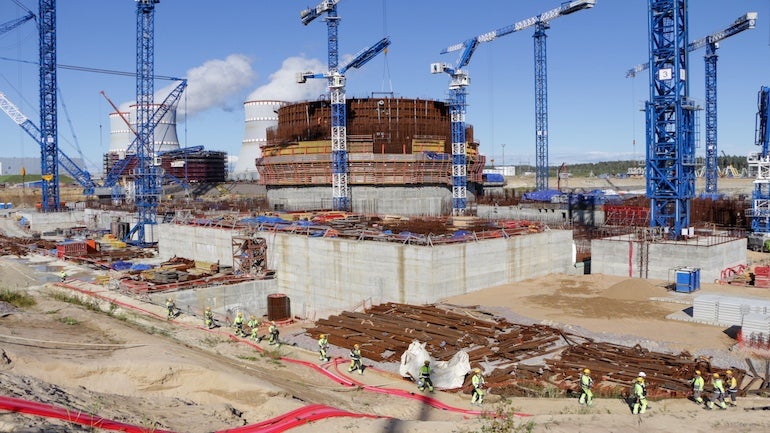
Rapid progress is being made at Russia’s Leningrad NPP. The first tier of the internal containment for unit 8 (also known as Leningrad-II unit 4) has been installed almost a month ahead of schedule. Installation of the steel structure weighing 97 tonnes was carried out using a heavy crawler crane. Workers from general contractor employees Titan-2 completed the operation in about seven hours, following several months of preparation. This included manufacturing elements, applying a protective coating to them before their assembly and welding on a slipway next to the reactor building.
This took place about a week after the melt trap (melt localisation device or core catcher) was installed just days after reinforcement and concreting of the annular corridor for the reactor building was completed. The 157-tonne steel housing for the melt localisation device was successfully installed in the reactor shaft after Titan-2 completed the complex lifting operation in a single 8-hour shift, hitting the milestone three months ahead of the original project timeline.
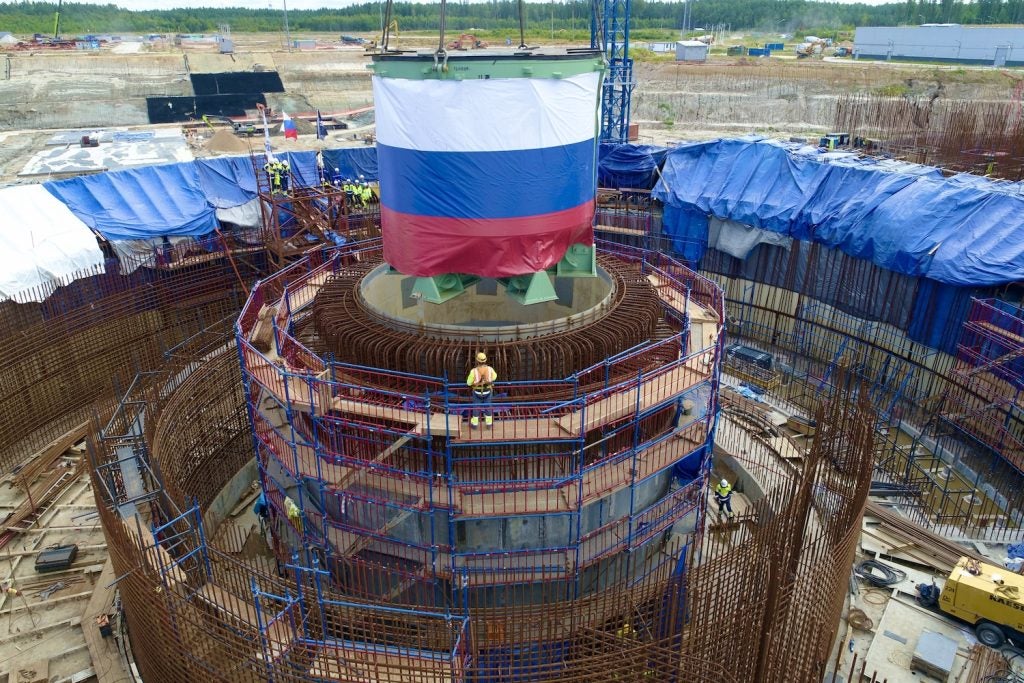
The installation followed the fast-tracked pouring of concrete for the unit’s reactor shaft structures. The core catcher components arrived at the Sosnovy Bor site via a 2,000-kilometre river-and-sea journey from the manufacturing plant in Syzran. The melt trap is a key passive safety feature for Generation III+ VVER-1200 reactors. In the highly unlikely event of a meltdown, it is designed to catch, retain, and cool molten core materials within the containment structure to prevent environmental leakage.
Following this installation, the sequential placement of the remaining internal core catcher components and the reactor support frame continued. The nuclear reactor vessel is slated for installation in the second half of 2029, with full unit commissioning expected by 2032.
With the first tier of the internal containment in place, work will now continue to complete the structure. “We have started producing stamps for the second tier, which we also plan to install this year,” said Konstantin Khudyakov, Director of the programme for Leningrad NPP facilities at Titan-2. “Then, step by step, the steel structure will rise higher and grow to the top where the dome will be installed.… Additionally the hermetic lining on the outer surface will result in powerful walls made of reinforcement and special concrete, which will be strengthened with steel ropes. The structure will reliably perform its function of containing the effects of events in the reactor building.”
The construction of the inner containment is scheduled for completion in 2029, after which work will begin on the outer containment, which will protect the reactor installation from external influences events, both natural and man-made.
The double containment, including the cylindrical part and the dome, will be ready in 2030. By then, all internal building structures of the reactor building will be completed and its main equipment, including the nuclear reactor, will be installed. This installation will take three years. The double containment is a distinctive feature of the Russian power units with VVER-1200 reactors.


