
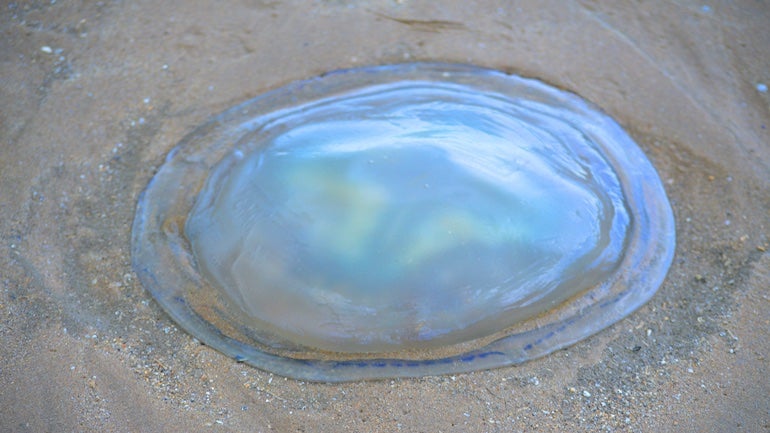
A massive influx of jellyfish into the pumping stations of the Gravelines NPP in northern France has led to the shutdown of units 2, 3 and 4 and a reduction in power output at unit 1 – all 900 MWe pressurised water reactors. Only unit 6 is operating at full capacity, with unit 5 closed for scheduled maintenance. The jellyfish consist primarily of Rhizostoma octopus (commonly known as the barrel jellyfish, which typically grow to between 10cm and 40cm in diameter.
Local fishermen had to intervene to haul out over 26 tonnes of jellyfish blocking the intake channels.Plant operators and environmental experts note that while jellyfish are a typical seasonal presence in the North Sea, climate change, warming marine waters, and overfishing have dramatically increased the frequency and scale of these swarms.
This is the second time Gravelines has been forced into major operational shutdowns by jellyfish. The first incident occurred a year ago in August 2025 when a swarm of jellyfish jammed the filter drums of the seawater pumping stations. This caused four of the plant’s six reactors to shut down automatically. Because the other two reactors were already offline for scheduled summer maintenance, the blockage brought the entire plant completely offline. It took around 10 days to safely reconnect all units to the national grid.
The Paluel NPP in Normandy is the French plant that has faced reactor shutdowns due to jellyfish swarms. The plant experienced a significant disruption in early September 2025 when a massive swarm of jellyfish drawn from the English Channel overwhelmed and clogged the seawater intake filters used to cool the facility’s reactors. Plant operator EDF was forced to shut down the 1,300 MWe unit 4 and scale unit 3 slashing the plant’s generation capacity by 2,400 MWe.
France relies on nuclear energy for roughly 70% of its electricity. To cope with the climate-driven heatwaves and low river levels that plague inland facilities, coastal stations like Paluel and Gravelines are vital because they rely on the sea for cooling. However, warming waters in the English Channel and North Sea have significantly widened the breeding windows for native and invasive jellyfish, leading to these explosive, filter-clogging population booms.
Currently, as of 11 August, four French reactors are closed because of the dought and heatwave. These are Golfech 2 (1,310 MWe) on the Garonne River, Cattenom 1 (1,300 MWe) on the Moselle River and Chooz 1&2 (each 1,450 MWe) on the Meuse River. In addition, the following units have their output restricted: Bugey 2&3 (910 MWe each) and St Alban 1&2 (1,335 MWe each) on the Rhône River, Cattenom 4 (1,300 MWe), Nogent-sur-Seine 1 (1,310 MWe), and Civaux 1&2 (1,495 MWe each) on the Vienne River.


