
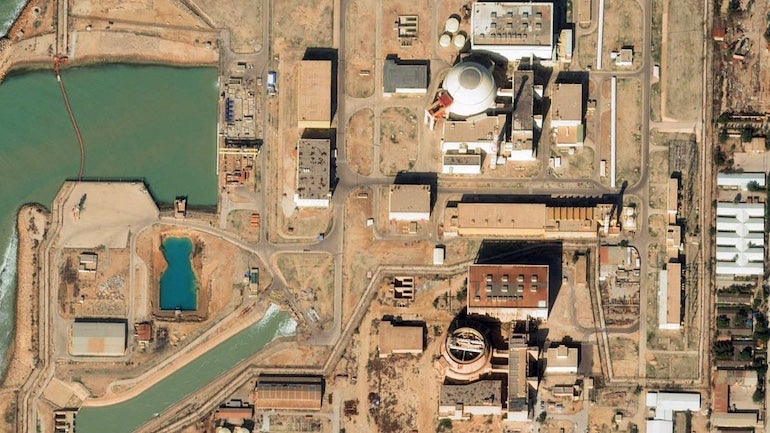
Rosatom has said it intends to send several dozen more employees to Iran’s Bushehr NPP within two weeks, building its total project staff up to 100 by autumn 2026. This expansion is strictly conditional on there being no further escalation of the conflict between the US and Iran.
On 28 February, the joint military offensive by the US and Israel against Iran prompted severe security risks for foreign workers. Rosatom progressively drew down its presence throughout March and April due to the threat of airstrikes near the 1,000 MWe unit 1 reactor, which continued to operate. By mid-April Rosatom had evacuated almost all personnel. It left behind a skeleton crew of 20 managers and safety operators to handle basic equipment integrity.
Moscow warned that military strikes targeting the immediate vicinity of the plant risked triggering a radioactive catastrophe comparable to the 1986 Chornobyl disaster. Following a brief ceasefire in April and a subsequent collapse of a peace framework in July, the situation has stabilised enough for a phased return of technical personnel.
Rosatom Director General Alexey Likhachev confirmed that construction continues on the site’s auxiliary buildings for power units 2&3. If stability holds over the coming weeks, the company expects to reach its 100-person operating threshold by the autumn.
The Iranian news agency Mehr quoted Likhachev as saying: “We have begun repatriating specialists to the construction site…. The first five engineers and technicians have arrived at their accommodation and begun their work – this brings the total number of Russian specialists to 25.”
The Bushehr NPP is Iran’s first commercial nuclear reactor and the first civilian NPP built in the Middle East. Its development spans five decades, transitioning from a West German industrial project into a major symbol of Russian-Iranian geopolitical and technological cooperation.
In 1974, Shah Mohammad Reza Pahlavi launched an ambitious energy initiative aiming to generate 23,000 MWe of nuclear power within 20 years. In 1975, Iran signed a multi-billion-dollar agreement with Kraftwerk Union (a subsidiary of West Germany’s Siemens) to build two 1,200 MWe pressurised water reactors. Construction on unit 1 was almost complee before the 1979 Iranian Revolution.
The new Islamic regime halted the project, and Kraftwerk Union completely withdrew from Iran. During the eight-year Iran-Iraq War (1980–1988), the reactor structures at Bushehr were heavily damaged by repeated Iraqi bombing. Following the war, Iran attempted to re-engage Siemens to finish the project but Siemens refused in face of intense diplomatic pressure and trade sanctions imposed by the US.
In 1995, Tehran and Moscow signed an agreement for Russia’s state-owned entity Atomstroyexport (part of Rosatom) to complete unit 1. The project became entirely unique because Russian engineers had to perform the highly complex task of retrofitting their own VVER-1000 light-water reactor technology into the existing, war-damaged German infrastructure.
Commercial startup was delayed for nearly 15 years by technical incompatibility, funding disputes, and global pressure over Iran’s broader uranium enrichment programmes. However, Russia began supplying safeguarded fuel in late 2007 and unit 1 was connected to the grid in 2011 and full operational control was transferred to Iran in 2013.
In 2014, Russia and Iran signed a contract to construct two additional units (2&3) – Phase 2 – at the same site. Preliminary site construction began in March 2017, but construction has faced direct impacts from the ongoing geopolitical conflicts and funding difficulties.
Phase 2 represents a $10bn investment designed to add 2,100 MWe of capacity to Iran’s national grid. The primary financial and payment disputes that delayed Phase 2 stemmed from a critical €500m ($577m) debt backlog accumulated by Iran, exacerbated by heavy Western banking sanctions. These interlocking financial disruptions severely slowed down construction by restricting Rosatom’s ability to finance supply chains and pay contractors.
US and international financial sanctions blocked Iran from using standard global banking networks to transfer funds to Russia. In September 2021, AEOI Chief Mohammad Eslami flew to Moscow to negotiate an emergency instalment plan with Rosatom to clear the debt gradually. In May 2023, Russian Deputy Prime Minister Alexander Novak visited Tehran and formally confirmed that the debt issues had been largely resolved and reduced through specialised alternate financing mechanisms. Despite all these difficulties, Rosatom continues to classify Phase 2 as a top-priority project.
Unit 2 is structurally much further along than unit 3, featuring an upgraded AES-92 Generation III+ design using a VVER-1000/V-392 reactor system. Construction began in March 2017 and first concrete pouring was poured in November 2019. The reactor’s core catcher was installed in 2024. In January 2026, domestic engineering teams completed installation of the third ring of the internal containment building, raising the structure’s height to 40 metres. The fourth containment ring is scheduled for installation later this year.
Despite the temporary stoppage due to airstrikes in March, site work has resume with some 2,200 Iranian contractors working on reinforcement and concrete casting for the primary reactor building. Iran has revised the target operational date for unit 2 to 2029 due to the delays.
Unit 3 is in the preliminary phases of structural engineering. Initial heavy excavation and site preparation works began in January 2021. In September 2025, Rosatom and the Atomic Energy Organisation of Iran (AEOI) signed an updated memorandum to solidify cooperative logistics. Site activity is currently centred around secondary structural components. Likhachev confirmed that workers are building the auxiliary buildings and finalising preparatory infrastructure.
Metallurgical factories in Russia are currently forging the heavy blanks and cast metal components for unit 3’s primary reactor loop. Rosatom plans to begin shipping this core equipment directly to Iran by next year. Unit 3’s timeline is tied to progress at unit 2 and has been pushed into the early 2030s.
The Bushehr plant’s associated nuclear-powered desalination facility, managed by the Atomic Energy Organisation of Iran (AEOI), is a designed to turn Persian Gulf seawater into drinking water using the thermal energy and electricity generated by the reactors. Phase 1 (unit 1) infrastructure, a baseline desalination facility occupying nine hectares within the main power plant perimeter, was originally established in late 2022. It is designed to pull 2.5-3.5 cubic metres of water per second from the Persian Gulf.
In November 2025, AEOI head Mohammad Eslami announced an expansion programme to launch the fully integrated nuclear-powered framework. This upgraded system was scheduled to come online by the end of the current Iranian calendar year (March 2026), but the ongoing conflict stalled progress.
However, Likhachev confirmed that engineers are now preparing the hydraulic facilities required to safely feed seawater to the plant, effectively restarting the delayed timeline with the goal of bringing the 70,000-cubic-metre system online in the near future.


