
Japan has begun another discharge to the sea of nuclear-contaminated wastewater from the crippled Fukushima Daiichi NPP – the 22nd such release since the operation began in 2023. Plant operator Tokyo Electric Power Company Holdings (Tepco) said about 7,800 tonnes of wastewater containing approximately 1.3 trillion becquerels of radioactive tritium will be released into the ocean. The discharge – the fourth for fiscal 2026, is scheduled to continue until 17 August.
The International Atomic Energy Agency (IAEA) confirmed that the tritium concentration in the Advanced Liquid Processing System (ALPS)-treated water is far below Japan’s operational limit and consistent with international safety standards.
The ALPS system removes 62 types of radionuclides, except for tritium (3H), a radioactive isotope of hydrogen. In addition, carbon-14 (C-14), potassium-40 (K-40), strontium-90 (Sr-90), iodine-129 (I- 129), and some isotopes of caesium (Cs) and plutonium (Pu) remain in the water, albeit in smaller quantities.
As part of its ongoing safety review, the IAEA independently tested samples from the latest batch before the release began. Analysis at the site showed that the tritium levels were far below Japan’s operational limit of 1,500 becquerels per litre and met international safety standards.
Japan has discharged approximately 163,800 cubic metres of ALPS-treated water in batches since the start of discharges in August 2023. The IAEA has confirmed that the tritium levels in the first 21 batches were also far below the operational limits set by Japan.
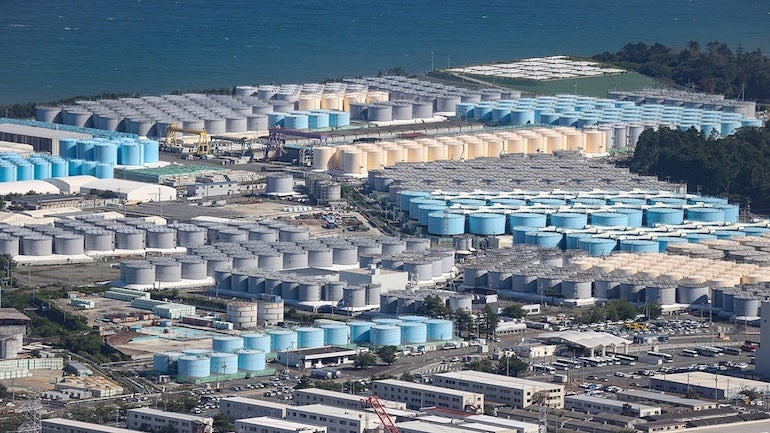
The water was accumulated after the NPP was crippled by the massive earthquake and tsunami that struck northeastern Japan in 2011 resulting in the core meltdown of three reactors. Water was used to cool the reactors. In total, 1.34m tonnes of radioactive wastewater is stored in about 1,000 tanks at the plant, which are almost full and need to be emptied to enable decommissioning of the plant to proceed.
The processed water is diluted with seawater to one-fortieth of the concentration permitted under Japanese safety standards before being released one kilometre off the power plant via an underwater tunnel.


