
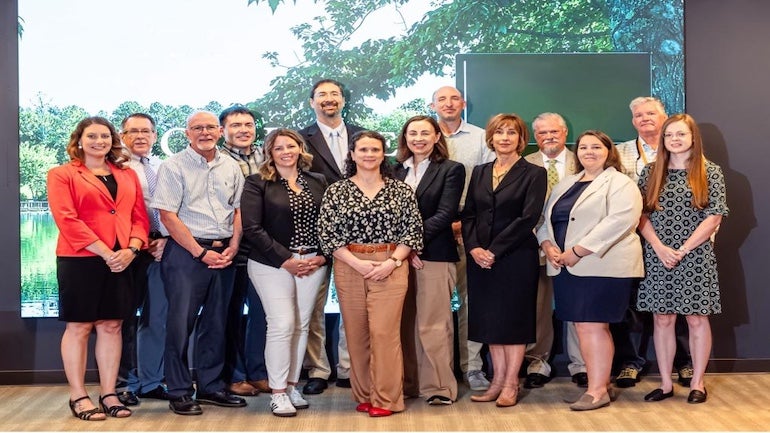
The US Department of Energy’s (DOE’s) Oak Ridge National Laboratory (ORNL) and fusion energy consultancy Rutherford Energy Ventures (REV) have begun development of a new public-private partnership framework to create shared fusion testbed infrastructure at ORNL. The new consortium model, the Fusion Upscaled Leveraged Consortia for Rapid Acceleration (FULCRA), is designed to address gaps identified in the DOE Fusion Science and Technology Roadmap by providing a novel design and funding model for Fulcrum test facilities at national laboratories.
By pooling federal research assets with private investment, this model creates shared Fulcrum test facilities to help private commercial developers validate expensive reactor subsystems. The consortium focuses heavily on testing components that must survive extreme reactor environments. These include:
- Plasma-facing materials: testing armour tiles that line inner reactor walls against temperatures reaching tens of millions of degrees Celsius.
- Fuel breeding blankets: validating the modules responsible for absorbing heat and breeding tritium fuel.
- Radiation-hardened materials: creating materials capable of withstanding intense, multi-decade neutron bombardment.
- Sensors and controls: qualifying reactor-compatible electronics and control systems under extreme magnetic and thermal pressure.
The development is structured as an 18-month, two-phase programme anchored at ORNL. During the first nine months, experts from REV will review the lab’s facilities. They will examine ORNL’s work in fusion materials, blanket design, and high-energy neutron sources. They will also gather technical feedback from commercial fusion firms. The final nine months will focus on designing the first pilot testing facility. This includes creating the engineering blueprints and the financial structure. Once built, private developers will use the facility to test their prototypes and collect real performance data.
For an individual organisation, the cost would be high to build the integrated test facilities required to validate commercial designs and advance the readiness of critical fusion plant components. The consortium model pools federal capabilities with private sector investment to build specialised testbeds for validating critical fusion subsystems. This testbed infrastructure will translate decades of foundational research investment into world-class infrastructure that would be shared with the broader community.
The collaboration combines ORNL’s deep expertise in fusion science and technology, established partnership network and unique facilities with REV’s technical fusion knowledge and expertise in capital and ecosystem development.
Venture capital company REV was founded, specifically to spur the private funding of the fusion ecosystem, by two MIT professors – Dennis G Whyte (inventor of the world’s strongest high temperature superconducting magnets that are key to fusion technology) and Andrew Lo (designer of the financial model that launched the US biotech industry) –
“ORNL’s leadership in fusion science, materials and neutron science makes it well-suited to anchor this shared infrastructure. This collaboration gives us the opportunity to build a partnership model that can serve the entire fusion ecosystem and be replicated across the national laboratory system,” said Troy Carter, director of ORNL’s Fusion Energy Division.
REV Partner & Managing Director Guinevere Shaw said the fusion field has the science but lacks the testing infrastructure to translate that science into validated, commercial-ready technology. “No single entity can build that alone. FULCRA is designed to solve exactly that problem, anchored at ORNL where the scientific foundation already exists.”
Arnold Lumsdaine, public-private partnerships lead in ORNL’s Fusion Energy Division, noted: “ORNL has spent decades building its fusion programme and relationships across the public and private sectors. The lab is positioned to be a national leader to meet today’s challenges, not just as a research institution, but as a partner and collaborator towards commercialisation.”
Once the pilot facility is running, the team will publish its framework as a standard guide. Other national laboratories can then use the blueprint to build similar test sites. This network will establish clear safety standards for fusion hardware and help train the technical workforce needed for commercial power plants.


