
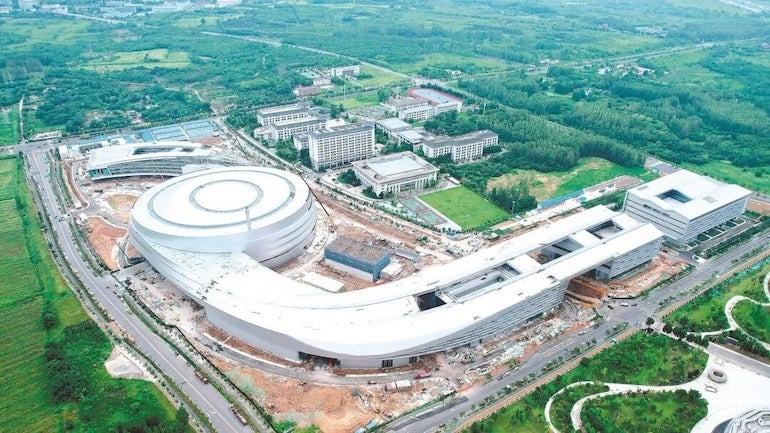
Construction of China’s Burning Plasma Experimental Superconducting Tokamak (BEST) is being carried out at an accelerated pace. BEST, located in the Sanshigang parish of Liuyang district of Hefei in Anhui province, acts as an intermediate testing phase between China’s record-breaking Experimental Advanced Superconducting Tokamak (EAST) and the planned Chinese Fusion Engineering Demo Reactor (CFEDR).
Unlike EAST, which focuses on sustaining high temperatures, BEST is specifically engineered to achieve and study a self-sustaining “burning” deuterium-tritium plasma. The reactor aims to demonstrate net fusion energy production, targeting an unprecedented five-fold energy gain (Q=5). BEST is built to demonstrate fusion-based pilot power generation, moving beyond purely academic plasma research. The goal is to demonstrate net energy gain from fusion and produce the world’s first fusion-generated electricity around 2030.
Recent aerial footage shows the massive circular construction site where the device is taking shape, complete with heavy machinery and dozens of workers assembling its multi-layered structure deep in the ground. Located in the Future Great Science City in Hefei, the facility spans a campus of approximately 160,000 square metres. The main unit’s 400-tonne base was installed in late 2025. It serves as a massive vacuum insulation container designed to withstand a total equipment load of over 6,000 tonnes. Scientists from more than 10 countries, including France, the UK, and Germany, have already signed the Hefei Fusion Declaration to collaborate on the project.
In July 2026, two of the reactor’s superconducting magnets passed full-load testing, a major milestone with the facility on track for completion by the end of 2027. With the successful completion of these tests, project officials confirmed that 100% of the core technologies have now been localised.
The Institute of Plasma Physics at the Hefei Institutes of Physical Science under the Chinese Academy of Sciences (ASIPP) completed the development, acceptance, and full-performance testing of the two superconducting magnet systems, namely a toroidal-field superconducting magnet and a high-temperature superconducting central solenoid coil.
The 582-tonne D-shaped toroidal field coil is 1.3 times the size of the TF magnet used in the International Thermonuclear Experimental Reactor (ITER), and its energy storage capacity is three times greater, according to its developers at ASIPP. The institute has been developing the magnet for six years.
In the future, 16 such magnets will be combined and built together to form a complete Toroidal Field. “Its function is to confine the plasma, preventing it from hitting the walls within the vacuum chamber,” said Wu Yu, a researcher at ASIPP. “The intensity of its magnetic field is related to the temperature and density required for the plasma in the future. A ring composed of 16 coils will generate a magnetic field of 6.5 teslas.”
Song Yuntao, head of the ASIPP noted: “This coil is the heaviest in the world, with the highest energy storage capacity among all superconducting coils currently. The special stainless steel we are currently using, as well as our insulating materials and superconducting materials, are all domestically produced. This project is realised with 100% of domestic products.”
The magnet was built and tested under a major national research programme called CRAFT (Comprehensive Research Accompanying Facility for Fusion Technology). CRAFT is an overarching test facility in Hefei built by the Institute of Plasma Physics. It develops and evaluates components for China’s next-generation reactors. While EAST served as the engineering foundation to develop this technology, its physical design is far too small for a 21-metre-tall, 582-tonne magnet component.


