
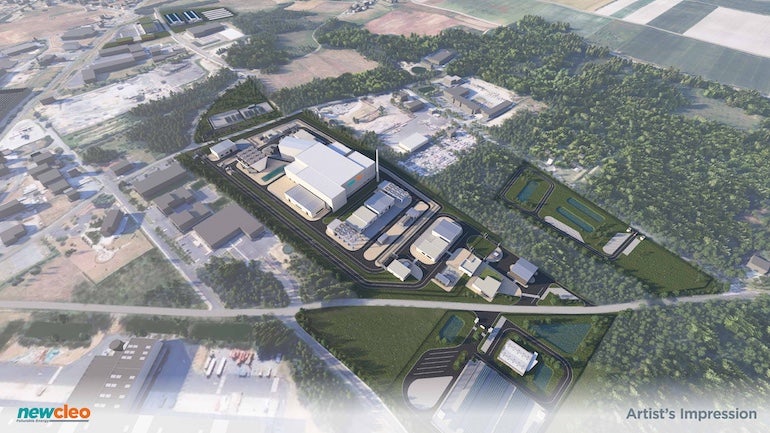
France-based start-up newcleo has submitted its official Regulatory Engagement Plan (REP) to the US Nuclear Regulatory Commission (NRC) to establish a roadmap for licensing its LFR-AS-200 lead-cooled fast reactor and an associated mixed-oxide (mox) fuel fabrication facility. This is a key step in the company’s strategy to bring its advanced modular reactor technology to the US market.
The company said the Regulatory Engagement Plan (REP) sets out the proposed framework for its pre-application engagement with NRC staff in support of the future licensing of the LFR-AS-200. It provides an overview of the company’s proposed licensing approach and an indicative schedule for technical submissions and interactions with the NRC.
The LFR-AS-200 is a 200 MWe lead-cooled fast reactor designed to provide stable, low-carbon electricity and process heat for industrial users, including data centres, hydrogen production facilities, cement and steel manufacturers. It is designed to operate using newcleo’s proprietary mox fuel, produced from recovered or surplus nuclear materials (uranium and plutonium). By pairing a fast-neutron spectrum with mox fuel, newcleo says its proposed technology enables the conversion of legacy nuclear materials and used nuclear fuel into competitively priced energy, while reducing the final volume and radiotoxicity of used nuclear fuel.
To support the development and licensing of its reactor technology, Newcleo has established an extensive international research and development programme, in collaboration with national laboratories in Italy, France and Japan. With than 900 highly skilled employees across Europe and the US, the company has built a network of over 100 industry partnerships and supports its growth through the targeted acquisition and vertical integration of key companies in the nuclear supply chain. Newcleo scaled its workforce to almost 1,000 in under five years through an aggressive strategy of vertical integration through corporate acquisitions across Europe. By buying established nuclear engineering and manufacturing firms, Newcleo absorbed ready-made teams of highly qualified nuclear specialists.
The company’s initial legal incorporation and formal operational launch took place in the UK in 2021. The company was founded by physicist-entrepreneur Stefano Buono following the $3.9bn sale of his previous venture – Nasdaq-listed nuclear medicine company Advanced Accelerator Applications – to Novartis.
Newcleo relocated its global corporate headquarters to Paris in September 2024, moving away from its original UK roots to anchor itself within the European Union’s (EU’s) nuclear ecosystem. The move was driven by three core strategic reasons:
- The primary driver was a massive €1bn ($1.14bn) equity funding round. By positioning its holding entity in Paris, Newcleo gained access to broader EU subsidies, European Investment Bank (EIB) grants, and continental institutional investors. Newcleo immediately secured a €135m investment tranche from continental funds.
- The regulatory environment in the UK was moving too slowly, leading to multi-year permit friction. In contrast, French President Emmanuel Macron held multiple direct meetings with Buono to pitch France’s streamlined France 2030 investment plan. This was further accelerated by the EU’s creation of a dedicated European Commissioner mandate specifically tasked with accelerating small modular reactor (SMR) deployments.
- France offered an immediate industrial base for the reactor’s closed-loop recycling lifecycle. Newcleo had already redirected its primary nuclear fuel recycling plans to France, securing a €20m Bpifrance grant and partnering with French nuclear giant Orano to design its mox fuel fabrication plant after the UK in January 2025 ended its plutonium re-use policy in favour of immobilisation and permanent disposal.
Because newcleo’s mox fuel plant and its first physical 30 MWe pilot reactor (LFR-AS-30) are co-dependent, moving to Paris structurally unified the corporate leadership with their most critical physical engineering projects. Newcleo did not shut down its UK operations and continue working on separate UK grid application designs, but its primary focus for its first operational reactor definitively shifted to France.
Newcleo announced its official expansion into the US market in March, coinciding with its first regulatory engagement filing with the NRC. To fuel its ambitions, Newcleo followed up in June announcing a major strategic partnership with US-based fusion and nuclear fuel recycling firm SHINE Technologies whereby SHINE would supply critical materials extracted from US used fuel for newcleo’s planned mox facility. The two companies combined forces to jointly pursue US federal funding and grants to co-develop US recycling and mox facilities.
Outside of the SHINE recycling agreement, Newcleo’s other primary US partnership agreements centre on an October 2025 Tri-Party Advanced Fuel Infrastructure Pact signed with advanced reactor company Oklo and Sweden’s Blykalla, which are combining resources to build a domestic supply chain for fast-neutron reactors. In May, Oklo and newcleo entered advanced negotiations with the US Department of Energy (DOE) under the federal Surplus Plutonium Utilisation Program.
DOE selected Oklo to lead a programme aimed at downblending and repurposing weapon-grade surplus plutonium into commercial reactor fuel. Newcleo is acting as the primary technical partner, offering its specific mox fuel-cycle expertise and project capital to turn a legacy US plutonium into an immediate domestic fuel source for their respective fast reactors.
In May, newcleo announced that it had entered into a definitive agreement for a business combination with NewHold Investment Corp III with the aim of becoming a US Nasdaq-listed public company. The transaction is expected to close in the second half of 2026.
Newcleo operates a multi-national regulatory strategy, running parallel licensing tracks in France, the UK and US. Because Newcleo’s fast reactor requires a closed nuclear fuel loop, it must simultaneously license its LFR reactor designs and its mox fuel facilities across multiple jurisdictions Newcleo’s earliest regulatory push focused on the UK, aiming to leverage its legacy plutonium stockpiles. In December 2024: Newcleo applied to enter the Generic Design Assessment (GDA) process for the LFR-AS-200. It also applied for a Regulatory Justification Decision.
In France regulator ASNR (Autorité de Sûreté Nucléaire et de Radioprotection) handles the reviews for newcleo’s 30 MWe pilot reactor and its European mox fuel plant. In December 2024, newcleo submitted its official safety approach dossier for its proposed mox facility. This came after French safety officials completed the preliminary regulatory “preparatory stage” to map out the technical parameters of the LFR-AS-30 pilot reactor core.
Earlier in July, ASNR published its formal regulatory opinion on newcleo’s mox facility safety approach concluding that the safety provisions are “satisfactory at this stage” and overall capable of meeting French statutory safety frameworks, while providing a list of technical guidelines for newcleo to address before applying for a construction licence. Newcleo is currently awaiting a matching safety opinion from the ASNR for the LFR design.
While newcleo’s reactor is in the basic design stage, the aim is to finalise its “standard design” by 2026–2028 and leverage modular factory manufacturing to hit first criticality of its 30 MWe pilot reactor in France by 2031/2032. The target for the larger commercial 200 MWe version is scheduled for 2033/2034.Nuclear industry experts view this schedule as exceptionally tight, given that standard Gen-IV reactors normally take 15 to 20 years to go from concept to grid connection.
To put this in context, Russia is currently building the world’s only commercial-scale lead-cooled reactor (the BREST-OD-300), due to begin operation in 2029. That project benefitted from decades of state-backed research and support. Yet newcleo claims it will go from basic design to deployment in six years.
Newcleo’s 2032 target is highly vulnerable to delays. In traditional nuclear engineering, the workflow is strictly sequential from detailed design to regulatory approval and then construction. Newcleo is attempting to do all three simultaneously. If a regulator demands a design modification during the review phase, any factory tooling or modular manufacturing Newcleo has already started will have to be completely redone.
Newcleo’s 30 MWe reactor cannot operate without mox. Newcleo has explicitly stated to regulators that the reactor and their planned French mox plant are entirely interdependent projects. Mox fuel is complex to license and manufacture because it deals with weapons-grade or reactor-grade plutonium. This requires highly shielded, heavily safeguarded, automated robotic “hot cells”. If the fuel facility is delayed by even a few months, the reactor timeline stalls completely.
Newcleo’s timeline has already suffered from shifting political landscapes. The company originally planned to build its first reactor in the UK using British plutonium stockpiles. However, the 2025 decision to immobilise its plutonium stockpile rather than lease it out forced Newcleo to scale back its UK operations and relocate to France to seek access to Orano’s fuel reserves. While Newcleo appears to be moving exceptionally fast, history suggests that Generation-IV nuclear projects almost always face delays of at least 3-5-years during the final regulatory and commissioning stages.


