
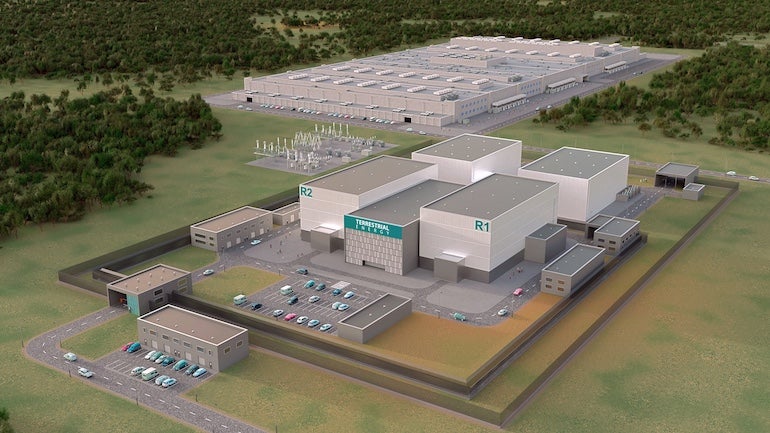
US-based Terrestrial Energy has submitted its Graphite Topical Report to the Nuclear Regulatory Commission (NRC) outlining the methodology used to qualify nuclear-grade graphite for commercial plant operations for its Integral Molten Salt Reactor (IMSR) design. Graphite serves as the core’s moderator, and its long-term performance directly dictates the overall service life of the IMSR Core-unit.
The IMSR design is for a 442 MWt per Core-unit (IMSR400) small modular molten salt fuelled, graphite moderated, thermal spectrum reactor. Terrestrial Energy has developed a two-unit configuration which can deliver 884 MWt/390 MWe. The design features a completely sealed reactor vessel with integrated pumps, heat exchangers and control rods all inside a single vessel. The sealed Core-unit is replaced completely at the end of its useful service life (nominally seven years).
To back up its report to NRC, Terrestrial Energy spent several years running advanced graphite core testing under operational stresses at the NRG High Flux Reactor in Petten, Netherlands. The design features a replaceable reactor core unit intended for replacement on a sequential seven-year cycle. Establishing a firm regulatory basis for graphite helps to secure this recurring component-supply pipeline.
This is the second of at least three Topical Reports Terrestrial intends to place before the NRC in 2026. It follows previously successful safety evaluations, including the approval of its Principal Design Criteria in 2025 and its Postulated Initiating Events methodology earlier in 2026. By systematically reviewing these components with the NRC, Terrestrial Energy aims to avoid continuous technical re-evaluation down the road, keeping the company on track for planned commercial deployments of its Generation IV plants in the early 2030s.
Simon Irish, CEO of Terrestrial Energy said the submission is part of a structured programme of NRC regulatory engagement that leads to the submission of an IMSR Plant licence application “Graphite performance sets the service life of the IMSR Core-unit, and this submission begins the NRC review that qualifies graphite for commercial operation,” he noted.
Terrestrial is also progressing its IMSR through parallel direct co-operation with the US Department of Energy (DOE). In January, Terrestrial Energy executed an Other Transaction Authority (OTA) agreement with DOE to support IMSR plant development. This advances Terrestrial Energy’s engagement with the Reactor Pilot Program (RRP), established by President Trump’s May 2025 Executive Order 14301, Reforming Nuclear Reactor Testing at the Department of Energy.
The RRP enables DOE to authorise privately built reactors outside its national laboratories. The programme provides a streamlined pathway to regulatory authorisation for operation, bridging the gap between pilot reactor operations for system testing, and licensing for commercial plant operation. The OTA enables Terrestrial to move quickly from design to operation under DOE authorisation.
Terrestrial’s multi-phase strategy aims at achieving full commercial operation of its IMSR plants by the mid-2030s. Following its transition to a publicly traded company on the Nasdaq in late 2025, the company has structured its commercial deployment around key regulatory and regional milestones.
Terrestrial has focused its near-term efforts on the Texas A&M University RELLIS Campus, securing ground and research leases covering 77 acres. Backed by DOE agreements, the site will host Project TETRA (a non-commercial test reactor) and the TEFLA project (a fuel line pilot facility) to demonstrate molten fuel-salt production. Zachry Group is currently executing site characterisation and engineering services for this first demonstration footprint. Terrestrial has already established agreements with Westinghouse, Orano, and Urenco to secure standard-assay low-enriched uranium (SALEU), avoiding high-assay low-enriched uranium (HALEU) supply bottlenecks.
In May, the company signed a Memorandum of Understanding (MOU) with Riot Platforms to co-locate IMSR plants with large-scale data centres. The plan outlines deploying multiple plants to support up to 4 GWe of nuclear capacity. Beyond grid electricity, the 390 MWe reactor design targets heavy industry, aiming to provide high-temperature process heat for hydrogen generation, petrochemical manufacturing, and ammonia production by the mid-2030s


