
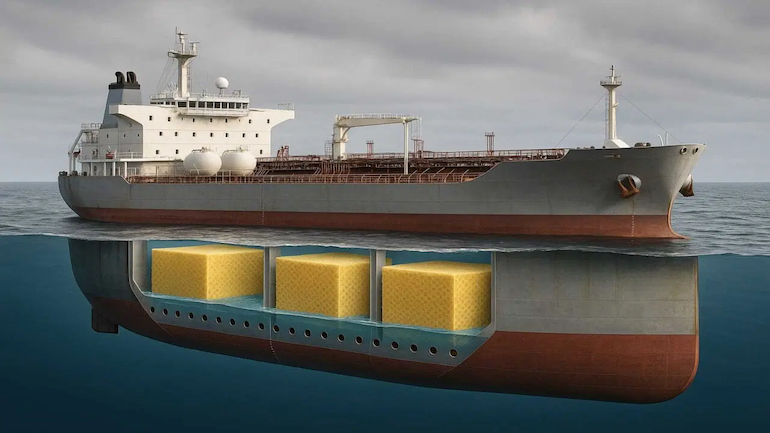
Texas-based SuperCritical Materials has secured a licence from the US Department of Energy (DOE) to commercialise a patented uranium and critical materials adsorbent manufacturing process developed by DOE laboratories and research partners.
The technology, originally developed by researchers at Pacific Northwest National Laboratory (PNNL) with support from DOE’s Office of Nuclear Energy, has demonstrated the feasibility of extracting uranium from seawater. SuperCritical has been granted rights to the manufacturing process and to deploy the technology at industrial scale initially in the US and subsequently in allied nations seeking to strengthen domestic nuclear fuel security.
Following the successful demonstration that advanced reactors can be brought to criticality under accelerated federal deployment programmes, US policymakers see the next major challenge as securing sufficient privately-funded fuel-cycle capacity to support long-term nuclear growth.
The world’s oceans contain approximately 4.5bn tonnes of uranium – more than 1,000 times the identified terrestrial reserves. SuperCritical believes that advances in selective adsorption chemistry, materials science, and industrial deployment can unlock a portion of this resource while also recovering other strategically important materials from seawater. The process involves specially treated acrylic fibres coated with proprietary adsorption chemistries. Dissolved uranium ions in the water bind to these fibres, allowing them to be harvested.
SuperCritical’s co-founder, Dr Gary Gill, is a former PNNL scientist who pioneered this research. Beyond uranium, the company intends to co-recover other strategic critical minerals from seawater, boosting domestic manufacturing supply chains.
The company aims to build its first plant in Texas, targeting an annual output of 1.85m pounds (839,150 kg) of uranium. This is enough to power roughly 4m households a year. SuperCritical estimates it can begin producing uranium by 2030 or 2031, following regulatory approvals from 13 different agencies.
SuperCritical describes its mission as becoming the Fuel Layer of the Intelligence Economy. While reactor developers build the systems that generate electricity, SuperCritical seeks to provide the uranium and critical materials infrastructure needed to fuel those systems at scale. The company believes this upstream supply-chain role represents one of the most important opportunities in the emerging nuclear economy.
The Intelligence Economy refers to the next phase of economic growth driven by artificial intelligence, advanced computing, robotics, autonomous systems, advanced manufacturing, defence technologies, and digital infrastructure. Just as the Industrial Economy was built on coal and steel, and the Information Economy on semiconductors and telecommunications infrastructure, the Intelligence Economy will be built on abundant, reliable energy.
“Our objective is straightforward,” said Alexander Canon Bryan, Founder and CEO of SuperCritical Materials. “If the Intelligence Economy requires abundant, reliable nuclear energy, then it will also require abundant, reliable nuclear fuel. SuperCritical is building the infrastructure needed to help supply that fuel. We are proud to advance technology developed by the US Department of Energy and contribute to strengthening America’s energy security, industrial competitiveness, and technological leadership.”
SuperCritical Materials is a privately held company based in Austin, Texas. During the 2000s and 2010s DOE funded research into extracting uranium from ocean water. This effort is spearheaded by researchers at PNNL, led by Dr Gary Gill. SuperCritical Materials was founded by CEO Alexander Canon Bryanin 2024 and Dr Gill joined as a co-founder to lead the technical programme, shifting his decades of marine sciences expertise into the private sector.
In November 2025 Skyline Builders Group Holding Limited entered a Letter of Intent to acquire SuperCritical Technologies. Around this period, Neal Froneman, former CEO of global precious metals giant Sibanye-Stillwater, left his corporate post and took on a leadership role with SuperCritical.
In January, SuperCritical joined the Texas Nuclear Alliance, aligning the company with regional infrastructure goals and setting the stage for a proposed processing plant in Texas. In May the company joined the Terra Praxis REPOWER Consortium, establishing it as a designated fuel-supply partner supporting a manufacturing-scale rollout of advanced nuclear reactors.
The US commercial licence from DOE for the PNNL-patented adsorbent manufacturing technology legally blocks domestic competitors from using the government-developed process. SuperCritical is targeting 2030–2031 for first production. This is the company’s projected window to navigate the complex regulatory grid, which spans 13 different government agencies, and begin its first industrial-scale extraction of uranium from ocean water. SuperCritical has raised $4.5m privately and is seeking to become a publicly traded company on Nasdaq this year.
“Our long-term goal is to transform the US from a net importer to a net exporter of uranium and nuclear fuels,” said CEO Alexander Canon Bryan. Ted Garrish, Assistant Secretary for Nuclear Energy at DOE, said the technology “represents a potentially significant contribution to America’s long-term fuel security and industrial competitiveness”.


