
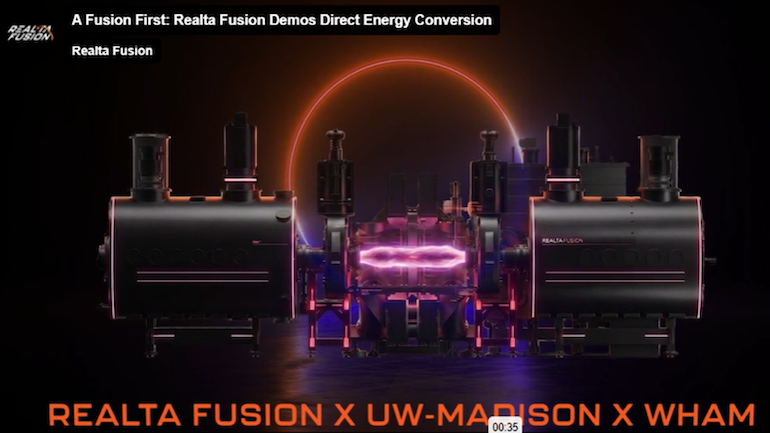
US-based Realta Fusion has achieved the world’s first commercial demonstration of Direct Energy Conversion (DEC), transforming plasma kinetic energy directly into electricity. By producing multiple amps of current at approximately 100 volts, the system generated enough electrical power to successfully illuminate several light bulbs.
Traditional nuclear and fusion concepts rely on thermal conversion. They use extreme heat to boil water, create steam, and spin a mechanical turbine. This process typically loses 60% or more of its energy as waste heat. DEC acts like a particle accelerator running in reverse. It directly captures the voltage of moving ions escaping the fusion plasma. This method can theoretically reach efficiencies over 80%, vastly reducing capital costs and system complexity.
Realta Fusion uses a magnetic mirror configuration rather than a tokamak loop. Magnetic mirrors naturally have “open” field lines at the ends. This design allows escaping plasma to enter a targeted DEC grid, making it uniquely suited for direct electrical harvesting. “People have been talking a big game about DEC for years, so we just went out and did it,” said Realta CEO Kieran Furlong. “We’re the first private fusion company to achieve DEC of plasma kinetic energy into electricity on a real fusion machine.”
Realta Fusion is developing compact, scalable, modular (CoSMo) fusion energy systems based on the magnetic mirror fusion concept. Realta is backed by leading venture capital investors Khosla Ventures and Future Ventures and is one of just eight companies selected for the US Department of Energy’s (DOE’s) Milestone-Based Fusion Development Program. Realta Fusion was also selected as one of the World Economic Forum’s Technology Pioneers in 2026.
On 19 June, Realta first installed and demonstrated its direct energy converter on the Wisconsin HTS Axisymmetric Mirror (WHAM) – the experimental fusion machine it operates in collaboration with the University of Wisconsin-Madison. The converter works by slowing down charged particles at one end of the machine, which builds up an electrical potential or voltage to drive an electrical current.
“This is a first demonstration, but still a meaningful technical milestone and proof-of-concept that DEC can be done at a scale to light things up,” said Dr Derek Sutherland, Realta’s Chief Scientific Officer. “While we’ve demonstrated DEC works on WHAM, this is not yet a demonstration of net-electricity or a large-scale conversion of fusion power directly into electricity. Those are milestones for our future fusion machines.”
DEC was first proposed by Lawrence Livermore National Laboratory’s Dr Richard Post in 1974. While DEC has been shown a handful of times in academic and national laboratory settings, Realta is the first commercial fusion company to demonstrate that it can apply DEC to a fusion plasma.
The use of DEC in fusion machines is especially meaningful for increasing the efficiency of the system. For the first-generation fusion power plants Realta expects to build starting in the mid-2030s, 80% of the fusion power would come from running a traditional thermal cycle operating at up to 45% efficiency while the remaining 20% would come from DEC operating at over 90% efficiency. The boost provided by DEC would offset all the energy Realta injects into its plasma to start up and sustain fusion plasma conditions, thereby raising the energy gain and lowering the cost per kilowatt hour by at least 10-20%.
“The prospect of using DEC in eventual fusion power plants has been discussed in the fusion field for decades, with the primary goal of increasing the overall power efficiency of the system,” noted Dr Sutherland. “In short, by directly converting fusion plasma power into electricity, we can push less of the energy through a thermal cycle that has inherent efficiency limits due to the laws of thermodynamics. We believe DEC will be especially attractive for magnetic mirror fusion power plants.”
This first prototype is a single-stage DEC converter composed of three finely meshed grids – an electrically grounded grid, an electron repulsion grid, and an ion collector grid. During mirror plasma operations, this assembly currently draws multiple amps of current at around 100 volts – providing sufficient power to illuminate a few lightbulbs. “We will continue scaling the voltage of our direct energy converter to draw even more current in the coming weeks,” Dr Sutherland said.
He explained that WHAM is a prototype scale magnetic mirror device using only deuterium fusion fuel, and so most of the directly converted energy is of the input power supplying the mirror plasma to heat and sustain it. In future devices using deuterium-tritium (DT) fuel designed for high fusion power production, a greater fraction of this converted power will be coming directly from fusion.
“Just as important as to what we’ve shown on WHAM with this first DEC demonstration, is clarity on what we have not shown yet: this is neither a demonstration of net-electricity production nor large-scale conversion of fusion-born power directly into electricity – these are milestones we will achieve on our future devices at Realta.”
He added: “Working with the philosophy of ‘first make it work, then make it good’, it’s now on us to scale what we’ve done on WHAM to multi-kW and ultimately multi-MW capability in our future devices. But, even with this first demo, our path to commercial DT mirror fusion power plants just got clearer…. Though we are currently focused on developing a DT mirror fusion power plant first, the physics of the magnetic mirror and the architecture that naturally allows for DEC motivates us to consider advanced fusion fuel cycles that require higher plasma temperatures than DT in pursuit of even lower cost fusion power plants.”


