
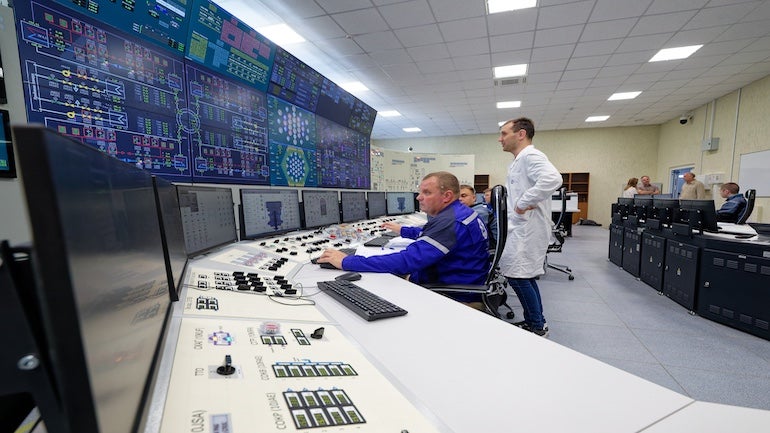
A full-scale simulator has begun operation for the BREST-OD-300 (lead-cooled fast neutron reactor being built at the Siberian Chemical Combine (SKhK – Sibirskovo Khimicheskovo Kombinata) in Seversk, Tomsk region as part of the pilot demonstration power complex (ODEK – Opitno Demonstratsionovo Energo-Kompleksa).
The BREST-OD-300, being built under the Breakthrough (Proryv) Project, is intended to demonstrate closed fuel cycle technology. As well as BREST, ODEK includes on-site nuclear fuel cycle facilities including a module for fuel fabrication and refabrication and a module for reprocessing and recycling irradiated fuel. The fuel fabrication unit began operation in December 2024.
The simulator is located in the SKhK Training and Information Centre. The software and hardware complex completely replicates the main and backup control panels of the power unit. It is equipped with settlement servers and a software model, audio and video surveillance, as well as a system for recording staff actions for subsequent analysis. Simulation of physical processes accurately reproduces the normal operating modes of the reactor installation as well as transitional and emergency modes.
“It is worth noting that there are no other such simulators in the world, since it was created for the unique lead-cooled BREST-OD-300 and will become a key technical means for training and licensing of personnel,” noted Dr Evgeniy Adamov, Scientific Director of the Breakthrough project.
The general contractor for the simulator was the All-Russian Research Institute for the Operation of Nuclear Power Plants (VNIIAES – Vserossiiskii Nauchno Issledovatelskii Institut po Expluatatsii Atomnikh Elektrostantsii), part of Rosatom’s Electric Power Division. VNIIAES has developed more than 40 simulators Russian for power units.
“For VNIIAES, creating a unique simulator for the future power unit posed a real challenge, said Director General Konstantin Artemyev. “Only the coordinated work of professionals from all participating organisations made it possible to cope with this challenge. As a result, the team created not just a simulator, but an adaptive modelling platform that will develop along with a completely new generation IV power unit.”


