
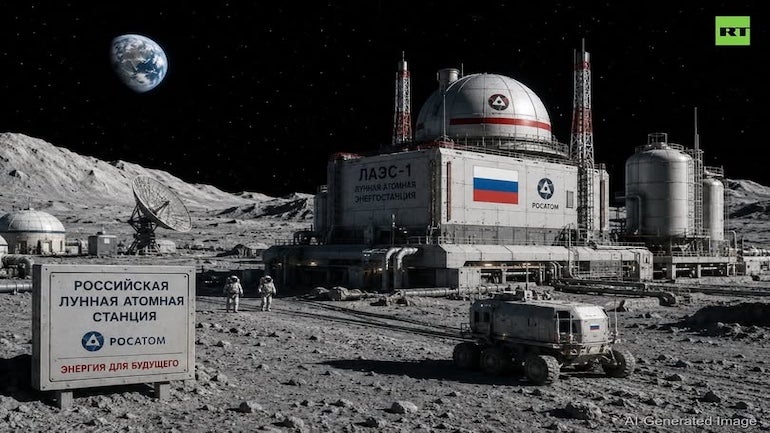
A draft decree prepared by Roscosmos and published on the federal portal of draft regulatory legal acts outlines Russia’s space policy up to and beyond 2036 establishing a major shift toward nuclear-powered spacecraft and long-term infrastructure to secure its technological sovereignty.
According to the draft presidential decree, On the Foundations of State Policy of the Russian Federation in the Field of Space Activities, Roscosmos plans to concentrate state resources on several high-priority initiatives. These include:
- Nuclear-powered propulsion – launching and operating spacecraft equipped with nuclear installations (such as the long-delayed Zeus space tug and its Nuklon propulsion system) after 2036.
- Lunar nuclear infrastructure – completing and deploying a nuclear power plant on the Moon by 2036 to provide continuous energy for habitats and rovers, developed in cooperation with China’s International Lunar Research Station (ILRS).
- Deep-space exploration – executing automated missions to explore Venus, asteroids, and the broader Moon surface after 2036.
- Orbital expansion – fully deploying a low-orbit multi-satellite constellation and utilising the upcoming Russian Orbital Station (ROS) for manufacturing and advanced scientific research.
The initiative falls under a broader RUB4,400bn ($47.2bn) national project, Cosmos, which officially initiated its federal sub-projects (such as Space Atom and Space Science) to drive funding up to 2036. Russia aims to pivot from short-term, one-off missions into permanent extraterrestrial infrastructure. This strategy runs parallel to NASA’s efforts to put a fission surface power reactor on the Moon, heating up the global space energy race.
The Zeus space tug and ILRS represent two distinct but deeply connected pillars of the Russian-Chinese strategic space partnership. The Zeus Nuclear Space Tug was developed as part of Russia’s Transport and Energy Module (TEM) project. It is designed to serve as an orbital transport vehicle capable of ferrying heavy payloads from Low Earth Orbit (LEO) to deep space.
Zeus weighs between 20,290 kg and 22 tones, restricted by the maximum payload capability of the heavy-lift Angara-A5V rocket. It is equipped with a 500 kWe to 1 MWe fission reactor. The system uses a closed-loop gas-turbine design to convert thermal energy into electricity.
The propulsion system is driven by a high-efficiency cluster of ion thrusters. It operates at an incredibly high Specific Impulse of 7,000 seconds, producing a low but continuous thrust of roughly 18 Newtons. Zeus features massive, deployable carbon-composite radiator panels designed to dump massive amounts of waste heat into the vacuum of space.
The reactor will only be switched on once the tug has reached a safe, high altitude of roughly 500 miles (800 km). Human crews aboard the upcoming Russian Orbital Station can dock with it to inspect or manage radiator deployment before it embarks on deep space transit. It is capable of transporting up to 7 tonnes of cargo to lunar orbit.
Roscosmos and the China National Space Administration (CNSA) are jointly developing a lunar surface nuclear reactor for the ILRS. The development road map is in four phases.
Phase One, Precursor Reconnaissance (2026–2029) – China’s Chang’e 7 and Chang’e 8 (2029) missions target the lunar South Pole to survey resources and test automated, robotic construction techniques.
Phase Two, Automated Reactor Deployment (2033–2035) – Joint teams plan to build the reactor core entirely via autonomous robotics, eliminating human risk during early installation. Roscosmos brings its Soviet-era space reactor heritage, while Rosatom and the Kurchatov Institute oversee the specialised nuclear architecture.
Phase 3, Bringing the base online (by 2036) – The core “basic model” of the ILRS will become operational. The nuclear reactor will be connected to a grid with heavy solar arrays and surface cables to provide uninterrupted power for science stations, rovers, and future crew habitats.
Phase 4, Deep Space Expansion (Post-2036) – With the infrastructure secured, Roscosmos will launch Zeus nuclear flight operations after 2036 to ferry heavy equipment, opening up deep-space corridors to Venus and Mars.


