
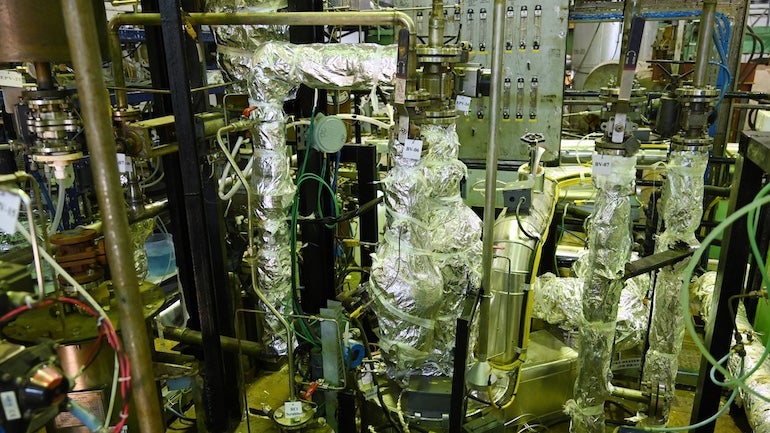
India’s Department of Atomic Energy has launched the world’s first hydrogen production facility using nuclear process heat at the Indira Gandhi Centre for Atomic Research (IGCAR) in Kalpakkam. The facility was inaugurated by Ajit Kumar Mohanty, DAE Secretary and, Atomic Energy Commission (AEC) Chairman in the presence of IGCAR Director Sreekumar G Pillai.
The facility has is a technology demonstrator to validate the production of hydrogen using the Copper–Chlorine thermochemical cycle powered by nuclear heat from the Fast Breeder Test Reactor (FBTR). The Copper–Chlorine (Cu–Cl) thermochemical process developed indigenously by the Bhabha Atomic Research Centre (BARC) in Mumbai.
IGCAR said the successful integration of nuclear process heat with hydrogen generation marks a pioneering technological breakthrough and opens a promising pathway for large-scale, carbon-free hydrogen production using advanced nuclear reactors.
Of the various hydrogen production technologies under development worldwide, the Cu–Cl thermochemical cycle is considered one of the most promising because of its relatively lower operating temperatures and higher thermodynamic efficiency.
The commissioning of the facility follows years of research, engineering, design, equipment fabrication, installation and testing carried out jointly by BARC and IGCAR. The plant will help researchers gain operational experience, improve the Cu–Cl process and support future work on scaling up nuclear-assisted hydrogen production for larger applications.
“The integration of nuclear energy with emerging clean energy technologies such as hydrogen production represents a strategic pathway towards a sustainable energy future,” said DAE Chairman Dr Mohanty. “Nuclear power, with its unique ability to provide reliable carbon-free electricity as well as high-temperature process heat, is ideally suited to support large-scale hydrogen production while contributing to India’s energy security, decarbonisation goals and long-term sustainable development objectives.”
IGCAR, a key institution in India’s fast breeder reactor programme since 1971, designed, built and operated the FTBR, which has supported the development of fuels, materials and technologies required for advanced reactor systems for more than four decades. The experience gained through FBTR has also contributed to the development of the 500 MWe Prototype Fast Breeder Reactor (PFBR), which forms part of the second stage of India’s three-stage nuclear power programme.
This programme is a strategic roadmap formulated by Dr Homi J Bhabha in 1954 to secure long-term energy independence. The programme is specifically tailored to exploit India’s unique mineral resource profile – India has limited domestic uranium reserves (1-2% of global reserves) but one of the largest thorium reserves in the world (approx. 25% of global reserves found in coastal monazite sands).
Because thorium-232 is “fertile” rather than “fissile,” it cannot sustain a nuclear chain reaction on its own. It must first be converted into fissile uranium-233. The three distinct stages function as a closed nuclear fuel cycle, where the byproduct of one stage acts as the fuel for the next.
In stage one, pressurised heavy water reactors (PHWRs) use natural uranium (containing 0.7% fissile U-235 and 99.3% fertile U-238) to generate electricity through fission. Simultaneously, the fertile U-238 absorbs neutrons and transutes into plutonium-239. PHWRs comprise the bulk of India’s commercial nuclear capacity.
In stage two, fast breeder reactors (FBRs) use plutonium-239 (reprocessed from stage one used fuel) mixed with uranium oxide/carbide. These reactors produce more fissile material than they consume. While generating power, a thorium blanket can be placed around the core to capture leaking neutrons, transmuting thorium-232 into fissile uranium-233. India officially entered this stage when the PFBR at Kalpakkam achieved its first criticality in April this year.
In stage three, thorium-based reactors will use a self-sustaining mix of thorium-232 and the uranium-233 bred from stage two. Once a sufficient inventory of U-233 is accumulated, the reactor core can be refuelled strictly using naturally occurring thorium. The thorium constantly converts into U-233, providing a virtually inexhaustible, low-carbon energy source.


