
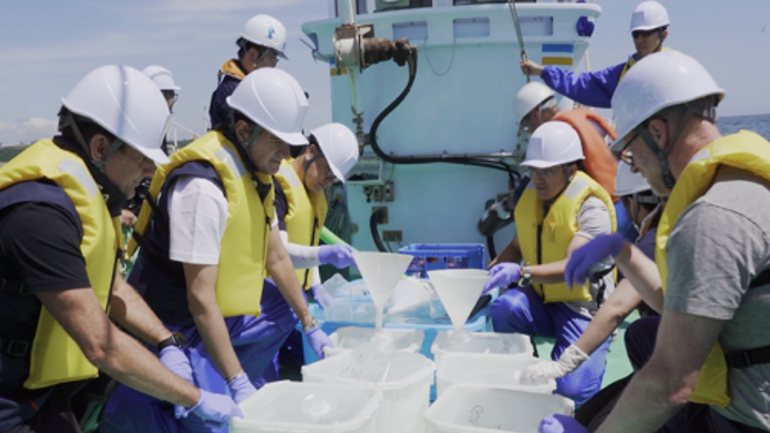
International Atomic Energy Agency (IAEA) Director General Rafael Mariano Grossi took part for a second time in activities to collect seawater samples near the Fukushima Daiichi NPP, together with other international experts from China, South Korea and Switzerland, as part of continuous efforts to ensure that radioactivity levels remain well below safety levels.
The sampling was conducted under Additional Measures agreed by the IAEA and Japan in 2024 which aim to broaden international participation and enhance transparency in the IAEA’s sampling and independent analysis in relation to the discharge of Advanced Liquid Processing System (ALPS) treated water.
Plant operator Tokyo Electric Power Company Holdings (Tepco) began discharging ALPS treated water from the Fukushima Daiichi plant in August 2023. Since then, more than 156,000 cubic metres have been diluted and released in 20 batches. The Agency has confirmed that the tritium levels in the batches released so far were far below Japan’s operational limit. Tepco intends to discharge the treated water in a series of batches over the coming decades.
“Additional measures enable third parties to independently verify that the water discharge complies, and will continue to comply, fully with international safety standards,” Grossi said. “By welcoming countries to collect and analyse samples directly, Japan is helping to increase transparency, shared understanding and confidence, particularly among its neighbours.”
The samples will be sent for analysis by the IAEA Marine Environment Laboratories in Monaco, laboratories in Japan and the participating laboratories of the Third Institute of Oceanography in China, the Korea Institute of Nuclear Safety in South Korea and the Spiez Laboratory in Switzerland.
IAEA is continuing its review of the ALPS treated water discharge, by having a continuous onsite presence, corroborating monitoring data through Interlaboratory Comparisons and providing live online monitoring.


