
A key remediation project has been completed at the All-Russian Research Institute of Chemical Technology (VNIIKhT – Vedushii Nauchno Issledovatelskii Institut Khimicheskoi Tekhnologii) in Moscow. The institute, established in 1951, played an important role in the Soviet weapons programme and is now a leading research and development enterprise under Rosatom specialising in hydrometallurgy, radiometric ore sorting, and the processing of radioactive, scattered, and rare-earth elements.
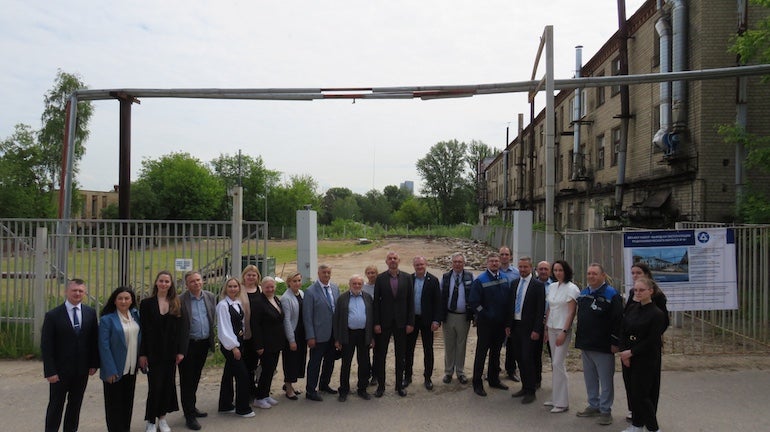
Currently the Federal State Unitary Enterprise Radon (part of Rosatom) is implementing a comprehensive project to decommission a number of older facilities at the VNIIKhT site. The Federal Medical and Biological Agency (FMBA) has now confirmed the radiation safety of all site facilities paving the way for buildings to be dismantled and the area rehabilitated for economic use. Representatives of the Federal Environmental, Industrial and Nuclear Supervision Service of Russia (Rostechnadzor), Moscow municipal authorities, Rosaton’s Public Council, and the Commission for the Environment and Safe Development of the Nuclear Industry visited the site.
A round table was held including members of the public to discuss modern approaches to the decommissioning with special emphasis on the environmental friendliness of the technologies used and the subsequent unrestricted use of cleared areas. It was agreed that such projects should be accompanied by maximum transparency and public scrutiny.
“Closing such facilities is an important step towards reducing the man-made load on the environment and the population,” said Alexander Asafov, First Deputy Chairman of the Commission for Public Expertise of Bills and Other Regulatory Acts at the Civic Chamber of the Russian Federation. “This is especially important in megacities. The rehabilitation of such sites makes it possible to completely eliminate radiation risks and return the territories to economic activity.”
During its early years in the 1950s and 1960s, VNIIKhT functioned as the secret chemical and metallurgical backbone of the Soviet atomic bomb project. Founded in April 1951 as NII-10 (and later known as the Military Research Institute), its primary mission was to solve the critical material shortages facing the Soviet nuclear programme by inventing industrial methods to extract and process uranium.
VNIIKhT was explicitly created to pioneer chemical engineering techniques for low-grade and complex domestic ores and it developed the USSR’s first industrial acid and carbonate leaching technologies. The institute developed technologies to convert purified uranium oxides into uranium tetrafluoride (UF4) and uranium hexafluoride (UF6). This was essential for the Soviet gas-diffusion and centrifuge uranium enrichment plants. VNIIKhT scientists optimised the hazardous radiochemical processes needed to isolate, precipitate, and purify plutonium-239 from irradiated reactor fuel. It also pioneered the extraction metallurgy for critical secondary elements such as lithium, beryllium, and thorium, which were vital for early reactor control systems.
By 1967, as the initial weapons focus stabilised into a broader industrial programme, the institute’s designation changed from “Military” to “All-Union”. VNIIKhT then used its laboratory-scale successes and deployed them across the entire Soviet bloc, designing the chemical processing flowcharts for massive mining combines in Uzbekistan, Kazakhstan, and East Germany (the Wismut company).
The current clean-up operations at the VNIIKhT site represent a massive urban environmental remediation project. Because VNIIKhT spent decades processing radioactive ores and testing used nuclear fuel directly within Moscow’s city limits, its site on Kashirское Highway became an industrial radiation hazard. The site is undergoing comprehensive decommissioning and radiological decontamination managed by the Moscow branch of Radon as part of Russia’s Federal Target Program on Nuclear and Radiation Safety.
Clean-up crews are systematically dismantling the 13 major scientific and industrial buildings previously used for uranium, thorium, and used fuel research. Radon has completed the dismantling of Building 8, the former central radiochemical facility. The building contained heavily contaminated hot cells. Teams used remotely controlled robotic demolition machines to crush thick protective walls and extract contaminated processing equipment from a safe distance. Having secured clearances from FMBA, teams are currently preparing Buildings 1 and 2 for mechanical demolition.
To ensure maximum safety in a populated megacity, Rosatom deployed advanced digitisation methods before tearing down any structures. Specialists conducted comprehensive laser scanning and mapped historical archival blueprints to construct highly accurate 3D “digital twins” of the hazardous facilities. Radiation monitoring data was digitally overlaid directly onto the 3D model. This allowed engineers to precisely calculate radioactive hot spots, predict the exact volume of nuclear waste to expect, and schedule transport safely.
A primary challenge is managing the soil and debris across the institute’s grounds. Debris and surrounding soils are mechanically excavated and sorted. Non-hazardous structures are treated with chemical or mechanical wash down methods to lower low-level radiation, reducing the volume of active material that needs to be permanently buried. All active radioactive waste collected from the site is packaged into protective containment casks and transported to specialised, permanent deep-storage isolation facilities.
The overarching objective of the clean-up is to achieve “greenfield” status and return to the remediated areas to the municipal economic pool. By the end of 2026, four major high-risk facilities will be fully decommissioned. Complete environmental rehabilitation of the entire former VNIIKhT industrial territory is scheduled to be finished by 2028.


