
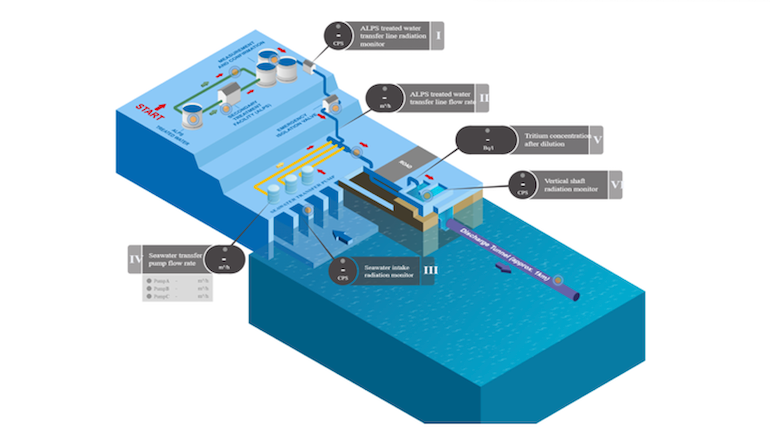
The International Atomic Energy Agency (IAEA) has confirmed that the tritium concentration in the 20th batch of Advanced Liquid Processing System (ALPS)-treated water discharged from the Fukushima Daiichi NPP is far below Japan’s operational limit and consistent with international safety standards.
As part of its ongoing safety review, the IAEA independently tested samples from the latest batch before it was released through a one‑kilometre tunnel into the ocean. Analysis at the site showed that tritium levels were far below Japan’s operational limit of 1,500 becquerels per litre and met international safety standards.
Tokyo Electric Power Company (Tepco) has discharged around 149,000 cubic metres of ALPS‑treated water in batches since August 2023. The IAEA has confirmed that the tritium levels in the first 19 batches were also far below the operational limits.
In its comprehensive report issued in July 2023, the IAEA concluded that Japan’s approach to the discharge of ALPS‑treated water is consistent with relevant international safety standards and that the release, as planned and assessed, would have a negligible radiological impact on people and the environment. The IAEA continues to maintain a presence at the site and to carry out ongoing monitoring and verification activities throughout the discharge process.
Before the water was discharged an IAEA team of international experts collected samples of the ALPS-treated water – the eighth such mission to be implemented as part of the Additional Measures under the framework of the IAEA, which aim to broaden international participation and enhance transparency in the IAEA’s sampling and independent analysis.
The international team of experts from China, the Republic of Korea, the Russian Federation, and Switzerland joined IAEA staff to conduct sampling of water. The Additional Measures allow independent third-party experts to conduct direct measurements of water and environmental samples.
The IAEA began implementing the Additional Measures in October 2024, as part of its broader efforts to further enhance transparency and confidence in the monitoring and assessment of ALPS treated water discharges.
Samples collected during the mission will be analysed by the IAEA Fukushima Laboratory and the participating laboratories including: the China Institute for Radiation Protection, the Korea Institute for Nuclear Safety, Lomonosov Moscow State University in the Russian Federation, and the Spiez Laboratory in Switzerland. All laboratories are members of the IAEA’s Analytical Laboratories for the Measurement of Environmental Radioactivity (ALMERA) network, selected for their demonstrated expertise and analytical capabilities. The results are planned to be published in the final quarter of this year.


