
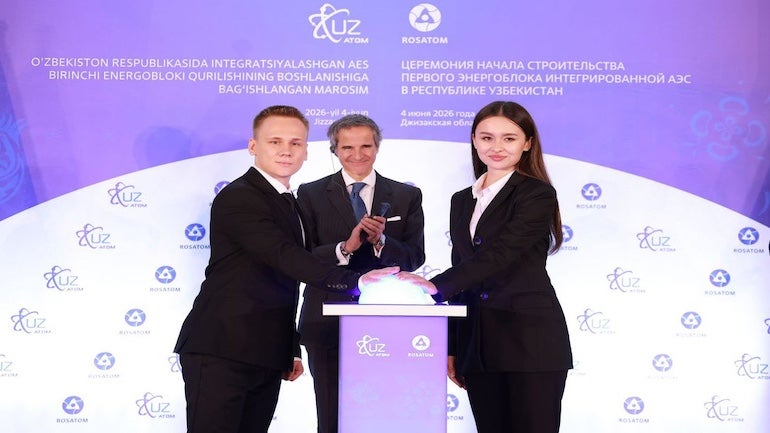
First concrete has been poured for the first low-capacity nuclear unit of an integrated NPP project in the Farish district of Uzbekistan’s Jizzakh region. The event was marked by a ceremony, which took place via teleconference between the NPP construction site in Uzbekistan and St Petersburg in Russia, where formal permission to build the first unit was jointly given by Russian President Vladimir Putin and Uzbek President Shavkat Mirziyoyev.
At the construction site International Atomic Energy Agency (IAEA) Director General Rafael Grossi addressed the guests gave a welcoming speech. The status of work on the project was described by Rosatom First Deputy General Director for Nuclear Energy and President of Atomstroyexport Andrey Petrov and Uzatom Director Azim Akhmedkhadzhaev.
In March a roadmap for nuclear cooperation was signed by Rosatom and Uzatom as well as an additional agreement to the contract for NPP construction. At the same time, preparatory concrete work began at the NPP construction site for construction of a low-power NPP (ASMM – Atomnoi Stantsii Maloi Moshnosti) with a RITM-200N reactor. The additional agreement expanded scope of the contract signed in May 2024 for two 55 MWe ASMMs to also include two VVER-1000 reactors on the same site. When the NPP is fully operational, it will generate about 17.2 TWh a year, providing up to 14% of Uzbekistan’s total energy needs and save more than 3.5bn cubic metres of gas annually. Documents related to the expanded project signed in September 2025 were formalised as a contract.
Formally launching the start of construction, Andrei Petrov, Azim Akhmedkhadzhaev, Rafael Grossi, as well as students of the Tashkent branch of NRNU MEPhI, Sevinch Yarkulova and Dmitry Eskin, initiated the project with the press of a symbolic button. As part of the priority work, specialists will pour 133 cubic metres of mixture, the total volume of concrete for the foundation will be 10,000 cubic metres.
Prior to the launch, the Committee on Industrial, Radiation & Nuclear Safety under Uzbek Cabinet of Ministers issued a licence to the state enterprise Directorate for Nuclear Power Plant Construction for the construction of a nuclear unit with a Russian RITM-200N reactor. The decision was made at a meeting of the Kengash (Council) of the Committee after the design documentation, technical solutions and safety justification materials underwent a full comprehensive examination at the Scientific and Technical Centre for Radiation & Nuclear Safety. The examination was carried out in accordance with national legislation, international requirements of the IAEA, as well as with the involvement of foreign experts, including leading Russian specialists. The committee monitor compliance with all licence conditions and nuclear and radiation safety requirements throughout construction.
“Today we are laying not just the first concrete of the foundation of a nuclear power plant. We are laying the foundation for a bright and sustainable future for the Republic of Uzbekistan,” said Uzatom Director Azim Akhmedkhadzhaev. “This integrated NPP will become a symbol of the new technological stage for our country – the stage of energy independence, industrial growth and environmental safety.… Uzbekistan is confidently reaching the forefront of global energy, strengthening its sovereignty and opening new horizons for innovative development. We are not only building a power plant – we are laying the foundation for a new era of prosperity, technological leadership and prosperity for future generations of Uzbeks.”
Rosatom First Deputy General Director for Nuclear Energy Andrey Petrov noted: “Uzbekistan is embarking on the path of accelerated development of high technologies, and Rosatom is honoured to be part of this historical process. My partners and I are only at the beginning of the project, but we cannot help but note its great importance. Once operational, the NPP will be able to provide up to 14% of the country’s energy consumption. This will give a new impetus to industrial, technological and economic development. Moreover, the nuclear city project that we proposed to Uzbekistan will create a new community of people. It will not be just an operators town for the NPP, it will be a real science city – a showcase of advanced nuclear and related technologies.”
According to the Times of Central Asia, Financing is now one of the central questions. Uzatom director Akhmedkhadjaev put the project’s base price at $9.5bn and described that as the maximum contract amount. The estimate does not include planned localisation, which Uzbekistan wants to increase to 30%. Tashkent wants loans to cover 85-90% of the project and may discuss funding with the New Development Bank and other partners.
Russia has also offered financing. President Putin said Moscow would provide Uzbekistan with a concessional export loan and support the project across the plant’s life cycle. That support includes fuel supplies, maintenance and work with used nuclear material. The loan amount and terms have not been made public. Tashkent has previously said it would judge any Russian credit by the competitiveness of its terms.
The IAEA said it will support Uzbekistan through technical cooperation, helping to strengthen regulatory frameworks, nuclear and radiation safety, and workforce capacity for the safe and secure development of nuclear power.


